

Mastering DTF Application on 50/50 Blends: The Professional Guide
Your high-margin 50/50 hoodies are one heat-press mistake away from becoming unsellable inventory. Achieving a professional DTF application on 50/50 blends isn't about luck; it's about managing the chemistry between heat and synthetic fibers. You've likely seen the disaster where white ink turns a muddy pink because the polyester dye bled right through the film. It's a frustrating reality for many, yet the 14,000 creators who partner with MoreTranz know that retail-ready quality is always within reach.
Mastering this process requires a shift from standard guesswork to industrial-grade precision. You don't have to settle for dull colors or scorched fabrics. This guide reveals the exact technical protocols to achieve vibrant, high-definition results without the fear of dye migration. We'll show you how to leverage the superior pigment density of TrueColor® MAX (9-Color) DTF transfers and low-temperature settings to lock in your design. You're about to learn the repeatable production process that ensures every print delivers maximum visual impact and industrial-grade wash fastness.
Key Takeaways
- Identify the exact chemical triggers that cause polyester dyes to gasify and ruin your white ink layers.
- Select the optimal transfer technology by comparing the TrueColor® (5-Color) Standard DTF product with the expanded gamut of the TrueColor® MAX (9-Color) DTF product.
- Execute the perfect DTF application on 50/50 blends using calibrated temperature protocols that prevent fabric scorching.
- Maximize your production ROI by utilizing MoreTranz DTF Gang Sheets for high-volume, retail-ready fulfillment.
- Discover how to expand your branding capabilities beyond apparel with high-performance UV DTF Decals.
Why 50/50 Blends are the Gold Standard for Modern Apparel
The 50/50 blend is the undisputed workhorse of the decorated apparel industry. It represents a strategic marriage between the organic breathability of cotton and the industrial resilience of polyester. This combination creates a garment that resists shrinking, fights wrinkles, and maintains its shape through countless wash cycles. It's why 14,000 creators rely on these blends for high-volume event tees and premium streetwear hoodies. When you master DTF application on 50/50 blends, you unlock a production tier that balances high-end tactile quality with mid-range cost efficiency. It's the sweet spot for serious profitability.
This specific fabric composition introduces a technical hurdle known as dye migration. Unlike 100% cotton, polyester fibers are colored with disperse dyes. These dyes can gasify under high heat and bleed into your ink, ruining your whites and muting your colors. Understanding various Textile printing methods helps you appreciate why DTF is the superior choice for managing these complex synthetic fibers. By using the right film and adhesive chemistry, you can create a barrier that cotton-only inks simply can't provide.
Creators choose these blends for several industrial advantages:
- Dimensional Stability: Blends don't warp or twist after the first wash, keeping your prints centered.
- Moisture Management: The polyester component pulls sweat away from the body, ideal for performance wear.
- Economic Scalability: You get the premium "soft-hand" feel of expensive tri-blends at a much lower price point.
Popular Garments for DTF Application
High-volume shops often build their business models around the Gildan G800 and G180. These blanks provide a consistent, reliable canvas for mass production. For decorators seeking a pill-resistant finish, the Jerzees NuBlend is a top-tier choice. Its high-stitch density creates a remarkably smooth surface. This smoothness is critical because it determines the "lay" of your TrueColor® (5-Color) Standard DTF product. If the fleece density is inconsistent, the adhesive bond might suffer. A tight knit ensures your graphics sit flat, look sharp, and feel retail-ready.
The Chemistry of the Blend
The 50% polyester content fundamentally changes how the garment interacts with heat and ink. Polyester fibers are non-porous and smoother than cotton. This creates a surface that helps the adhesive powder of your DTF transfer bite more effectively. While the moisture-wicking properties of the blend are great for the wearer, they require a thorough pre-press. This step ensures no trapped moisture or steam interferes with the chemical bond. You must also account for heat sensitivity. Polyester has a lower melting point than cotton. Excessive heat will scorch the fibers or trigger the dye migration mentioned earlier. Precision is your only defense when scaling production.
The Science of Dye Migration on Poly-Cotton Blends
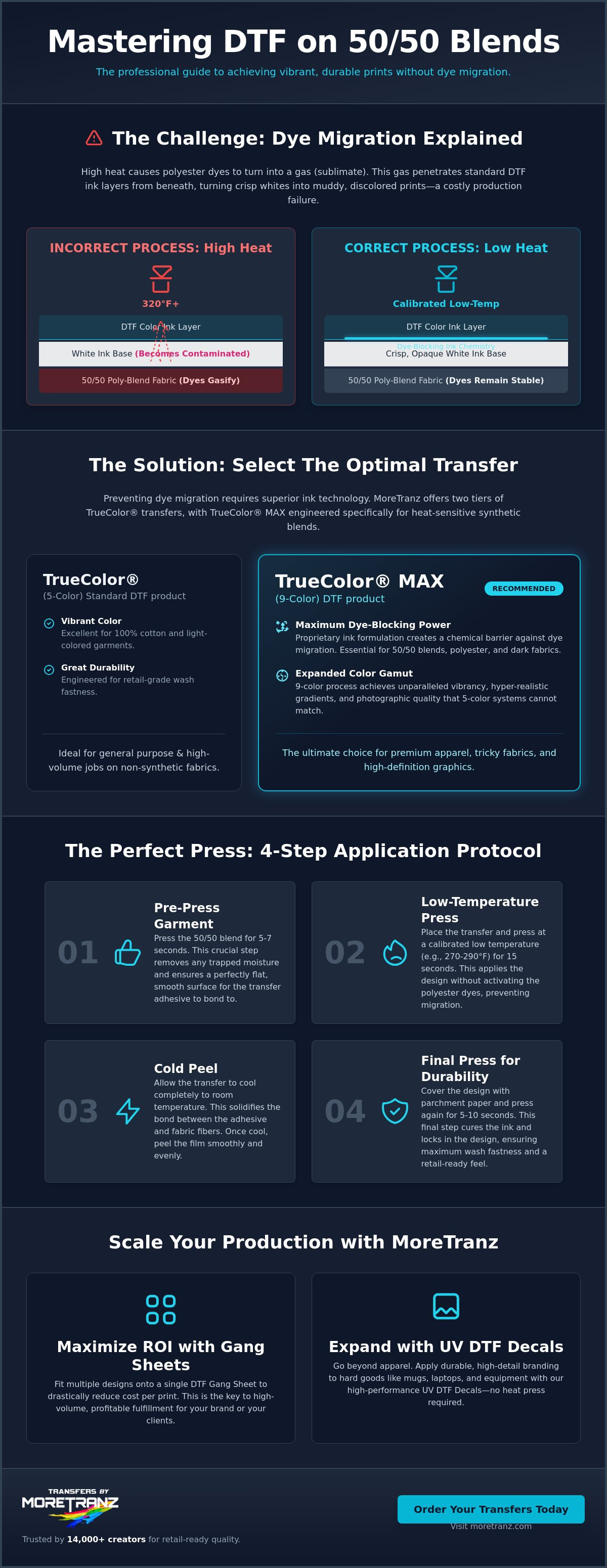
Dye migration isn't just a visual flaw; it's a chemical reaction that can bankrupt a production run. When you apply heat to a 50/50 blend, the disperse dyes used to color the polyester fibers reach a sublimation point. These dyes don't just sit on the surface; they turn from a solid into a gas. This gas bypasses the adhesive and penetrates the ink layer from beneath. The result is a total loss of color integrity. Your crisp white logo turns a muddy grey or a neon pink, often hours after the garment has cooled. This chemical reality is the primary hurdle for any professional DTF application on 50/50 blends.
White ink is always the first casualty of this process. Because it serves as the base layer for almost every print, it acts like a sponge for migrating gas. If your application fails, you might also see the "ghosting" effect. This is a faint, secondary image or a halo of color bleeding around the edges of your graphic. It's a hallmark of poor thermal management and inferior ink chemistry. By the time the garment reaches the customer, the damage is permanent. MoreTranz helps 14,000 creators avoid these pitfalls by providing technology engineered for stability.
Our proprietary TrueColor® technology is specifically designed to act as a barrier. We focus on blocking dye migration by ensuring the ink density is sufficient to trap the gas before it reaches the surface. This isn't just about thicker ink; it's about the specific formulation of the pigment and the adhesive bond that prevents the gas from ever entering the ink stack.
Heat vs. Time: The Balancing Act
Excessive heat is the enemy of polyester. If you press at 320°F like you would for 100% cotton, you're inviting disaster. The "sweet spot" for 50/50 blends usually sits between 280°F and 300°F. You must compensate for the lower temperature with a slightly longer dwell time. This allows the adhesive to melt and bond without triggering the sublimation of the fabric dyes. Always use the 5-second pre-press rule. It vents trapped moisture and flattens the fibers, giving you a stable surface for the transfer. If you want to see how our transfers handle these lower temps, grab a MoreTranz Sample Pack for your next test run.
Ink Density as a Defense Mechanism
The TrueColor® (5-Color) Standard DTF product provides a robust base layer that cheaper alternatives simply can't match. We utilize high-quality TPU (Thermoplastic Polyurethane) powder designed for synthetic fiber locking. This powder creates a flexible yet impenetrable foundation. Cheap transfers often use inferior powders that become porous under heat, allowing heathered or dark dyes to seep through and ruin the final product. Professional-grade results require professional-grade chemistry.
TrueColor® vs. TrueColor® MAX: Choosing the Right Tech
Your output quality depends entirely on the engine behind the ink. For a successful DTF application on 50/50 blends, you must choose between standard reliability and premium visual dominance. The TrueColor® (5-Color) Standard DTF product is the industrial workhorse of the industry. It provides the consistent, high-speed results required for daily production. When your project demands more than just standard accuracy, the TrueColor® MAX (9-Color) DTF product steps in. This premium system is engineered to handle the complex color requirements that standard CMYK setups often miss. It's the difference between a good print and a retail-ready masterpiece.
The primary challenge with polyester fibers is how they reflect light. Synthetic threads have a natural sheen that can make standard colors appear flat or washed out. The 9-color gamut of TrueColor® MAX overcomes this by utilizing a broader spectrum of pigments. It hits the difficult neons and deep, saturated tones that are essential for high-end streetwear. While the TrueColor® (5-Color) Standard DTF product is excellent for most applications, the MAX version ensures that your designs maintain their visual "pop" even on the most challenging heathered surfaces. This technological edge is why 14,000 creators rely on MoreTranz to scale their brands.
Durability remains a non-negotiable factor in professional apparel decoration. Both tiers of our technology deliver industrial-grade wash fastness. Industry research confirms that these prints can withstand over 50 wash cycles without significant fading or cracking. Whether you choose the standard or premium path, you're delivering a product built for physical resilience. Your customers expect longevity; our technology ensures you provide it every single time.
When to Use TrueColor® (5-Color)
This system is your go-to for high-volume, cost-effective promotional apparel. It performs exceptionally well on light-colored 50/50 tees and simple, bold logos. If you're managing a massive order for a local event or a corporate giveaway, the efficiency of the standard product is unmatched. It balances speed with professional quality. You can explore all our standard transfer types to see which configuration fits your current production workflow best.
The Power of TrueColor® MAX (9-Color)
TrueColor® MAX (9-Color) DTF product is the elite choice for creators who need to stand out in a crowded market. It's essential for achieving high-definition results on dark heathered hoodies where color depth is often lost. The additional ink channels allow for smoother gradients and more precise skin tones. It effectively manages the synthetic sheen of polyester blends, making the print feel integrated rather than just sitting on top. This is the professional standard for brands that demand perfection on every garment.
The Perfect Press: Step-by-Step Application for 50/50
Achieving a flawless DTF application on 50/50 blends requires more than just a heat press; it requires a repeatable, industrial protocol. Precision is your only defense against the variability of synthetic fibers. Preparation begins with a clean surface. Use a lint roller to eliminate micro-debris that can cause pinholes in your ink layer. Pre-pressing is your next critical step. This 5 to 8 second burst flattens the garment fibers and drives out trapped moisture. If you skip this, the steam generated during the main press can interfere with the chemical bond of the adhesive.
Temperature calibration is where most decorators fail. You must set your press between 280°F and 300°F. This range is the technical "sweet spot" for 50/50 blends. It's high enough to activate the specialized TPU powder on our transfers but low enough to keep polyester dyes from gasifying. Aim for medium-firm pressure. On a manual press, this should feel like a significant struggle to lock the handle. This pressure ensures the adhesive bites into the weave of the fabric, creating the industrial-grade wash fastness that 14,000 creators expect from MoreTranz.
The finishing press is the secret to a retail-grade soft-hand feel. After the initial peel, press the design again for 5 seconds using a finishing sheet or parchment paper. This final step slightly textures the ink, removing the "plastic" feel and making the design move naturally with the garment. It's the difference between a stiff patch and a professional-grade apparel decoration.
Application Protocol
- Step 1: Pre-press the garment for 5-8 seconds to flatten fibers and remove moisture.
- Step 2: Position your TrueColor® MAX (9-Color) DTF product and press for 12-15 seconds at 290°F.
- Step 3: The Peel. For maximum stability on blends, allow the film to cool completely before peeling. This ensures the adhesive has fully set into the synthetic fibers.
Advanced Troubleshooting
Heat press marks, often called "The Box," are the bane of 50/50 hoodies. To avoid this, use a pressing pillow to raise the print area above the thick seams. This distributes pressure evenly and prevents the platen edges from leaving permanent marks on heat-sensitive polyester. Always use a Teflon sheet to prevent scorching on the exposed areas of the garment. Finally, perform a post-press inspection. Check for any edge lift or early signs of dye bleed. If you see pink hues in your white ink, your temperature is too high. Dial it back and test again. To ensure your equipment is dialed in correctly, order a MoreTranz Sample Pack and run a calibration test on your specific 50/50 blanks.
Scaling Your Production with MoreTranz Solutions
Efficiency is the engine of profit. Once you've mastered the technical protocols for DTF application on 50/50 blends, your next objective is industrial-grade scalability. MoreTranz provides the professional toolkit necessary to move from single-press samples to high-volume fulfillment without sacrificing quality. Utilizing our Custom DTF Gang Sheets is the most effective way to maximize your ROI. By nesting multiple designs onto a single 22-inch wide roll, you reduce material waste and slash your production costs. This approach allows you to handle bulk orders for 50/50 hoodies and performance tees with the same precision as a boutique run.
Technical perfection on the heat press is useless if your source files are sub-par. We offer a dedicated Vector Conversion Service to ensure your artwork meets the high-definition standards required for our 9-color systems. Clean, crisp vectors prevent the blurred edges and pixelation that can ruin a professional garment. Beyond apparel, you can maintain brand consistency across all surfaces by utilizing our UV DTF Decals. These high-performance decals apply to hard goods like water bottles and equipment with the same durability you expect from our textile transfers. It's about building a comprehensive brand ecosystem for your clients.
Speed is our primary signature. We understand that in the modern apparel market, rapid fulfillment is a competitive necessity. Our production cycle is optimized for a 1-2 business day turnaround. This agility positions MoreTranz as a high-performance partner for serious creators who require immediate results to meet tight deadlines. We don't believe in arbitrary barriers; our no-minimum ordering system ensures you can pivot quickly as your business grows.
Specialty Options: Spangle and Glitter
Differentiating your brand requires unique textures that catch the eye. You can easily add dimension to 50/50 garments by integrating Spangle Transfers into your workflow. These provide a lead-free, "bling" effect that is much softer and more durable than traditional sequins. For spirit wear and cheer designs, our Glitter DTF transfers offer high-impact visual intensity without the mess of loose glitter. You can even combine these specialty options with standard TrueColor® designs on a single gang sheet to create complex, multi-textured apparel that commands a premium price point.
Join the 14,000 Creators
MoreTranz is more than a vendor. We are a tech-forward facilitator for the modern entrepreneur. This commitment to precision and technological dominance is why 14,000 creators trust us with their production needs. We invite you to experience the physical resilience and visual impact of our output firsthand. Start by ordering a Free Sample Pack to run your own calibration tests for DTF application on 50/50 blends. From frictionless vector conversion to rapid doorstep delivery, we provide the industrial-grade resources you need to dominate your market.
Elevate Your Production Standard
Mastering the technical nuances of DTF application on 50/50 blends is the final step in moving your brand from amateur to industrial-grade. You now have the protocols to defeat dye migration through calibrated heat management and superior ink density. By choosing the right technology, specifically the proprietary TrueColor® MAX (9-Color) DTF product, you ensure every print achieves high-definition vibrance that standard CMYK setups simply cannot replicate. Precision is your competitive advantage in a market that demands both speed and physical resilience. You've learned how to balance time, temperature, and pressure to lock in a bond that lasts through fifty plus washes.
MoreTranz is already the trusted partner for 14,000 creators who refuse to settle for dull colors or scorched fabrics. We provide the professional-grade toolkit needed to scale your business with total confidence. With no minimum orders and rapid fulfillment cycles, your production line never has to wait for quality. Take control of your output and deliver the retail-ready results your customers deserve. It's time to execute with total dominance and watch your brand growth accelerate.
Order Your TrueColor® MAX Transfers for 50/50 Blends Today
Frequently Asked Questions
Can I apply DTF transfers to 50/50 blends using a home iron?
You cannot achieve a professional-grade result on synthetic blends using a standard home iron. These devices lack the calibrated temperature control and heavy, consistent pressure required to fuse the TPU adhesive into the fabric weave. For a successful DTF application on 50/50 blends, you must use a professional heat press. This ensures the design remains resilient and retail-ready through industrial-grade wash cycles without lifting or cracking.
What temperature should I use for DTF on 50/50 cotton-poly hoodies?
Set your heat press to a range of 280°F to 300°F when working with cotton-poly hoodies. This lower thermal window prevents the polyester fibers from reaching their sublimation point, which is where dye migration begins. While cotton can handle higher heat, the synthetic component of the blend is sensitive. Use a medium-firm pressure for 12 to 15 seconds to lock the bond without scorching the garment or damaging the fibers.
How do I prevent dye migration on dark-colored 50/50 t-shirts?
Preventing dye migration requires a combination of low-temperature application and high-density ink barriers. Utilizing the TrueColor® MAX (9-Color) DTF product provides a robust pigment layer that blocks gassed-out dyes from penetrating the surface. Always perform a thorough pre-press to remove moisture. This step stabilizes the synthetic fibers before the transfer is applied, ensuring your whites stay crisp and your colors remain vibrant on even the darkest fabrics.
Do DTF transfers last longer on 100% cotton or 50/50 blends?
DTF transfers deliver exceptional longevity on both 100% cotton and 50/50 blends, typically lasting over 50 washes. However, 50/50 blends often provide better dimensional stability because the polyester component resists shrinking and warping. This helps the print maintain its original shape over time. As long as you follow the correct application protocols, the physical resilience of the output will meet industrial standards on either fabric type with total confidence.
What is the difference between TrueColor® and TrueColor® MAX for blends?
The TrueColor® (5-Color) Standard DTF product is designed for high-volume, reliable production on light-colored garments. In contrast, the TrueColor® MAX (9-Color) DTF product utilizes an expanded gamut to hit difficult neons and complex gradients. For 50/50 blends, the MAX version is the superior choice for dark or heathered fabrics. It provides the extra ink density needed to act as a barrier against aggressive synthetic dyes that cause dulling.
Why is my DTF transfer peeling off the 50/50 fabric after one wash?
Peeling is usually caused by trapped moisture or insufficient pressure during the initial press. 50/50 fabrics are notorious for holding moisture that turns to steam under heat, which can blow the adhesive off the fibers. Ensure you pre-press the garment for at least 5 to 8 seconds. Verify that your press is delivering medium-firm pressure to force the adhesive into the fabric's texture for a permanent, industrial-grade bond.
Should I hot peel or cold peel when working with cotton-poly blends?
You should utilize a cold peel for maximum stability when working with cotton-poly blends. Allowing the transfer to cool completely ensures that the adhesive has fully solidified and anchored into the synthetic fibers. Peeling while hot can cause the design to lift or stretch, especially on the smoother surface of a polyester blend. Patience during the cooling phase results in a more durable and professional finish that stands up to wear.
How do I avoid the "heat press box" mark on polyester-heavy garments?
Avoid the "heat press box" by using a pressing pillow to raise the print area away from seams and zippers. This technique prevents the edges of the heat platen from making direct, high-pressure contact with the sensitive polyester fibers. Using a Teflon sheet or parchment paper also helps distribute heat more evenly. These tools are essential for 14,000 creators who need to deliver pristine, mark-free hoodies and performance tees to their clients.