

Applying UV DTF Decals to Curved Surfaces: The Professional Masterclass
A single air bubble on a high-margin custom tumbler isn't just an eyesore; it's a direct hit to your bottom line. You've likely felt the frustration of watching a premium design lift or crease on a tight radius, turning expensive inventory into scrap. At MoreTranz, we know these technical hurdles slow down production for the 14,000 creators we support, including businesses like Chlosha Creations that specialize in premium personalized labels and gifts. Mastering the art of applying UV DTF stickers to curved surfaces is the difference between a hobbyist's struggle and industrial-grade output.
This masterclass delivers the tactical center-out application method designed to eliminate air pockets and ensure permanent adhesion on tumblers, mugs, and complex substrates. Whether you're using our standard TrueColor® or the high-fidelity TrueColor® MAX UV DTF Decals, the goal is total precision. We're going to dive into the exact workflow required for a flawless, bubble-free finish that stands up to heavy use. You'll gain the technical confidence to scale your branding operations with zero waste and maximum durability.
Key Takeaways
- Understand how the flexible varnish and unique adhesive chemistry of UV DTF Decals allow for the micro-adjustments necessary for curved substrate success.
- Implement a clinical-grade preparation protocol using 99% Isopropyl alcohol to eliminate microscopic lifting points and ensure an unbreakable bond.
- Execute the tactical center-out technique for applying UV DTF stickers to curved surfaces to achieve a flawless, bubble-free finish every time.
- Learn professional troubleshooting maneuvers, including the "Pin Prick" technique, to manage tension and creases on complex compound curves.
- Leverage the high-performance 9-color technology of TrueColor® MAX to deliver industrial-strength branding results trusted by 14,000 creators.
Mastering the Mechanics: Why UV DTF Decals Excel on Curved Substrates
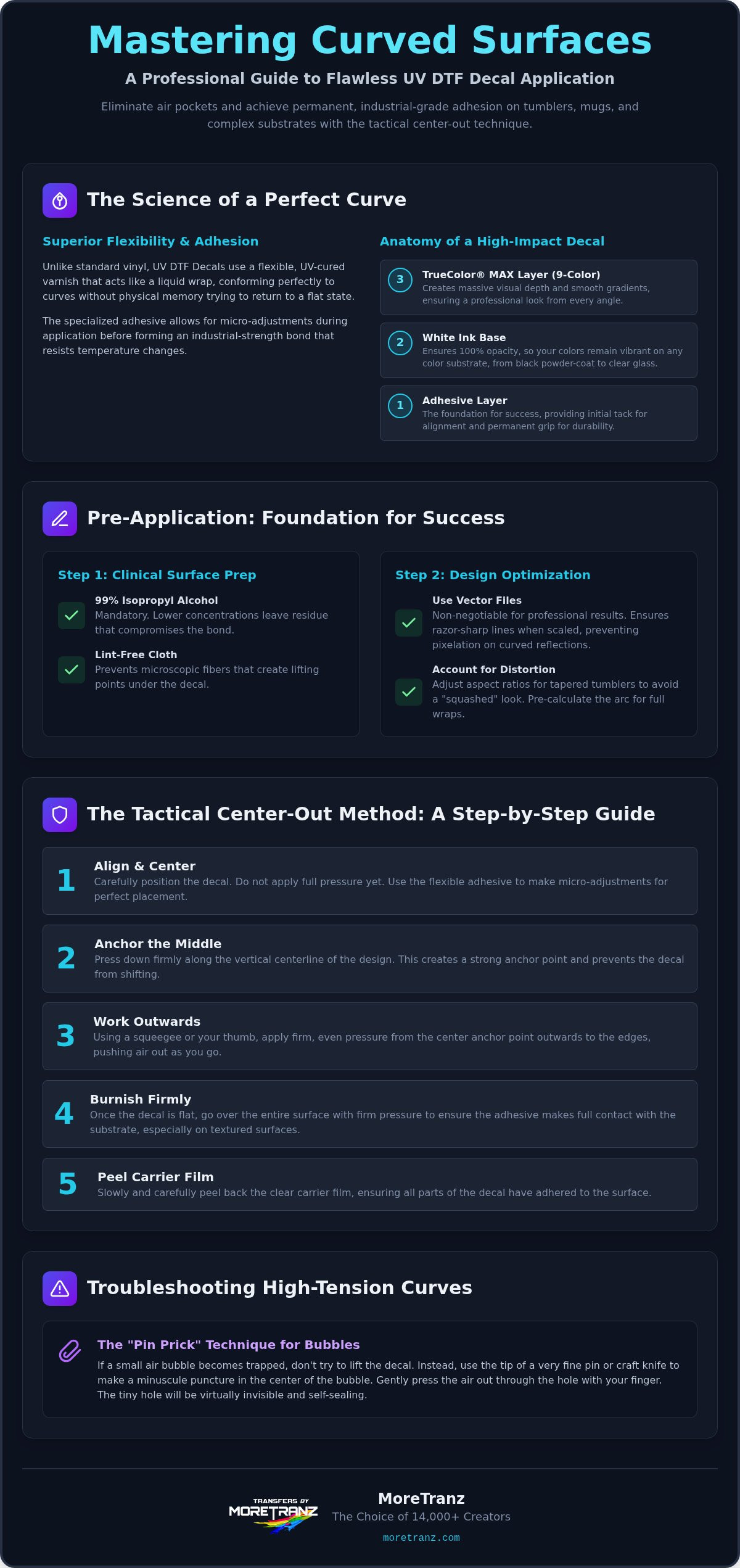
Standard permanent vinyl has a physical memory. It constantly tries to return to its original flat state, which is why you often see edge lifting on tight radii. UV DTF Decals operate on an entirely different physics model. By utilizing a multi-layer print system topped with a flexible, UV-cured varnish, these decals behave more like a specialized liquid wrap than a traditional plastic film. This inherent flexibility is the core technical advantage when applying UV DTF stickers to curved surfaces.
The adhesive chemistry is specifically engineered for professional-grade performance. It allows for micro-shifts during the initial contact phase, giving you the tactical window needed to align a design on a tapered tumbler. Once the bond is fully established, it transitions into an industrial-strength state. This bond is designed to resist temperature-induced expansion and contraction, a common failure point for creators working with stainless steel or glass. It's this level of reliability that has led 14,000 creators to trust MoreTranz UV DTF Transfers for their high-volume production needs.
The Anatomy of a High-Impact Decal
Success on a curved substrate depends on what's happening inside the decal layers. Every MoreTranz product is built for resilience:
- Adhesive Layer: This is the foundation. It provides the initial tack and long-term grip required for complex geometries.
- White Ink Base: This layer ensures total opacity. Whether you're applying to a black powder-coated mug or a clear glass bottle, your colors won't wash out.
- TrueColor® MAX Layer: Our premium 9-color technology creates massive visual depth. It allows for smoother gradients on cylindrical surfaces, ensuring your brand looks professional from every angle.
Substrate Compatibility for Curves
Not all curves are created equal. You must understand how your material interacts with the decal. Stainless steel tumblers are the gold standard because they provide a stable, non-porous surface. Powder-coated finishes offer more texture, requiring firm, consistent pressure during application to ensure the adhesive penetrates the finish. Glassware and ceramic mugs introduce smooth, high-tension curves that demand a precise center-out approach. For plastics and composites, adhesion testing is a mandatory step in your workflow to ensure the surface energy is high enough for a permanent bond. Mastering these mechanics is the first step toward achieving a flawless finish on every project.
Pre-Application Strategy: Surface Prep and Design Optimization
Prep is the silent partner of production speed. If your surface isn't clinically clean, the decal will fail. Period. We recommend 99% Isopropyl alcohol. It's mandatory. Lower concentrations often contain oils or water that compromise the adhesive bond. Use a lint-free cloth. Standard paper towels leave fibers that create microscopic lifting points. Clean surfaces don't just happen; you create them through a disciplined workflow.
Design optimization is equally critical. When applying UV DTF stickers to curved surfaces, you have to account for cylindrical distortion. A logo that looks perfect on a flat screen will appear squashed on a 20oz tumbler if you don't adjust the aspect ratio. This is especially true for full wraps. Tapered vessels require a curved layout to prevent creeping or misalignment at the seam. You must calculate the arc of your substrate before printing to ensure a professional finish. This proactive approach eliminates wasted inventory and keeps your fulfillment cycles tight.
Artwork Precision for Professional Results
Raster files are a liability. When a pixelated edge hits a curved reflection, the flaw is magnified. This is why vector files are non-negotiable for scaling decals to specific dimensions. For complex logos or low-resolution assets, utilizing Vector Conversion Services ensures every line is razor-sharp. Scaling artwork to fit specific curved dimensions requires the mathematical precision that only vectors provide. At MoreTranz, we see many of our 14,000 creators switch to vector-only workflows to eliminate these visual artifacts. If you want the depth of TrueColor® MAX to shine, start with high-definition source files.
Handling and Storage of UV DTF Decals
Preserving the tack of your decals starts before you touch the substrate. Store your transfers in a cool, dry environment between 60°F and 75°F. High humidity can soften the adhesive, making it difficult to release from the carrier sheet. For high-volume workflows, pre-cut your decals from the gang sheet. This allows for a rapid, repetitive motion that keeps your production line moving. It's about maintaining film integrity so that when you're ready to press, the decal performs exactly as expected. You can test these storage strategies yourself by ordering a MoreTranz Sample Pack to see how our adhesive holds up in your environment.
The Center-Out Application Method: 5 Steps to Flawless Adhesion
Theory is useless without a repeatable execution plan. Applying UV DTF stickers to curved surfaces requires more than just steady hands; it requires a tactical workflow that manages tension and air displacement. At MoreTranz, we've refined this process through supporting 14,000 creators who demand perfection on every unit. Follow these five steps to secure an industrial-strength bond on any cylindrical substrate.
- Step 1: The Tactical Hinge. Position your decal on the substrate. Use a piece of low-tack tape to create a vertical hinge down the center of the design. This locks your alignment before the adhesive touches the surface.
- Step 2: Initial Center Contact. Peel back one side of the backing paper up to the hinge. Cut the excess backing away. Press the decal down starting strictly at the vertical center line. This is your anchor point.
- Step 3: The Outward Sweep. Using firm, progressive pressure, sweep your thumb or a squeegee from the center line toward the outer edge. This movement forces air out horizontally, preventing trapped bubbles.
- Step 4: Perimeter Sealing. Repeat the process for the second half of the decal. Once the entire design is down, use a burnishing tool to apply high-intensity pressure to the edges. This prevents the high-tension lift common on tight radii.
- Step 5: The Controlled Peel. Wait 30 to 60 seconds for the adhesive to settle. Peel the clear carrier sheet back slowly at a 180-degree angle. If any part of the design lifts, lay it back down and burnish again.
Applying UV DTF Cup Wraps
Full wraps present a unique challenge: the seam. For a professional result, we recommend a "butt-join" where the edges meet perfectly without overlapping. If you're a beginner, a 1mm overlap is safer to prevent substrate gaps. Utilize the "roll and press" technique by laying the tumbler on a flat, stable surface and rolling it into the decal. This method uses the weight of the vessel to provide consistent pressure, which is essential when using high-fidelity TrueColor® MAX designs that require perfect registration.
Spot Decal Placement on Mugs
Mugs often feature subtle tapers that cause a "smile" effect, making straight text look curved. To avoid this, align your decal to the peak of the curve rather than the handle. Always center the design between the handle and the opposite side of the mug for visual balance. Final burnishing is non-negotiable here. Because mugs face frequent handling, the edges must be fused to the ceramic or glass to ensure long-term durability. Our TrueColor® technology is built to withstand this friction, provided your application technique is flawless.
Troubleshooting High-Tension Curves: Overcoming Bubbles and Creases
Even with a perfect center-out technique, high-tension geometry can fight back. Applying UV DTF stickers to curved surfaces often reveals trapped air pockets or "darts" where the film simply runs out of room to flex. At MoreTranz, we see these challenges as technical hurdles that require professional solutions. If you find a stubborn bubble after peeling the carrier, don't scrap the item. Use a fine-point needle to perform a "Pin Prick." Insert the needle at the edge of the bubble, press the air out toward the hole, and burnish the spot. The adhesive is resilient enough to seal the microscopic puncture instantly.
Creases or "darts" are more complex. These occur on compound curves, such as the shoulder of a bottle or a sphere-like mug. If the film begins to fold, you've likely hit the physical limit of the substrate's radius. As a rule of thumb, avoid applying decals to curves that exceed a 90-degree bend over a short distance. Unlike heat-shrink wraps, UV DTF Decals have a finite amount of stretch. Can you reposition them? Generally, no. The industrial-strength adhesive is designed for immediate high-tack bonding. Attempting to lift a partially applied decal usually results in adhesive distortion or tearing the white ink base. Precision on the first pass is your only path to a zero-waste workflow.
Explore high-performance UV DTF Decals for your next project
Heat Assistance for Difficult Contours
Heat is a powerful tool when used with precision. If you're working with a textured powder-coated finish or a particularly cold substrate, use a heat gun on its lowest setting. Brief, two-second bursts of heat soften the adhesive. This allows it to flow into the microscopic valleys of the surface texture for a deeper bond. Be careful. Exceeding 120°F can damage the TrueColor® varnish layer, causing it to lose its gloss or become brittle. We recommend a post-heating step after the carrier sheet is removed. Gently warming the applied decal and burnishing it one last time ensures the bond reaches its maximum potential quickly.
Material-Specific Adhesion Issues
Some surfaces are engineered to be "no-stick." Silicone-coated tumblers or certain low-energy plastics will reject even the strongest adhesives. If your decal slides or lifts immediately, check the manufacturer's specs for silicone content. In these cases, an adhesion promoter may be necessary, though it's often more efficient to switch to a compatible substrate. Remember that while the bond is strong immediately, it takes time to reach full industrial strength. We advise 14,000 creators to observe a 24-hour cure window before subjecting the item to heavy use or friction testing. This patience ensures the TrueColor® MAX output remains permanent and resilient for the long haul.
Elevate Your Brand with MoreTranz TrueColor® MAX UV DTF Decals
High-performance branding isn't about luck. It's about the technical tools you deploy to dominate your niche. Applying UV DTF stickers to curved surfaces becomes a massive competitive edge when you utilize the right adhesive chemistry and print technology. While standard vinyl often fails on high-tension curves, our decals are engineered to fuse with the substrate. This cold, reliable efficiency is exactly why 14,000 creators trust MoreTranz as their high-performance production partner.
Choosing the correct product tier is the first step in your professional workflow. TrueColor® delivers industry-leading 5-color performance, which is ideal for standard branding and high-volume spot decals. However, for creators who demand total visual dominance, TrueColor® MAX is the only choice. Utilizing an advanced 9-color process, TrueColor® MAX achieves over 16.7 million color possibilities. This ensures that complex gradients on cylindrical surfaces remain smooth, vibrant, and free from the pixelation that plagues lower-tier alternatives. You don't just sell a product; you deliver a masterpiece of industrial manufacturing.
One of the most significant advantages of partnering with MoreTranz is our commitment to your scale. We offer no minimum orders. This allows boutique brands to test new designs and scale with zero wasted inventory. You can move from a single prototype to a massive production run with the same level of precision and speed. Integrating these decals into your existing product line is a frictionless process that immediately elevates your brand's perceived value and physical durability. To expand your custom branding strategy even further, learn more about A1 Promotions Ltd. and their specialized promotional product solutions.
Professional Grade Output
Most market alternatives struggle with color vibrancy on dark or textured curves. Our proprietary multi-layer system solves this. By using a high-density white ink base, we ensure that your designs pop even on black powder-coated tumblers or dark glassware. The industrial-strength varnish isn't just a finish; it's a resilient shield. It outlasts standard vinyl by providing superior resistance to the friction and handling that everyday items endure. Explore our full range of transfer types to identify the specific output that fits your brand's aesthetic.
Get Started with Confidence
We've eliminated the technical barriers to professional-grade branding. If your artwork isn't ready for the precision required for tight radii, leverage our professional artwork services to ensure your files are print-ready. We're invested in your technical success. Ready to witness the visual intensity and physical resilience of our transfers firsthand? Order your Free Sample Pack today and put our adhesive to the test. Join the community of elite creators who are pushing the limits of what's possible in the custom branding space.
Dominate the Market with Industrial-Grade Precision
Success in the custom branding industry is measured by the durability of your output and the speed of your fulfillment. You now have the tactical blueprint for applying UV DTF stickers to curved surfaces with industrial-grade precision. By combining clinical prep with the center-out application method, you eliminate the technical failures that drain your profits. Every tumbler, mug, and complex substrate is an opportunity to showcase a flawless, bubble-free finish that stands the test of time.
MoreTranz provides the professional-grade toolkit you need to scale with total confidence. Our TrueColor® MAX 9-color technology delivers a visual intensity that standard transfers cannot match. With no minimum order requirements and a community of 14,000 creators, we're ready to support your most ambitious projects immediately. It's time to stop worrying about adhesion failures and start focusing on your brand's growth. The transition from hobbyist struggle to manufacturing dominance starts with one high-performance transfer.
Order your TrueColor® MAX UV DTF Decals and join 14,000 creators today!
Take control of your production cycle and deliver the resilient, high-impact branding your clients demand. Your next masterclass-level project is just one click away.
Frequently Asked Questions
Can UV DTF Decals be applied to tapered tumblers?
Yes, UV DTF Decals are highly effective for tapered tumblers, provided you utilize a curved artwork template. Because the top diameter of a tapered vessel is larger than the bottom, a standard rectangular wrap will inevitably creep or overlap incorrectly. You must adjust your design to follow the physical geometry of the substrate. This ensures your branding remains level and professional across the entire surface without visual distortion.
Are UV DTF Decals dishwasher safe once applied to curves?
Hand-washing is the mandatory recommendation for maintaining decal integrity, as UV DTF Decals are not typically dishwasher safe. While the industrial-strength bond is waterproof and durable, the extreme heat and aggressive detergents in dishwashers can degrade the varnish over time. We advise the 14,000 creators we support to recommend hand-washing only. This practice preserves the high-gloss finish and prevents edge lifting on frequently handled items.
How do I prevent air bubbles when applying a full cup wrap?
The most effective way to prevent air bubbles when applying UV DTF stickers to curved surfaces is to utilize the "roll and press" method combined with a vertical center hinge. This technique allows you to lock in your alignment before the adhesive makes full contact. By rolling the tumbler slowly over the decal, you force air out in a single, controlled direction. It eliminates the random air pockets that often occur with manual placement.
What is the difference between TrueColor® and TrueColor® MAX for hard surfaces?
TrueColor® is our high-performance 5-color standard, while TrueColor® MAX utilizes 9-color technology for unmatched color depth and vibrancy. TrueColor® MAX achieves over 16.7 million color possibilities, making it the superior choice for complex gradients and photographic designs. While both tiers offer industrial-strength adhesion, TrueColor® MAX provides the visual intensity required for premium branding on dark or transparent curved substrates where standard colors might appear flat.
Can I apply UV DTF Decals to powder-coated metal surfaces?
You can achieve industrial-strength adhesion on powder-coated metal by using firm pressure and clinical surface preparation. Powder coating is naturally textured, which means the adhesive must be forced into the microscopic valleys of the finish to create a permanent bond. We recommend a brief burst of heat from a heat gun to help the adhesive flow. This ensures the decal fuses to the metal for a finish that resists heavy use.
What happens if I misalign a decal on a curved surface?
Repositioning a decal after initial contact is generally not possible due to the high-tack nature of the professional-grade adhesive. Attempting to peel the decal back usually results in adhesive distortion or damage to the white ink base. If you catch a misalignment before applying pressure, you might have a split-second to adjust. Otherwise, it's more efficient to remove the decal entirely, clean the substrate with Isopropyl alcohol, and start over.
Is a heat press required for UV DTF Decal application?
No heat press is required because UV DTF Decals are pressure-sensitive transfers that bond at room temperature. The process of applying UV DTF stickers to curved surfaces relies entirely on mechanical pressure to activate the adhesive. While a heat gun can assist with difficult contours or cold substrates, it's not a requirement for standard application. You can achieve a professional, permanent bond using only a squeegee or firm thumb pressure.
How long do UV DTF Decals last on frequently used tumblers?
UV DTF Decals are designed to last the entire lifespan of a tumbler when applied to a properly prepared, non-porous surface. When the application protocol is followed correctly, the bond is permanent and resists peeling or fading from standard friction. Most creators report that the decals maintain their visual intensity through thousands of handling cycles. Proper edge sealing during the initial application is the key to ensuring long-term durability on any curved item.