

Custom UV DTF Decals: The Professional Guide to Hard-Surface Branding in 2026
Standard vinyl is failing your brand on the very surfaces where durability matters most. You've likely dealt with the frustration of logos peeling off curved glass or fading on industrial plastic after just a few weeks. It's a common bottleneck for professionals who need to scale branding beyond apparel but can't find a reliable way to maintain quality on hard goods. At Transfers by MoreTranz, we understand that inconsistent print quality and slow production times are the enemies of growth. That's why high-performance custom uv dtf transfers have become the new gold standard for 14,000 creators looking for industrial-strength adhesion without the complexity of traditional printing.
This guide provides the technical roadmap to mastering UV DTF Decals. You'll learn how to achieve vibrant, high-resolution color reproduction and a streamlined workflow that handles bulk orders with ease. We'll explore the transition from standard apparel branding to the world of hard-surface excellence using our TrueColor® and TrueColor® MAX technology. From understanding the pressure-sensitive application process to ensuring your designs withstand the elements in 2026, this is your professional toolkit for total branding dominance. It's time to stop settling for generic results and start executing with industrial precision.
Key Takeaways
- Scale your branding beyond apparel by mastering UV-cured ink technology that delivers permanent, industrial-grade adhesion to non-porous surfaces.
- Optimize your production workflow with custom uv dtf transfers that utilize a cold-apply process, eliminating the need for heat presses on hard goods.
- Learn the technical layering of white ink and varnish that creates the signature 3D texture and scratch resistance of professional UV DTF Decals.
- Boost your profit margins by leveraging high-density gang sheets to streamline bulk production for glass, metal, and plastic equipment.
- Join a community of 14,000 creators using TrueColor® MAX technology to achieve high-resolution color reproduction that standard market alternatives cannot match.
Beyond Apparel: Why Custom UV DTF Decals are the Future of Hard-Surface Branding
The branding landscape is evolving beyond the limitations of fabric. While apparel remains a core revenue stream, serious entrepreneurs are looking for ways to dominate the hard-goods market. custom uv dtf transfers are the catalyst for this expansion. These aren't your standard stickers; they are industrial-grade UV DTF Decals that combine UV-curable inks with high-tack adhesives. This technology creates a permanent, "printed-on" look that previously required expensive direct-to-substrate machinery. Transfers by MoreTranz is built to facilitate this transition, empowering our community of 14,000 creators with the high-performance tools needed to brand everything from stainless steel tumblers to industrial equipment.
Breaking the Limits of Traditional Permanent Vinyl
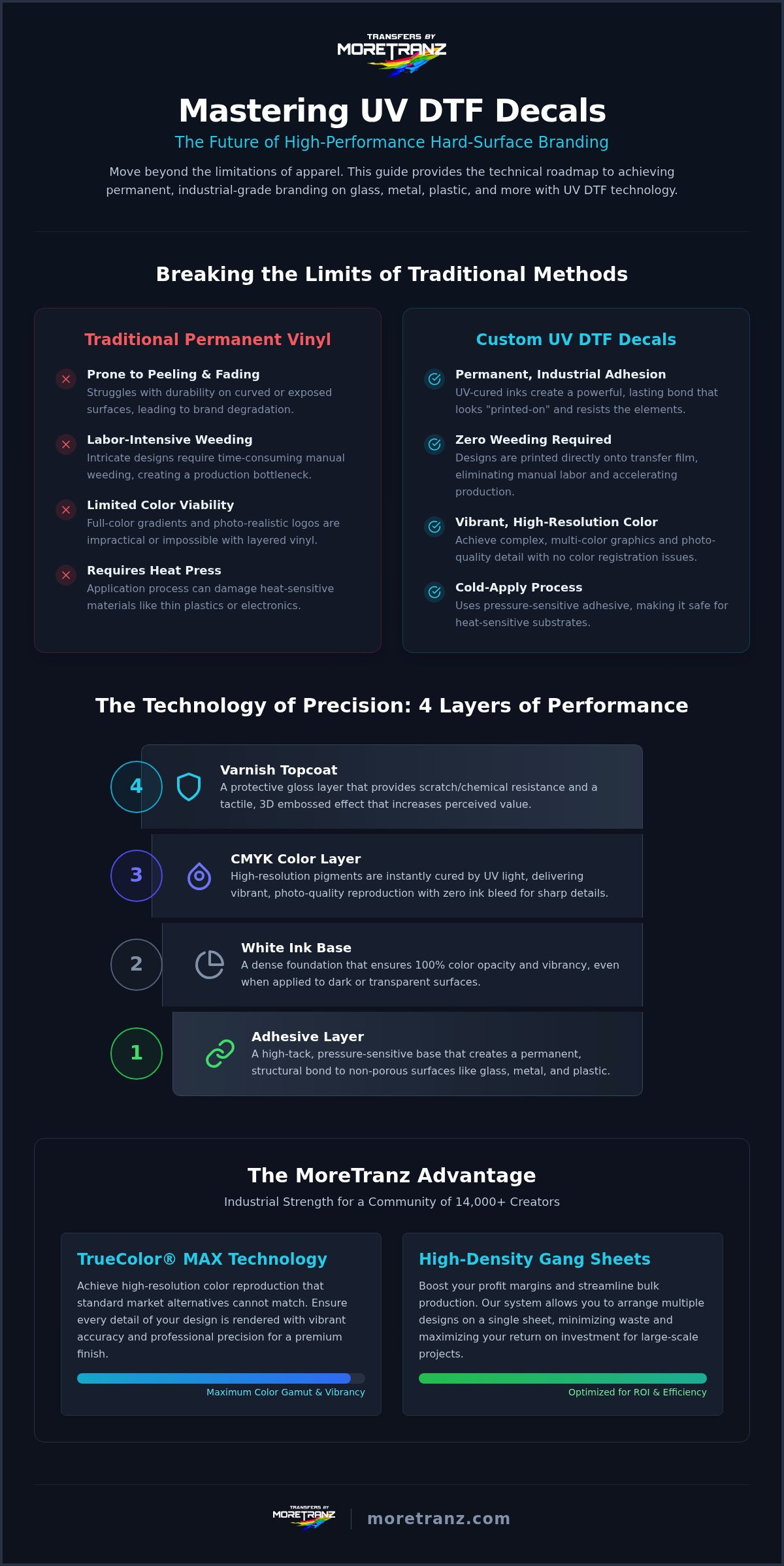
Traditional permanent vinyl has long been a production bottleneck for growing brands. The labor-intensive process of weeding intricate designs drains time and limits your ability to scale. If your client wants a full-color gradient or a photo-realistic logo, layered vinyl is simply not a viable solution. UV DTF technology removes these constraints by printing the entire graphic, including a white ink base and a protective varnish, onto a single transfer sheet. UV DTF is a cold-transfer technology that eliminates the need for heat presses on sensitive substrates. This allows for a seamless application of complex, multi-color logos without the frustration of manual weeding or color registration issues.
The Rise of Cold-Apply Industrial Decals
The shift toward cold-apply decals is driven by the need for versatility and durability. Many high-value hard goods are heat-sensitive. Materials like thin plastics, electronics, and treated glass can warp or discolor under the high temperatures of a standard heat press. By utilizing a pressure-sensitive mechanism, UV DTF Transfers allow you to brand these items safely and efficiently. The resulting output is remarkably resilient. UV-curable inks are polymerized instantly during the printing process, creating a surface that is highly resistant to scratches, chemicals, and water.
Beyond the technical specs, there is a distinct psychological impact to the 3D embossed texture of these decals. The raised varnish layer provides a tactile experience that standard flat labels lack. This high-gloss, textured finish increases the perceived value of the product, signaling professional craftsmanship to the end user. When you use TrueColor® MAX technology for your hard-surface projects, you ensure that every detail is rendered with vibrant accuracy. This isn't just a label; it's an industrial-strength branding solution designed for the modern marketplace.
The Technology of Precision: How UV-Cured Ink Transfers Work
Precision in branding demands more than just a clear image; it requires a structural bond that survives real-world use. While traditional methods rely on solvent evaporation, custom uv dtf transfers utilize Ultraviolet (UV) light to trigger instant polymerization. This process transforms liquid ink into a solid, durable polymer the moment it hits the carrier film. The result is a high-resolution output with zero ink bleed, allowing for the sharp edges and fine details that 14,000 creators expect from professional-grade tools. This instant curing is the foundation of the chemical and UV resistance that makes these decals suitable for industrial environments.
The architecture of a high-performance decal consists of four distinct layers that work in unison to provide visual intensity and physical resilience:
- Adhesive Layer: A high-tack, pressure-sensitive base that anchors to non-porous surfaces.
- White Ink Base: A dense foundation that ensures color opacity on dark or transparent substrates.
- CMYK Color: High-resolution pigments delivered via TrueColor® technology for vibrant reproduction.
- Varnish Topcoat: A protective gloss layer that provides scratch resistance and a tactile 3D effect.
Layering for Impact: White Ink and Gloss Varnish
The white ink base is the unsung hero of the UV printing process. Without it, colors would lose their punch when applied to black metal or clear glass. By utilizing our proprietary TrueColor® MAX technology, we achieve a level of opacity that standard market alternatives can't match. This foundation allows the CMYK pigments to sit on top without interference from the substrate color. The final varnish layer isn't just for show; it acts as a physical shield against abrasion. This gloss finish creates a premium, raised texture that mimics the look of direct UV printing or embossing, significantly elevating the perceived value of your branded goods.
Adhesion Science: Why UV DTF Decals Stay Put
The bond created by these transfers is the result of advanced pressure-sensitive chemistry. Unlike heat-applied transfers that melt into fabric fibers, UV DTF Decals rely on a molecular grip on smooth, non-porous surfaces like ceramic, glass, and treated plastics. To see the physical resilience of these layers firsthand, you can request a free sample pack to test on your specific substrates. Proper application is vital for long-term durability. UV DTF Decals achieve their maximum bond after 24 hours of dwell time on the substrate. This curing window allows the adhesive to fully lock onto the surface, ensuring the decal remains waterproof and chemical-resistant for years of service.
UV DTF vs. Standard DTF: Selecting the Right High-Performance Transfer
Choosing between transfer types is a strategic decision based on your substrate's physical properties. Standard DTF transfers are engineered for the flexibility of textiles, providing a soft-hand matte finish that withstands repeated wash cycles. In contrast, custom uv dtf transfers are designed for the rigidity of hard goods. While standard DTF requires a heat press to melt adhesive into fabric fibers, UV DTF uses a pressure-sensitive bond that adheres to the surface of non-porous materials. This fundamental difference in application technology determines which tool you reach for when a client demands branding for a fleet of vehicles or a batch of promotional tumblers.
The visual and tactile differences are just as significant. Standard transfers offer a flat, integrated feel that moves with the garment. UV DTF Decals provide a high-gloss, 3D textured finish that stands out from the substrate. This makes them the superior choice for high-end retail products where perceived value is tied to the "raised" feel of the logo. While standard DTF is optimized for wash-cycle resilience, UV DTF is built for abrasion resistance, ensuring your branding stays intact on high-touch items like phone cases or industrial tools.
Surface Compatibility: When to Switch from Apparel to Hard Goods
Success in hard-surface branding depends on matching the transfer to the material's porosity. For glass, stainless steel, and powder-coated metals, UV DTF Decals offer a level of adhesion that traditional vinyl cannot replicate. This technology is particularly effective for irregular or curved shapes, such as sports helmets or tapered glassware, where a flat heat press cannot reach. By reviewing different Dtf Transfer Types, you can select the specific chemistry needed for your project. Whether you're using TrueColor® for standard projects or TrueColor® MAX for high-intensity color, the goal is a permanent bond that resists peeling on complex geometries.
Application Mechanics: Eliminating the Heat Press
The "Peel, Place, Press" workflow of UV DTF Decals is a game changer for production speed. It removes the cooling times and heat-setting variables associated with apparel. This makes it the ideal solution for on-site branding at trade shows or corporate events where bringing a heavy heat press is impractical. Consider the production delta: branding 100 stainless steel tumblers with UV DTF can be significantly faster than pressing 100 t-shirts, as you eliminate the pre-pressing and post-pressing cycles. For the 14,000 creators we support at MoreTranz, this efficiency means higher throughput and faster fulfillment. You get the same vibrant results as our TrueColor® MAX apparel transfers, but with the industrial reliability required for hard-surface dominance.
Maximizing ROI with Custom UV DTF Decal Gang Sheets
ROI in the printing industry is often won or lost in the margins of production efficiency. For serious brands, custom uv dtf transfers are most profitable when utilized through the gang sheet concept. A gang sheet allows you to maximize every square inch of the transfer film by nesting multiple designs into a single print run. This approach dramatically reduces the cost-per-unit, turning what could be an expensive specialty item into a high-margin branding tool. Transfers by MoreTranz supports 14,000 creators by providing a platform where they can scale from single prototypes to massive bulk orders without the overhead of traditional manufacturing setups.
Our "No Minimum" policy is a strategic advantage for modern entrepreneurs. It allows you to test new product lines or offer limited-edition hard-surface decals without committing to thousands of units. This flexibility ensures that your capital isn't tied up in unsold inventory when ordering custom uv dtf transfers for seasonal promotions or niche market testing. For businesses pairing on-demand transfer printing with pre-branded corporate gifts and merchandise, working with established suppliers like KP Innovations allows you to deliver a complete product catalog. You can pivot quickly based on real-time customer feedback, maintaining a lean and responsive business model.
Scaling with the UV DTF Gang Sheet Builder
Efficiency starts at the design stage. Using the Truecolor Uv Gang Sheet Builder, you can organize various logos, sizes, and colors on a single sheet to cover an entire product line in one order. Whether you are utilizing our TrueColor® standard output or the expanded gamut of TrueColor® MAX, the builder ensures every pixel is captured with industrial precision. To ensure professional results and prevent waste, always maintain a 0.5-inch safety margin between designs. This spacing provides ample room for easy cutting and prevents accidental damage to adjacent decals during the application process.
Application Best Practices for Professional Results
The industrial-strength bond of UV DTF Decals is only as good as the surface preparation. Before application, cleaning the substrate with 70% or higher isopropyl alcohol is mandatory. This removes oils, dust, and fingerprints that can interfere with the pressure-sensitive adhesive. When applying large-format decals, start from one edge and use a squeegee with firm, overlapping strokes to avoid air bubbles. This technique ensures a smooth, "printed-on" finish that meets the high standards of professional decorators. For a complete technical walkthrough, refer to our official Instructions for professional settings.
The MoreTranz Advantage: Industrial Strength for 14,000 Creators
MoreTranz isn't just a vendor. We are a high-performance partner for serious brands. By serving a national network of 14,000 creators, we've refined our production cycles to meet the most demanding industrial standards. Our commitment to technological dominance is evident in every sheet we ship. Whether you're producing a small run of prototypes or scaling a global product line, our infrastructure is built to ensure your custom uv dtf transfers arrive with uncompromising quality and physical resilience. We provide the professional-grade toolkit necessary for entrepreneurs to transition from simple apparel to total hard-surface branding dominance.
TrueColor® MAX: The Gold Standard of Color Depth
Standard 5-color (CMYK+W) printers often struggle with the vibrant intensity required for high-end retail branding. TrueColor® MAX utilizes a sophisticated 9-color process that expands the available color gamut significantly. This allows for the reproduction of difficult neon tones and deep-saturation hues that are impossible to achieve with basic equipment. When you choose TrueColor® MAX DTF Transfers for your UV decals, you're investing in a level of visual impact that commands attention on any hard surface. This technology ensures that your brand colors remain consistent across different media, from glass and metal to treated plastics.
From Vector Conversion to National Fulfillment
The secret to a perfect UV DTF Decal lies in the pre-production workflow. Low-resolution files lead to jagged edges and blurry details, which can ruin the professional look of your hard-surface goods. MoreTranz's Artwork Services solve this problem by providing expert vector conversion and background removal. Our team ensures that your files are print-ready, with the precise layering required for high-definition output. We bridge the gap between your digital vision and industrial-grade physical output, ensuring every edge is crisp and every gradient is smooth.
Once your artwork is perfected, our national fulfillment network takes over. We understand that speed is a competitive differentiator in 2026. Our rapid production times and reliable shipping ensure that you get your brand to market faster than your competitors. By combining proprietary technical capabilities with a community-focused support system, MoreTranz remains the ultimate toolkit for the modern entrepreneur. We don't just provide custom uv dtf transfers; we provide the precision, speed, and reliability necessary for your business to scale without limits.
Future-Proof Your Brand with Industrial UV DTF Technology
Hard-surface branding is no longer restricted by the limitations of traditional vinyl or the high costs of direct-to-substrate machinery. You now have the blueprint for using UV-cured technology to create 3D-textured, high-performance decals that survive the rigors of industrial use. By mastering the "Peel, Place, Press" workflow and optimizing your ROI through high-density gang sheets, you've unlocked a scalable revenue stream that extends far beyond the apparel market.
MoreTranz is your high-performance partner in this transition. We provide the TrueColor® MAX output and rapid national fulfillment that 14,000 creators rely on to maintain their competitive edge. With no minimum orders and professional artwork services at your disposal, there's no technical barrier left to stop your growth. It's time to execute with the precision and speed that custom uv dtf transfers offer to the modern entrepreneur.
Frequently Asked Questions
What is the difference between a UV DTF Decal and a standard sticker?
UV DTF Decals are industrial-grade transfers that utilize UV-cured ink and a high-tack adhesive, unlike standard stickers that often rely on thin vinyl or paper. These decals provide a raised, 3D-textured finish and superior scratch resistance. While stickers might peel or fade on curved surfaces, our custom uv dtf transfers create a permanent, "printed-on" look that withstands heavy use on glass, metal, and plastic substrates without the need for weeding.
Do I need a heat press to apply UV DTF transfers to tumblers?
You don't need a heat press or any specialized heating equipment to apply these decals. UV DTF is a cold-apply technology that relies entirely on pressure-sensitive adhesion. You simply peel the carrier sheet, place the design on your cleaned surface, and press it down firmly with a squeegee. This makes it a perfect solution for heat-sensitive items like electronics or thin plastics that would warp under a traditional heat press.
Are custom UV DTF Decals dishwasher safe and waterproof?
Yes, UV DTF Decals are waterproof and highly resistant to moisture once they have fully cured. For the best results, we recommend allowing the decal to sit for a 24-hour dwell period before exposing it to water. While they are resilient enough for hand-washing, it's always best to check specific dishwasher cycle counts if you're using them for commercial retail. They maintain their vibrant TrueColor® MAX finish even in damp environments.
What surfaces can I apply UV DTF transfers to?
These transfers are engineered for smooth, non-porous, and hard surfaces. They perform exceptionally well on glass, stainless steel, ceramic, acrylic, and sealed wood. If you are developing commercial displays or looking for bespoke dimensional acrylic signage, visit First Stop Signs Print to explore professional custom options. MoreTranz supports 14,000 creators who use these for everything from custom tumblers and car windows to industrial tool labeling. They aren't suitable for fabrics or highly flexible materials; for those applications, you should utilize our standard TrueColor® DTF transfers instead to ensure a proper bond with the fibers.
How long do UV DTF Decals last on hard surfaces?
In 2026, UV DTF technology is rated to last between two and three years when exposed to outdoor elements like direct sunlight and rain. When used indoors on items like trophies or office equipment, the lifespan is significantly longer. The UV-cured ink is polymerized to resist fading and abrasion, ensuring your branding remains sharp. Using a high-quality custom uv dtf transfers provider ensures the adhesive won't degrade prematurely under standard conditions.
Can I order UV DTF Decals with no minimum order requirements?
MoreTranz has no minimum order requirements, allowing you to order exactly what you need. This flexibility is ideal for prototyping new designs or fulfilling small-batch custom orders for niche clients. Whether you need a single small sheet or a bulk run for a national campaign, we provide the same industrial-grade quality. This "no minimum" policy empowers creators to scale their businesses without the burden of excessive upfront inventory costs.
How do I prepare my artwork for a UV DTF gang sheet?
Start by ensuring your files are high-resolution, preferably in a vector format. If you need help, our Artwork Services can handle vector conversion to ensure clean edges. When arranging logos on a gang sheet, maintain at least a 0.5-inch safety margin between each design. This allows for easy cutting without damaging adjacent decals. Make sure your background is transparent and your colors are set to capture the full TrueColor® depth.
Can UV DTF transfers be used on fabric or t-shirts?
No, UV DTF transfers are not designed for fabric or t-shirts. The pressure-sensitive adhesive is formulated to bond with hard, non-porous substrates rather than porous textile fibers. If you need high-performance branding for apparel, you should use our TrueColor® or TrueColor® MAX Standard DTF products. Those are specifically engineered to withstand wash cycles and maintain a soft-hand feel on cotton, polyester, and various fabric blends.