

DTF Transfer Quality Standards: The 2026 Professional Guide to High-Definition Output
If your prints aren't surviving 50 industrial wash cycles with zero degradation, you aren't meeting the professional dtf transfer quality standards of 2026. At MoreTranz, we know that inconsistent colors and peeling edges can cripple a growing business. You're likely tired of the guesswork that leads to failed batches and wasted inventory. It's frustrating to watch fine-line graphics lose their sharpness or see vibrant designs turn dull after a few washes.
This guide provides the definitive blueprint to master industrial benchmarks for high-definition output. You'll learn how to leverage our TrueColor® and TrueColor® MAX lines to achieve visual intensity that standard systems can't match. We've helped over 14,000 creators eliminate production waste and secure their reputation for quality. We'll examine the essential 300 DPI resolution standards, precise curing temperatures, and the exact heat press settings required for elite durability on both cotton and polyester fabrics. Stop settling for "good enough" and start executing with the technical precision of a market leader.
Key Takeaways
- Master the industrial curing and heat press parameters required to achieve a minimum of 50 wash cycles without fading or cracking.
- Identify the specific dtf transfer quality standards that differentiate standard 5-color TrueColor® prints from the elite 9-color gamut of TrueColor® MAX.
- Eliminate failed prints by implementing professional artwork preparation standards, including 300 DPI resolution and true vector conversion.
- Scale your production with confidence by partnering with MoreTranz, the high-performance provider trusted by 14,000 creators.
- Expand your brand's reach by integrating specialized technologies like Spangle Transfers and UV DTF Decals into your product lineup.
Defining Industrial DTF Transfer Quality Standards
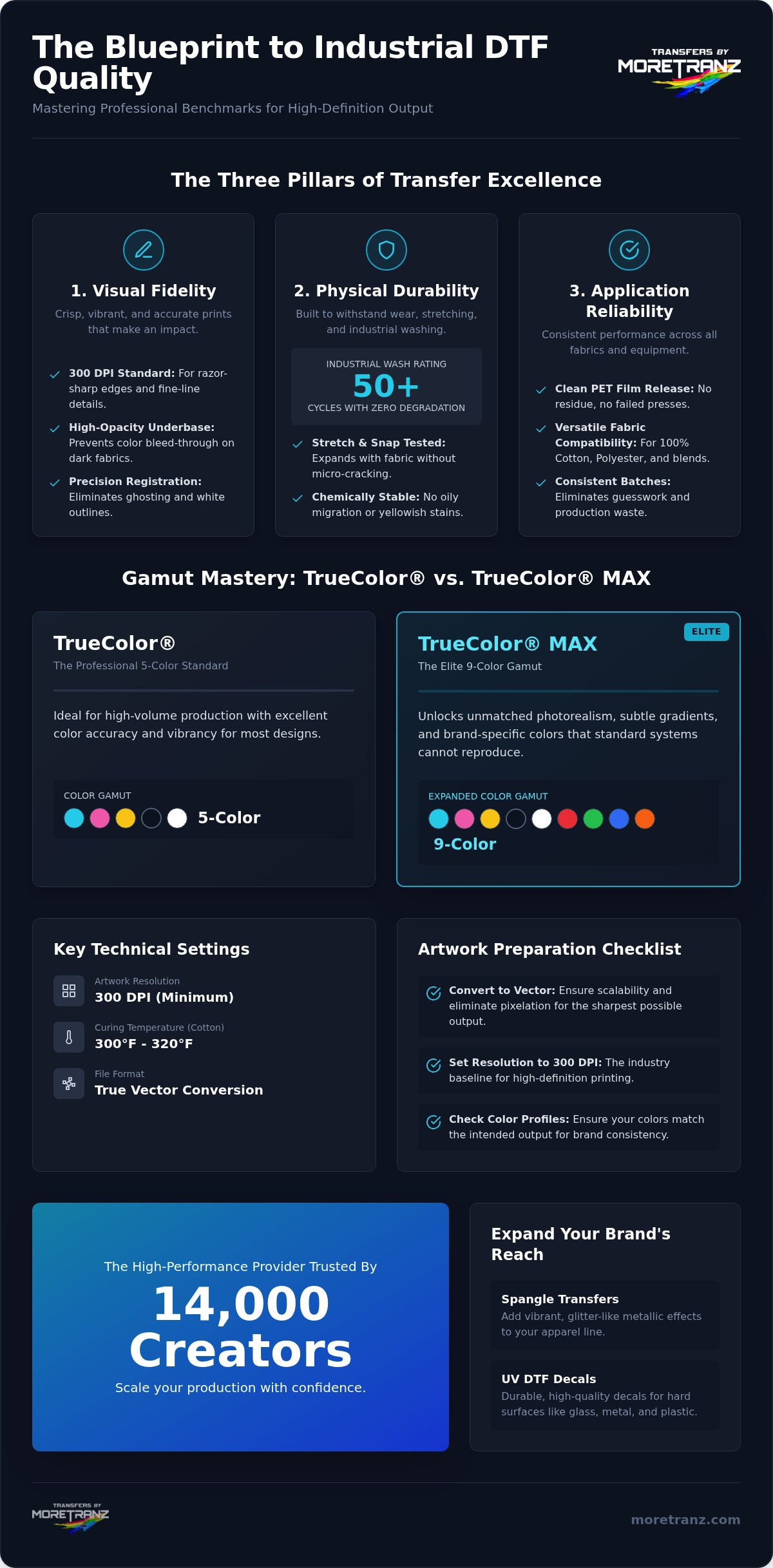
In 2026, the custom apparel market has reached a critical turning point. It is no longer enough to simply produce a transfer; you must deliver industrial-grade reliability. Professional dtf transfer quality standards are built on three non-negotiable pillars: visual fidelity, physical durability, and application reliability. Cheap, entry-level transfers often fail at the retail level because they prioritize low upfront costs over long-term performance. These inferior products result in oily migration, cracked graphics, and disappointed customers. For the 14,000 creators we support, MoreTranz acts as a professional-grade toolkit that ensures every print meets a rigorous standard: surviving 50+ washes without losing a single shade of color.
Visual Fidelity: More Than Just Resolution
High-definition output starts with artwork, but it lives in the ink. While 300 DPI is the industry baseline for sharp edges, true visual excellence requires maximum ink density. This is especially critical for the white underbase. Without high-performance opacity, dark fabrics will bleed through your design, muting your colors and ruining the visual impact. Precision registration is another hallmark of elite standards. If your production system lacks technological dominance, you will see white outlines or ghosting around your graphics. We eliminate this friction by ensuring our TrueColor® and TrueColor® MAX transfers maintain razor-sharp alignment even on complex, fine-line designs.
The Durability Benchmark
A transfer that looks good on the film but peels after three washes is a liability to your brand. Industrial durability is measured by physical resilience. Serious brands use the stretch-and-snap test, particularly for athletic wear and spandex blends. A quality transfer must expand with the fabric and return to its original shape without micro-cracking. This resilience depends heavily on chemical stability. Low-grade adhesive powders often lead to oily migration, where the chemicals seep through the ink and create a yellowish stain. To meet 2026 dtf transfer quality standards, your output must withstand 50+ commercial wash cycles. This requires precise curing, typically between 300 and 320 degrees Fahrenheit for cotton fabrics, to ensure the adhesive and ink bond permanently with the fibers.
Application reliability is the final piece of the professional puzzle. It means your transfers perform consistently across different heat press setups and fabric types. Whether you work with 100% cotton or heat-sensitive polyester, the transfer must release cleanly from the PET film. By standardizing these parameters, MoreTranz empowers entrepreneurs to spend less time troubleshooting failed prints and more time scaling their businesses. We provide the technical foundation so you can focus on the creative execution.
The Technical Pillars of Transfer Excellence
High-performance output isn't accidental. It's the result of precise chemical engineering. While many competitors focus strictly on resolution, true dtf transfer quality standards demand a deeper look at the synergy between ink, film, and adhesive. Professional-grade pigments ensure a visual intensity that doesn't wash out or fade. We use advanced ink chemistry to provide the saturation needed for serious brands that require retail-ready results. This technical foundation is what allows the 14,000 creators we serve to scale their production without fearing batch-to-batch inconsistency.
Ink Density and Opacity Standards
On 100% polyester, standard inks often suffer from dye migration. This occurs when the garment's synthetic dyes bleed into the transfer during the heating process. High-load white ink acts as a critical chemical barrier. It ensures your TrueColor® prints remain crisp and opaque regardless of the base fabric color. Consistent ink flow is mandatory for large-scale production. If the flow fluctuates, your white underbase becomes uneven. This creates weak spots where the transfer might peel or crack under stress. By maintaining high-load density, you ensure every print delivers a punchy, professional look that survives the retail shelf.
Film coating technology determines your production speed and the final hand feel of the garment. Instant-peel films are designed for rapid fulfillment, while cold-peel options often provide a smoother, more refined texture. The adhesive powder grain size must also match the fabric texture. Fine powder is essential for high-detail graphics on smooth pima cotton. Coarser grains provide the necessary grip for textured fleeces or heavy canvas. Matching the powder grain to the substrate is a hallmark of industrial-grade execution.
Film Release and Texture
Choosing between matte and gloss finishes defines your brand's aesthetic. Matte remains the industrial standard for a retail-ready look that mimics traditional screen printing. The film coating must ensure a clean release during the peeling process. If the coating is subpar, it will grab fine-line details, leaving jagged edges or missing pixels on your design. Our films are engineered to protect every detail, ensuring a flawless transfer every time. You can see the difference in texture and clarity by ordering a MoreTranz sample pack to test on your specific heat press equipment.
Curing precision is the bridge between a print and a garment. The temperature must reach 300 to 320 degrees Fahrenheit to achieve full ink-powder fusion. If the temperature is too low, the bond is weak and will fail in the wash. If it's too high, the PET film may warp or the ink may scorch. This delicate balance is what separates professional practitioners from hobbyists. Mastering these dtf transfer quality standards ensures that your output is not just a sticker, but a permanent part of the fabric.
Gamut Mastery: TrueColor® vs. TrueColor® MAX
Color accuracy is the ultimate differentiator in custom apparel. In 2026, meeting professional dtf transfer quality standards requires more than just "bright" colors; it requires surgical precision in color reproduction. Most providers treat all designs with a standard four-color approach. This often leaves brands with dull oranges, muddy greens, and visible banding in gradients. MoreTranz has redefined these benchmarks by offering two distinct tiers of color performance. Whether you need reliable high-volume production or elite retail-grade accuracy, understanding the gamut gap is essential for your brand's growth.
The TrueColor® 5-Color Advantage
TrueColor® is our industrial workhorse. It utilizes a refined CMYK plus White (CMYK+W) ink configuration optimized for high-speed, high-impact results. This is the standard for 90% of professional branding needs. It delivers vibrant, opaque output that remains consistent across thousands of impressions. It's the ideal choice for creators who prioritize rapid fulfillment and reliable daily production. When you order TrueColor® transfers, you are securing a professional baseline that far exceeds entry-level market alternatives. It ensures your logos are punchy and your white underbase is thick enough to block garment bleed.
TrueColor® MAX: The 9-Color Revolution
For brands that refuse to compromise, TrueColor® MAX represents the pinnacle of dtf transfer quality standards. This system expands the traditional gamut by adding four additional ink channels. This 9-color technology allows you to hit "impossible" colors that standard CMYK systems simply cannot reproduce. High-intensity oranges, deep forest greens, and electric violets become a reality. This expanded color space is why 14,000 creators choose TrueColor® MAX for their premium retail collections. The benefits go beyond just "more" color:
- Eliminate Banding: Additional ink channels provide smoother transitions in complex gradients and skin tones.
- Exact Brand Matching: Achieve tighter tolerances for corporate hex codes and specific brand palettes.
- Visual Intensity: Experience a level of saturation that makes graphics pop off the fabric with photographic realism.
- Superior Detail: The 9-color process captures micro-details in shadows and highlights that 5-color systems often flatten.
High-performance output is about technical dominance. Standard prints look fine until they are placed next to a TrueColor® MAX transfer. The difference in vibrancy and depth is immediate. If your business targets high-end streetwear, professional sports teams, or corporate clients with strict brand guidelines, the 9-color standard is your competitive edge. Stop settling for colors that are "close enough." Execute your vision with the full spectrum of modern print technology.
Artwork Preparation: The Secret to Meeting Standards
High-performance output depends entirely on the quality of your digital assets. If your source file is flawed, even the most advanced 9-color system can't save the print. In 2026, dtf transfer quality standards start long before the ink hits the film. Low-resolution files are the primary cause of failed transfers. They lead to jagged edges, visible pixels, and a finished product that looks amateur. MoreTranz provides the professional tools needed to ensure your artwork matches the technical dominance of our TrueColor® MAX technology. We treat artwork preparation as a technical discipline, not a suggestion.
The Vector Conversion Standard
Many creators make the mistake of simply upscaling a low-resolution raster image. This doesn't add detail; it just makes the blurriness larger. Industrial printing requires mathematical precision. Vector files like AI, SVG, and EPS use paths instead of pixels. This ensures your design remains razor-sharp at any scale. Our Vector Conversion Service is a critical resource for brands that need to maintain sharp edges on fine-line graphics. By converting your raster art into a high-performance vector format, you eliminate the risk of pixelation. This guarantees your output meets the highest dtf transfer quality standards in every batch.
Preparing Print-Ready Files
Clean backgrounds are non-negotiable. Stray pixels or semi-transparent fuzz around your design will capture white ink and adhesive powder. This creates a visible box effect or dirty-looking edges on the final garment. Utilizing professional artwork services to remove these artifacts saves production time and reduces waste. You must also manage your color profiles correctly. While most digital designs start in RGB, DTF printers operate in CMYK. Converting your files to CMYK before uploading ensures that the colors you see on your screen are the colors that appear on the fabric. This prevents the muddy look that occurs when the printer tries to interpret out-of-gamut RGB values.
Efficient production also relies on how you arrange your designs on the film. Setting up custom DTF gang sheets allows you to maximize every inch of the PET film, effectively lowering your cost per print. This reduces material costs and streamlines your fulfillment workflow. We've helped 14,000 creators transition from inefficient single-print setups to high-volume gang sheet production. This approach ensures you spend less time on logistics and more time on creative execution. Precision in your layout is just as important as precision in your design. Don't let poor file preparation be the bottleneck that stops your scaling efforts.
Upgrade your artwork to vector standards now
Scaling Quality with MoreTranz: The Professional Partner
Scaling a brand requires a partner that treats your reputation as its own. MoreTranz supports 14,000 creators by maintaining relentless dtf transfer quality standards across every production run. We don't just ship transfers; we deliver a competitive advantage through rapid fulfillment and technological dominance. Whether you're a boutique designer or a high-volume manufacturer, our "No Minimum" philosophy ensures you receive industrial-grade output on every order. This accessibility allows you to test new markets and scale without the burden of excessive inventory. We've optimized our workflow to ensure that a single custom sheet receives the same technical scrutiny as a thousand-unit production run.
Our specialty options provide the visual intensity needed to stand out in a crowded marketplace. You can elevate your designs with Spangle Transfers or high-impact textures that traditional printing can't replicate. These advanced tools are part of a professional-grade toolkit designed for modern entrepreneurs who require immediate, high-performance results. We prioritize your speed to market because we know that in the creative industry, timing is everything. Our rapid fulfillment cycles mean you spend less time waiting and more time executing your objectives.
Beyond Apparel: UV DTF Decals
Professional branding doesn't stop at fabric. We apply the same rigorous quality standards to hard surfaces through our UV DTF Decals. These aren't standard stickers. They are industrial-strength transfers engineered for tumblers, glass, and metal. While traditional vinyl stickers peel and fade, UV DTF Decals offer superior physical resilience and chemical stability. They provide a permanent, raised-texture finish that withstands daily use and commercial cleaning. This technological shift allows you to expand your brand's footprint into promotional products with total confidence in the output's durability.
Get Started with the MoreTranz Standard
Beyond promotional items, creating a professional workspace is vital for scaling brands; if you're transitioning to a new space, American Luxury Gifts provides excellent suggestions for office-warming gifts that inspire productivity.
The best way to verify our claims is to experience the output yourself. Every serious professional should start by ordering a MoreTranz Sample Pack. This allows you to perform your own stretch-and-snap tests and verify the vibrancy of our 9-color TrueColor® MAX technology. You can also explore high-impact textures with Glitter DTF Transfers to see how they catch the light and command attention. Joining our community of 14,000 creators means gaining access to a high-performance toolkit that values precision and rapid execution. Secure your reputation and scale your business with the partner that sets the industrial standard.
Dominate the Market with Professional Standards
Industrial success in 2026 requires more than basic equipment; it demands a commitment to technical excellence. You now have the blueprint to master dtf transfer quality standards by focusing on ink density, chemical stability, and precise artwork preparation. By moving beyond standard 5-color prints to the elite TrueColor® MAX 9-color technology, you secure a competitive advantage that standard vendors can't replicate. Our specialized toolkit allows you to deliver visual intensity that survives over 50 industrial wash cycles.
MoreTranz is your partner in this high-performance journey. We empower 14,000 creators with the tools to scale rapidly without the burden of minimum order requirements. Whether you're applying UV DTF Decals to hard surfaces or pressing TrueColor® transfers onto premium apparel, your output will reflect the precision of a market leader. It's time to stop guessing and start executing with total confidence in your durability and visual impact.
Order the MoreTranz Sample Pack and Feel the Quality Difference Today
Take control of your production and join the ranks of high-growth brands today.
Frequently Asked Questions
What is the standard DPI for high-quality DTF transfers?
300 DPI is the non-negotiable standard for professional dtf transfer quality standards in 2026. This resolution ensures that fine-line graphics and small text remain razor-sharp during the printing process. Lower resolutions lead to visible pixelation and jagged edges that degrade the perceived value of your brand. We recommend preparing all files at full scale to maintain this level of precision. High-resolution source files are the foundation of every successful transfer.
How many washes should a professional DTF transfer last?
A professional-grade transfer must withstand a minimum of 50 wash cycles without significant fading, cracking, or peeling. This durability benchmark is what separates industrial transfers from hobbyist alternatives. Achieving this requires precise control over curing temperatures, typically between 300 and 320 degrees Fahrenheit. MoreTranz helps 14,000 creators meet this elite standard by providing materials engineered for physical resilience. If your prints don't survive 50 washes, they don't meet modern industry benchmarks.
What is the difference between TrueColor® and TrueColor® MAX?
TrueColor® utilizes a high-performance 5-color CMYK plus White ink configuration for reliable, high-speed production. It's the standard for most corporate branding needs. TrueColor® MAX is our premium 9-color system that adds four additional ink channels to expand the color gamut. This technology eliminates banding in gradients and captures intense oranges, greens, and violets that standard systems can't reach. MAX is the definitive choice for elite retail collections and photographic realism.
Why do my DTF prints have a white border around the edges?
A visible white border usually indicates a registration error or poor artwork preparation. If your file contains semi-transparent "stray pixels" around the edges, the printer will apply white underbase ink to those areas. This creates a "halo" effect on the final garment. Using our professional background removal service eliminates these artifacts. Precise registration and clean, high-contrast edges are essential components of modern dtf transfer quality standards for high-definition output.
Do I need a vector file for high-quality DTF printing?
Vector files are the preferred choice for industrial-grade printing because they use mathematical paths instead of pixels. This allows you to scale designs to any size without losing sharpness or detail. While high-resolution raster files can work, vector formats like AI or SVG guarantee the cleanest possible edges. We offer a dedicated Vector Conversion Service to help you transition low-quality assets into print-ready files that meet our rigorous production benchmarks.
What is the best way to test DTF transfer quality before a bulk order?
Ordering a MoreTranz Sample Pack is the most effective way to verify performance before committing to a large run. This pack allows you to test the visual intensity of TrueColor® MAX and the physical resilience of our adhesives on your specific heat press. You can perform wash tests and stretch tests to ensure the output meets your brand's requirements. It's a critical step for serious creators who prioritize technical dominance and reliable fulfillment.
Can I use UV DTF Decals on outdoor equipment?
UV DTF Decals are designed for extreme durability on hard surfaces including metal, glass, and heavy-duty plastics. They provide a permanent, raised-texture finish that outlasts traditional vinyl stickers in outdoor environments. These decals are resistant to physical abrasion and chemical cleaners, making them ideal for branding tumblers or industrial equipment. They maintain their visual impact and adhesive strength even under heavy use. It's a professional-grade solution for branding that goes beyond apparel.
Why is background removal necessary for DTF transfers?
Background removal is mandatory to prevent the "box" effect on dark fabrics. DTF printers apply a white underbase to every non-transparent pixel in your file. If your background isn't 100% transparent, the printer will create a solid block of white ink behind the design. This ruins the hand feel and visual appeal of the garment. Professional background removal ensures that only your intended graphic receives ink, resulting in a seamless, retail-ready finish.