

DTF vs Sublimation: 2026 Guide for Apparel Decorators
Why are you still turning away high-value orders because a client wants cotton instead of polyester? In the 2026 apparel market, the DTF vs sublimation choice determines whether your brand scales or stalls. You've likely felt the sting of sublimation limitations or the technical headaches of maintaining an unreliable printer. It's a constant struggle to balance visual intensity with production speed, especially when color matching feels like a guessing game across different fabrics. We understand that you need a professional-grade toolkit that eliminates these bottlenecks and delivers physical resilience.
This guide settles the debate by analyzing technical efficiencies, cost structures, and real-world ROI. We will show you how to break through fabric barriers and achieve industrial-grade durability without the maintenance nightmares. You'll discover why 14,000 creators now rely on Transfers by MoreTranz to deliver the precision of TrueColor® and the expanded 9-color gamut of TrueColor® MAX. From high-speed gang sheets to durable UV DTF Decals, we are mapping out the exact path to a more diverse, profitable product line that secures your technological dominance in a competitive landscape.
Key Takeaways
- Break the "polyester prison" and discover how DTF technology enables vibrant, industrial-grade results on cotton, nylon, and leather.
- Understand the technical nuances of DTF vs sublimation, including why multi-layered transfers offer superior versatility over gas-phase chemical bonds.
- Eliminate the high cost of printer maintenance and ink waste by leveraging a streamlined production workflow trusted by 14,000 creators.
- Achieve unmatched visual intensity with the TrueColor® MAX 9-color gamut, outperforming standard 5-color systems and DIY sublimation hacks.
- Learn to scale your brand beyond apparel using UV DTF Decals for hard surfaces, maintaining total color consistency across your entire product line.
The Great Debate: DTF vs. Sublimation in 2026
The apparel decoration industry is at a crossroads. The choice between DTF vs sublimation isn't just about ink; it's about your brand's ability to fulfill diverse orders without compromising on quality. Direct to Film (DTF) utilizes a multi-layered transfer approach, while sublimation relies on a chemical gas-phase transition. This technical divide creates a fundamental conflict: do you prioritize the universal fabric versatility of DTF or the fully integrated, no-feel finish of sublimation? Currently, 14,000 creators are accelerating their shift toward DTF to escape the limitations of polyester-only production and gain total control over their product lines. They require the visual intensity and physical resilience that only modern transfer technology can provide.
What is DTF Printing?
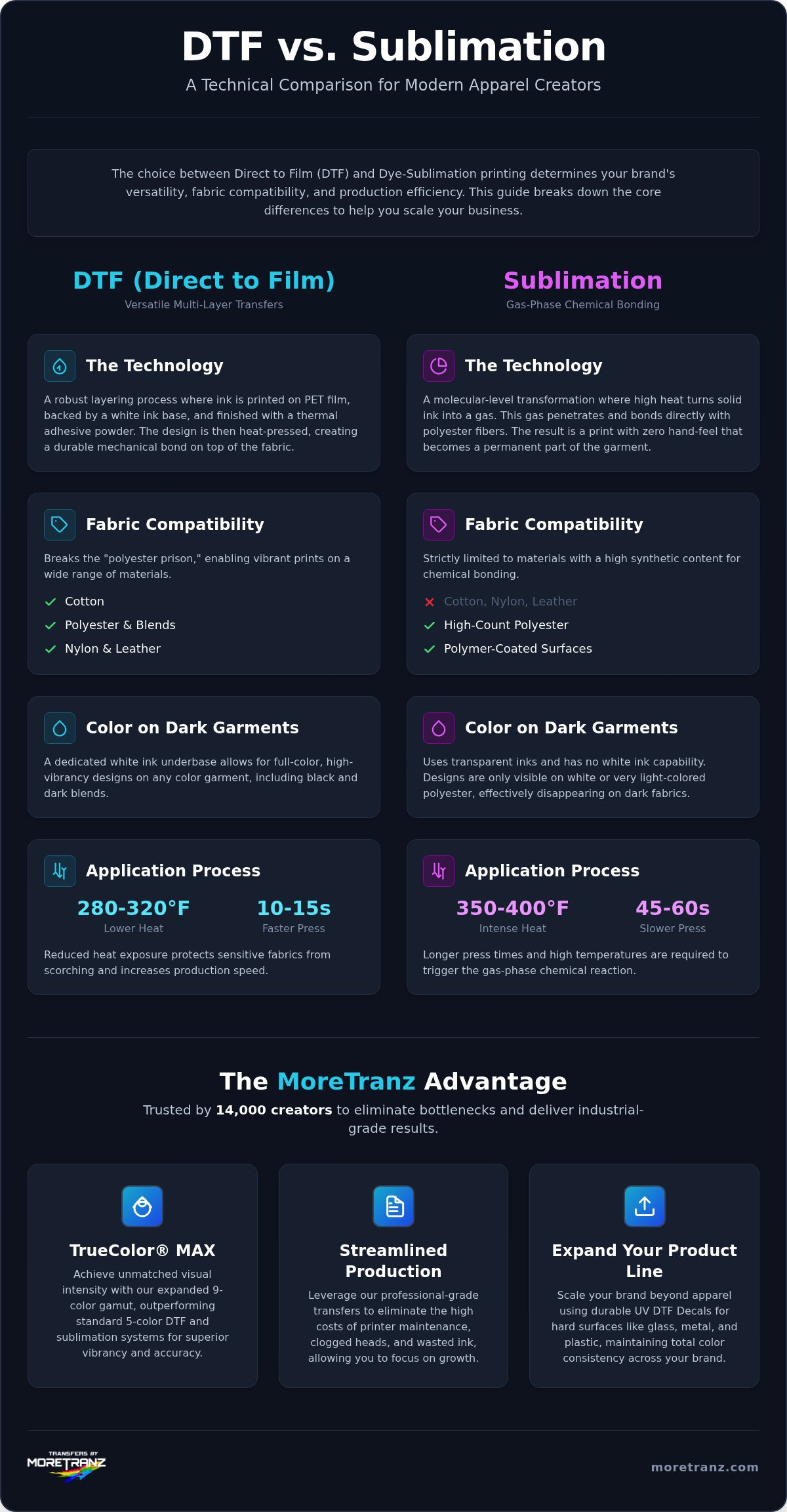
DTF is a robust, three-stage layering process. It begins with high-vibrancy pigments printed onto a specialized PET film. A white ink base is applied over the colors, followed by a thermal adhesive powder. This multi-layered construction ensures that the design sits on top of the fabric rather than sinking into it. The PET film acts as a stable carrier, allowing for intricate details and sharp edges that remain crisp during the transfer process. Modern advancements, specifically TrueColor® MAX technology, have revolutionized this method. By utilizing a 9-color gamut and refined adhesive layers, it produces a significantly thinner and softer hand-feel than legacy DTF methods. This tech allows you to achieve industrial-grade durability on almost any substrate, from heavy cotton to flexible blends.
What is Sublimation Printing?
Sublimation is a molecular-level transformation. Unlike DTF, which uses a physical adhesive bond, sublimation uses high heat and pressure to turn solid ink into a gas. This transition typically occurs between 350-400°F. During this phase, the pores of synthetic fibers open, allowing the gaseous ink to penetrate and bond directly with the polymer chains. Once the heat is removed, the pores close, trapping the ink inside the fiber. This results in a print that essentially becomes part of the garment. It offers zero hand-feel and permanent durability. However, this process strictly requires high-polyester content or polymer-coated surfaces to facilitate that chemical bond. Without those polymers, the ink has nothing to grab onto. This leads to faded results, ruined inventory, and restricted product lines.
The Science of the Press: How the Two Technologies Differ
Achieving a professional-grade finish depends on understanding the thermodynamics of your heat press. In the DTF vs sublimation comparison, the application variables are starkly different. Sublimation requires intense heat, typically between 350-400°F, for a duration of 45 to 60 seconds to trigger the gas-phase transition. Conversely, DTF operates at a much lower thermal threshold, usually 280-320°F for just 10-15 seconds. This reduced heat exposure protects sensitive fabrics from scorching or "pressing boxes" while maintaining high production speeds. It's a matter of industrial efficiency versus chemical reaction time.
The physical bond also differs at a molecular level. DTF relies on a thermal adhesive powder that melts and grips the fabric surface, creating a mechanical bond. Sublimation requires a polymer-rich substrate to absorb the gaseous ink for a chemical bond. Without this polymer, the ink cannot anchor. This is why professional Artwork Services are critical for both methods; your files must be optimized for these specific bonding behaviors to ensure crisp edges and vibrant saturation. High-quality output begins long before the heat press is closed.
The White Ink Advantage
Sublimation printing uses transparent inks, meaning it has no white ink capability. If you print on a black shirt, the design effectively disappears into the dark fibers. This limitation tethers your brand to light-colored polyester or white surfaces. DTF shatters this barrier by utilizing a dedicated white ink channel. By printing a solid white underbase, DTF allows colors to pop with extreme visual intensity on black cotton or dark blends. This single technical capability is why 14,000 creators have adopted DTF as their primary production method for diverse apparel lines. It provides the freedom to design for any garment color without restriction, whether you are producing everyday corporate gear or creative novelty designs like those seen at WhimSpin.
Durability and Wash Fastness
Durability is the ultimate benchmark for professional apparel. Sublimation offers unmatched longevity because the ink lives inside the fibers; it lasts as long as the garment itself. However, modern DTF has closed the gap significantly. TrueColor® transfers are engineered for physical resilience, rated for 50+ washes with zero cracking or peeling. We define wash fastness as the ability of a print to resist fading or cracking over time despite repeated laundry cycles. While sublimation excels in fiber integration, the multi-layered strength of TrueColor® MAX provides the durability serious brands require for high-performance streetwear and workwear. You can test this resilience yourself with a MoreTranz sample pack to see how these transfers hold up under pressure.
Fabric Compatibility: Breaking the Polyester Barrier
Sublimation is often called the "Polyester Prison" for a reason. While it produces stunning results on synthetic fibers, it fails completely on natural materials like 100% cotton or silk. The chemical gas-phase transition requires a polymer to latch onto; natural fibers simply don't have them. This is the primary bottleneck in the DTF vs sublimation debate. If your customer wants a premium cotton hoodie, sublimation isn't just difficult; it's impossible. Beyond material limits, sublimation inks are transparent. If you press a blue logo onto a yellow shirt, you'll end up with a green logo. This lack of opacity forces you to stick to white or very light fabrics, severely limiting your brand's creative reach.
Sublimation Material Limits
For a successful sublimation print, 65% polyester is the bare minimum for acceptable saturation. Anything less results in the "vintage look" problem, where the image appears faded or washed out after the first cycle. This happens because the ink only bonds to the polyester threads, leaving the cotton fibers bare. While Sublimation Transfers remain a top-tier choice for hard goods like mugs and polymer-coated coasters, they lack the flexibility required for a modern apparel brand. Relying on unreliable "sublimation sprays" for cotton is a gamble that usually ends in poor wash fastness and customer returns. Serious businesses don't build their reputation on hacks; they build it on reliable technology.
DTF: The Universal Decorating Tool
DTF is the gold standard for entrepreneurs who refuse to be limited by their inventory. Whether you're pressing onto heavy hoodies, canvas tote bags, nylon windbreakers, or even leather jackets, TrueColor® DTF Transfers provide a universal solution. Because the adhesive creates a mechanical bond on top of the fibers, the fabric's chemical makeup doesn't matter. You get total opacity and zero color bleed, even on dark-colored garments. This allows you to maintain perfect brand colors regardless of the substrate.
Don't confuse this with the thick, plastic feel of old-school heat transfer vinyl. The modern TrueColor® MAX output is engineered for a soft, flexible, and breathable finish that moves with the fabric. It offers the visual intensity of a screen print with the precision of digital tech. This versatility is why 14,000 creators use MoreTranz to scale their businesses. You can offer a diverse product line without stocking five different types of transfer paper or worrying about fabric-specific color shifts. You gain the freedom to say "yes" to every order, knowing the output will be consistent, durable, and professional.
Scalability and ROI: Which Tech Drives Business Growth?
The math of DTF vs sublimation changes when you look past the initial sticker price of a printer. While entry-level sublimation setups appear affordable, they often trap creators in a cycle of high-cost consumables and limited substrate options. High-end sublimation printers require significant capital, yet they still lack the versatility of a professional DTF transfer. The real threat to your ROI, however, is the hidden cost of printer maintenance. Clogged print heads, ruined film, and massive ink waste during cleaning cycles are the industry's silent profit killers. By outsourcing your production to MoreTranz, you shift your energy from troubleshooting hardware to closing high-volume sales. Our community of 14,000 creators has already discovered that technical dominance comes from using a professional-grade toolkit, not from fixing it.
Gang Sheet Efficiency
Maximizing your surface area is the fastest way to increase profit margins. Using the TrueColor® MAX Gang Sheet Builder allows you to pack multiple logos and designs onto a single roll. A gang sheet is a single transfer sheet containing multiple designs to reduce waste. When you compare the per-print cost of a densely packed gang sheet to individual sublimation sheets, the efficiency of DTF becomes undeniable. You aren't just saving on the physical material; you're reducing the labor cost associated with prepping multiple small transfers. This scalability allows you to handle everything from a single custom t-shirt to a 500-piece corporate order with the same level of ease.
Production Speed and Turnaround
Time is your most valuable asset in a high-performance fulfillment environment. Sublimation is a slow process, often requiring 45 to 60 seconds of heat press time to ensure a proper gas-phase bond. DTF technology operates with rapid press times of just 10 to 15 seconds. This allows for nearly 4x faster production cycles, meaning you can move through your queue at a pace sublimation simply cannot match. Because MoreTranz offers no minimum orders, you can maintain this high-speed turnaround even for small custom runs. You get the benefit of industrial-scale speed without the overhead of maintaining your own machinery.
Why 14,000 Creators Choose MoreTranz TrueColor® MAX
The DTF vs sublimation debate often overlooks the most critical factor: the actual quality of the professional output. While DIY sublimation hacks struggle with color accuracy and substrate limitations, MoreTranz provides a professional-grade toolkit designed for technological dominance. We serve 14,000 creators who require more than just "good enough" results for their growing brands. Our advanced manufacturing operations ensure rapid fulfillment and industrial-grade reliability for serious entrepreneurs nationwide. You aren't just buying a transfer; you're accessing a proprietary methodology that guarantees visual intensity and physical resilience on every garment you produce.
TrueColor® vs. TrueColor® MAX
Choosing between our two primary offerings depends on your brand's specific creative requirements. Standard TrueColor® is our high-performance 5-color system. It delivers exceptional results for everyday apparel, offering a soft hand-feel and vibrant colors that surpass standard market alternatives. It's the reliable workhorse for creators who need consistent, high-quality transfers for cotton and blends. For brands that demand the most vivid neons and ultra-vivid shades, TrueColor® MAX is the ultimate competitive advantage. This premium 9-color process unlocks a massive gamut that reproduces complex gradients and high-intensity visuals impossible to achieve with a standard 5-color setup or basic sublimation. This technological superiority ensures your designs stand out in a crowded marketplace with unmatched clarity.
Beyond apparel, our technology extends to hard surfaces through professional UV DTF Decals. These transfers allow you to maintain total color consistency across tumblers, electronics, and equipment. You get the same TrueColor® precision on hard goods as you do on fabric, creating a unified brand experience that scales effortlessly across multiple product categories. This versatility allows you to expand your brand beyond the limitations of sublimation without investing in separate, expensive printing equipment. You gain the power to brand anything, anywhere, with total confidence in the durability of the final product.
Get Started with a Free Sample
Testing is the only way to truly understand the MoreTranz difference and see how we outperform the competition. We encourage every creator to put our transfers through a rigorous wash test. When you receive your samples, look for superior stretch and immediate rebound without cracking. Observe the color retention after multiple high-heat cycles. You'll find that our transfers maintain their visual impact long after DIY sublimation prints have faded or cracked. We are so confident in our industrial-grade durability that we offer a seamless way to experience it firsthand. Don't settle for inconsistent results when you can join a community that values precision and professional growth. Your brand deserves the impact of a professional-grade toolkit.
Dominate the 2026 Apparel Market with Professional-Grade Tech
The choice between DTF vs sublimation is the difference between being limited by your equipment and having the freedom to brand anything. You've seen how Direct to Film technology shatters the polyester barrier, allowing you to deliver high-impact designs on cotton, leather, and dark garments with absolute precision. By eliminating the high costs of printer maintenance and ink waste, you position your brand for rapid scalability and superior ROI. You can finally stop turning away customers and start fulfilling every order with total confidence in your output.
MoreTranz is your high-performance partner in this transition. We offer the exclusive TrueColor® MAX 9-color technology to ensure your output achieves a level of visual intensity that standard systems cannot match. With no minimum order requirements, you can execute small custom runs or massive corporate orders with the same industrial-grade efficiency. We are proud to be the trusted toolkit for 14,000 creators who refuse to settle for mediocre results. It's time to stop troubleshooting and start executing.
Take control of your production cycle today. Build a brand that stands on durability, vibrancy, and technological dominance.
Frequently Asked Questions
Can I use a sublimation printer for DTF?
No. Sublimation printers lack the white ink channel and pigment ink chemistry required for Direct to Film production. Sublimation ink is designed to turn into gas and bond with polymers, while DTF requires a specialized adhesive powder and a white underbase to create a physical bond. Attempting to swap these technologies will lead to failed transfers and permanent damage to your print heads. Professional results in the DTF vs sublimation comparison require hardware dedicated to each specific process.
Does DTF feel like a heavy sticker on the shirt?
Modern technology has eliminated the thick, plastic feel of legacy transfers. While older heat transfer methods were rigid, TrueColor® MAX is engineered for a soft, flexible, and breathable hand-feel that moves with the fabric. The multi-layered system is thin enough to maintain garment comfort while providing industrial-grade durability. It won't crack or peel under stress, ensuring that your high-performance streetwear feels as professional as it looks.
What happens if I try to sublimate on 100% cotton?
The design will wash out almost entirely after the first laundry cycle. Sublimation ink requires synthetic polymer fibers to create a permanent chemical bond. Since cotton is a natural fiber without these polymers, the ink has nothing to anchor to during the gas-phase transition. You'll be left with a faded, ghost-like image that ruins your inventory. This limitation is why 14,000 creators rely on MoreTranz to bridge the gap between polyester and cotton garments.
Which is more durable: DTF or sublimation?
Both methods offer exceptional longevity when applied correctly. Sublimation is permanent because the ink lives inside the fibers, but it's limited to light polyester. TrueColor® transfers are rated for 50+ washes with zero cracking, providing nearly identical durability on a much wider range of fabrics. DTF offers the added benefit of physical resilience on dark cotton and nylon, where sublimation simply cannot perform. Both are professional-grade solutions for serious apparel brands.
Do I need a special heat press for TrueColor® MAX transfers?
No, any high-quality commercial heat press is sufficient. You simply need a machine capable of maintaining consistent temperature and pressure across the entire platen. TrueColor® MAX transfers are designed for ease of use, typically requiring 280-320°F for just 10-15 seconds. This lower heat threshold protects your garments from scorching while ensuring a perfect mechanical bond. It's a streamlined process that fits into any existing professional production workflow.
Can DTF transfers be used on hard surfaces like tumblers?
Yes, but you must utilize specialized UV DTF Decals for hard surface applications. Standard apparel DTF transfers require heat and fabric pores to create a bond. For hard goods like tumblers, electronics, or equipment, our UV DTF process creates a permanent, high-gloss finish that doesn't require a heat press. This allows you to maintain total color consistency across your entire product line, from hoodies to hardware, using a single trusted partner. For businesses expanding further into rigid presentation media and signage, you can explore הדפסה על קאפה for durable foam-board display printing.
Why do 14,000 creators prefer ordering transfers over owning a printer?
Ordering from MoreTranz eliminates the massive overhead of printer maintenance and technical downtime. DTF printers are notoriously difficult to manage, often suffering from clogged heads and expensive ink waste. By outsourcing to a professional facilitator, 14,000 creators focus their energy on sales and design rather than repairing machinery. It's a more efficient path to scaling a business. You get industrial-grade quality without the technical headaches of maintaining your own hardware.
Is there a minimum order for TrueColor® DTF transfers?
There are no minimum order requirements at MoreTranz. We believe in empowering entrepreneurs at every stage of their growth, from the first prototype to the thousandth unit. Whether you need a single custom design or a massive run of gang sheets, we provide the same industrial-grade quality and rapid fulfillment. This flexibility allows you to test new designs or fulfill small custom orders without the risk of carrying excess inventory or wasting profit.