


Glitter DTF Application Tips: The Professional Guide to High-Impact Pressing
A flawless glitter finish isn't about the sparkle; it's about the science of the cold peel. If you've ever dealt with ink lifting or rough, fraying edges on a polyester blend, you know that standard pressing routines don't cut it for high-impact textures. Achieving retail-ready apparel requires more than just a heat press. It demands specific glitter DTF application tips that bridge the gap between creative vision and industrial durability. MoreTranz supports 14,000 creators who refuse to settle for inconsistent results, and the secret lies in mastering the technical variables of the press.
You're about to learn how to lock in vibrant, long-lasting finishes using TrueColor® MAX technology and precise application workflows. We'll cover the exact heat and pressure settings needed to prevent edge fraying while ensuring your designs survive the toughest wash cycles. From optimizing gang sheets for rapid production to the discipline of the cold peel, this guide provides the professional-grade toolkit you need for total confidence in your output. It's time to stop guessing and start executing with the precision of a high-performance partner.
Key Takeaways
- Learn how glitter DTF delivers multi-dimensional shimmer and complex gradients that traditional screen printing and vinyl cannot replicate.
- Master essential glitter DTF application tips, focusing on the heavy pressure and precise heat calibration required to bond specialty particles to diverse fabrics.
- Implement non-negotiable pre-pressing and center-crease alignment techniques to eliminate moisture and ensure high-impact, professional placements.
- Resolve common troubleshooting issues like glitter migration and edge fraying on high-stretch materials using industrial-grade adhesive standards.
- Scale production with MoreTranz by utilizing TrueColor® MAX technology and no-minimum orders to meet the demands of 14,000 creators.
Why Glitter DTF Transfers are Revolutionizing Custom Apparel
Custom apparel is no longer just about flat ink. It's about depth, texture, and visual intensity. Glitter DTF transfers have disrupted the market by offering a multi-dimensional shimmer that traditional screen printing simply cannot replicate. While screen printing often feels heavy and lacks sparkle, glitter DTF provides a lightweight, integrated finish that catches the light from every angle. It creates a premium tactile experience that customers are willing to pay more for.
The real game-changer is the ability to print complex, multi-color gradients directly into the sparkling texture. Traditional glitter vinyl requires tedious layering and weeding; it's a slow process that limits design complexity and slows down your workflow. With MoreTranz, you get intricate details and smooth color transitions in a single press. This industrial efficiency is exactly why 14,000 creators are pivoting to specialty transfers. They aren't just looking for style. They're looking for higher retail margins and faster turnaround times. Professional practitioners know that speed and quality must coexist.
Quality matters in a high-performance production environment. Standard market alternatives often suffer from cracking or fading after just a few washes. MoreTranz transfers are engineered for physical resilience. They maintain their structural integrity and visual punch even under heavy wear. To get the best results, following specific glitter DTF application tips is essential to ensure the adhesive bonds perfectly with the garment fibers. Precision in your technique ensures that the output is as durable as it is visually striking.
The Difference Between TrueColor® and TrueColor® MAX Glitter
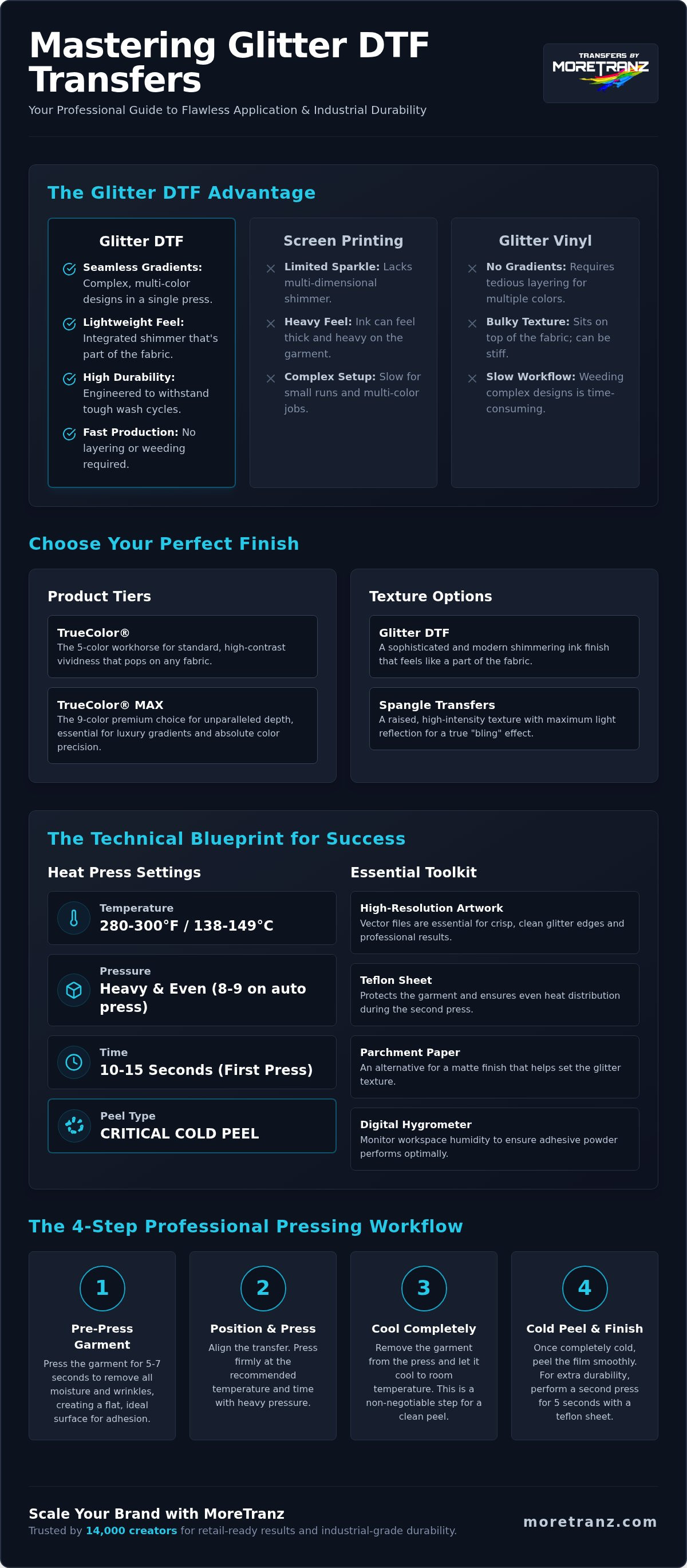
Choosing between our two tiers depends on your design's complexity. TrueColor® (5-color) is the workhorse for standard vividness. It delivers high-contrast results that pop on any fabric. For creators dealing with high-end boutique apparel, TrueColor® MAX (9-color) is the superior choice. The additional color channels provide unparalleled depth. This is essential for complex glitter gradients where subtle shifts in tone define the luxury feel of the garment. Use the MAX tier when your brand requires absolute color precision and a professional edge.
Glitter vs. Spangle Transfers: Choosing Your Texture
Texture defines the user experience. Glitter DTF provides a shimmering ink finish that feels like a part of the fabric. It’s sophisticated and modern. If your project requires a sequin-like, holographic punch, Spangle Transfers are the answer. They offer maximum light reflection for a true "bling" look. While glitter is an integrated finish, spangles provide a raised, high-intensity texture that demands attention. Both options allow you to command higher prices while maintaining rapid production cycles.
The Technical Foundation: Heat Press Settings and Equipment
Precision is the difference between a retail-ready garment and a production failure. Unlike standard transfers, glitter DTF involves suspended particles that require significant mechanical force to embed into the adhesive and fabric fibers. If your pressure is inconsistent, the glitter texture will feel "sitting on top" of the garment rather than integrated within it. This lack of penetration leads to premature cracking and edge lifting. Professional practitioners don't guess; they calibrate. Your heat press must deliver even heat distribution across the entire platen to ensure every square inch of the design receives the same thermal energy.
Foundational success also depends on your pre-production workflow. Low-resolution files are the primary cause of "blurry" glitter edges. Because glitter particles are physically larger than standard ink pigments, they need a clean, sharp landing zone defined by high-quality artwork. Utilizing a Vector Conversion Service ensures your design paths are mathematically perfect, providing the crisp borders necessary for high-impact results. Beyond the press, keep these essential tools at your workstation:
- Teflon Sheets: Essential for protecting the garment and ensuring even heat distribution during the second press.
- Parchment Paper: A professional alternative for a matte finish that helps "set" the glitter texture.
- Digital Hygrometer: Use this to monitor humidity; excessive moisture in your workspace can compromise the adhesive powder's performance.
If you're looking to test these technical variables before a large run, consider starting with a specialty transfer sample pack to dial in your specific equipment.
Temperature and Timing Benchmarks
Thermal accuracy is non-negotiable. For standard cotton and heavy blends, set your press between 300°F and 320°F for 12 to 15 seconds. If you're working with polyester or sensitive synthetics, drop the temperature to 285°F to prevent fabric scorching or "ghosting" rings. Regardless of the material, you must utilize heavy pressure. Aim for 60 to 70 PSI on pneumatic presses or a "firm" lock on manual machines. This force ensures the adhesive encapsulates the glitter particles for maximum durability.
Preparing Your Artwork for Glitter Texture
Design for the medium. Avoid ultra-fine lines under 1pt; these thin elements don't provide enough surface area for the glitter particles to adhere properly. For 14,000 creators, the standard is 300 DPI resolution. This high density is critical for the TrueColor® MAX 9-color process, allowing for the complex shading that makes glitter designs pop. Our background removal service can further optimize your files by cleaning up "negative space" areas, ensuring that the glitter only lands exactly where you want it.
Step-by-Step Application Guide: Pressing for Perfection
Execution is the final barrier between a design and a high-margin product. Even with the best equipment, poor workflow leads to lifting and texture failure. These glitter DTF application tips focus on the physical mechanics of the press. You aren't just applying heat; you're managing moisture, tension, and thermal cooling to create a permanent bond. Success in this phase ensures your output meets the rigorous standards required for retail-ready apparel.
The Pre-Press and Alignment Phase
Moisture is the enemy of adhesion. Press your blank garment for 5 to 8 seconds before introducing the transfer. This removes trapped humidity and flattens stray fibers that could interfere with the glue layer. Once pressed, let the fabric cool slightly. Placing a transfer on a steaming hot garment can cause the adhesive to liquefy prematurely, leading to "ghosting" or blurred edges. When working with complex designs from DTF Gang Sheets, use heat-resistant tape to secure your alignment during the transition to the platen. Precision at this stage prevents costly alignment errors during the main press.
The Cold Peel Mastery
Patience is a technical requirement, not a suggestion. Glitter films retain heat longer than standard transfers. You must wait at least 2 to 3 minutes until the film is completely cold to the touch. If the film is even slightly warm, the adhesive hasn't fully crystallized, which causes ink lifting. Peel low and slow. Keep the film flat against the garment and pull horizontally. If you see any part of the design lifting, stop immediately. Lay the film back down and re-press for 5 seconds at full pressure before attempting the peel again. This horizontal peeling technique is one of the most vital glitter DTF application tips for maintaining sharp edge definition.
The Finishing Press (The Secret to Softness)
The second press is what separates hobbyist output from professional-grade apparel. After removing the carrier film, cover the design with parchment paper. Press for a final 5 to 7 seconds. This step drives the glitter particles deeper into the fabric grain, "locking" the design in place. It significantly improves wash-fastness and eliminates the scratchy texture often associated with lower-quality specialty products. This finishing touch ensures your brand delivers the comfort and durability that 14,000 creators depend on for their business growth. It transforms the transfer from an overlay into an integrated part of the garment.
Advanced Troubleshooting and Durability Tips
Professional grade output is only as good as its last wash. While the visual impact of glitter is immediate, its longevity depends on how you navigate technical hurdles like glitter migration and fabric-specific tension. These advanced glitter DTF application tips ensure your designs remain vibrant and intact long after they leave the heat press. Success here means moving beyond basic pressing and into the realm of industrial-scale durability.
Glitter migration is a common failure where particles "bleed" beyond the design borders. This happens when inferior adhesive powders fail to lock the particles in place during the melt cycle. MoreTranz utilizes high-performance adhesive technology specifically engineered for the TrueColor® MAX process to prevent this issue. Beyond the adhesive, your customers must follow strict care instructions to maintain the finish. Turning garments inside out is mandatory. This simple step protects the shimmering surface from abrasive contact during the wash cycle, preserving the multi-dimensional shimmer that defines your brand.
To maximize your ROI, transition to bulk production using custom gang sheets. This allows you to nest multiple specialty designs into a single layout, significantly reducing your cost per print. It is the most efficient way to scale your brand while maintaining the high standards that 14,000 creators demand. By consolidating your glitter projects, you reduce setup times and material waste, ensuring every press contributes to your bottom line.
Optimize your production with professional DTF Gang Sheets
Solving the 'Ink Lifting' Issue
If you experience ink lifting during the cold peel, your equipment might be the culprit. Use a digital thermal gun to verify that your heat plate provides even temperature distribution across the entire surface. Cold spots are the primary cause of partial transfers. Environmental factors also play a role. For creators in humid regions like Georgia, storing transfers in a climate-controlled, airtight space is essential to prevent moisture absorption. If a bond feels weak, increase your dwell time by 3 to 5 seconds. This is safer than increasing the temperature, which can lead to fabric discoloration or adhesive scorching.
Optimizing for Different Apparel Types
Different fabrics require different mechanical approaches. Hoodies and heavy fleece often have thick seams that create uneven pressure zones. Use a heat press pillow to elevate the print area, ensuring the platen makes full contact with the design. When working with 100% polyester, stick to the "low and slow" method. Dropping the temperature to 285°F prevents the fabric from developing permanent shiny press marks. This level of precision is what allows creators to match the durability of industry leaders like Fairtex in the combat sports apparel market. For hats and accessories, a dedicated hat press is required. The curved surface demands extra firm pressure to ensure the edges of the glitter film don't pull away during the cooling phase.
Scaling Your Brand with MoreTranz Specialty Transfers
Scaling a brand requires a partner that matches your pace and precision. MoreTranz serves as the professional-grade toolkit for 14,000 creators who demand immediate results and industrial reliability. While mastering glitter DTF application tips is essential for individual garment success, the ability to scale depends on a frictionless supply chain. We provide the infrastructure you need to move from a single prototype to a high-volume product line without the burden of inventory overhead. Our systems are built for the modern entrepreneur who values precision and speed above all else.
Our "No Minimum" order policy is a strategic advantage for your business. It allows you to test new glitter designs and complex gradients using TrueColor® MAX technology without a significant upfront investment. This flexibility ensures you only produce what sells; it keeps your business lean and responsive to shifting market trends. Beyond apparel, you can expand your brand ecosystem with UV DTF Decals. These high-durability transfers bring your aesthetic to tumblers, electronics, and other hard surfaces. It creates a cohesive brand experience across multiple product categories without requiring new equipment.
Experience the technical superiority of our output firsthand. You can order a Free Sample Pack to see and feel the TrueColor® MAX difference. It’s the fastest way to verify our print density and adhesive strength before committing to a larger production run. When you feel the integrated texture and see the 9-color vibrance, you'll understand why professional practitioners don't settle for standard market alternatives.
From Concept to Fulfillment: The MoreTranz Advantage
Our workflow is designed for technological dominance. We utilize a professional vector conversion service to transform your sketches or low-resolution files into retail-ready transfers. This service is the ultimate solution for "blurry" edges, ensuring your glitter designs maintain razor-sharp definition. Operating from our Georgia headquarters, we maintain rigorous quality control on every custom order. Our rapid national shipping keeps your production schedule on track, ensuring you never miss a customer deadline or a retail opportunity.
Your Next Steps in Apparel Decoration
Ready to execute your vision? Start by building a gang sheet to test multiple glitter colors and design variations simultaneously. This is the most efficient way to apply the glitter DTF application tips you've learned while optimizing your material costs. Join our community of 14,000 creators who are scaling their businesses with professional-grade tools and specialty finishes. Your growth is our priority, and we have the technical resources to support your success at every scale.
Browse all Transfer Types and start your next project today.
Dominating the Market with Precision Pressing
Success in the custom apparel industry is defined by the quality of your output and the speed of your execution. You now have the technical framework to master complex glitter finishes, from the initial pre-press to the final texture-softening second press. Implementing these glitter DTF application tips ensures your brand delivers the physical resilience and visual intensity that modern customers demand. Professional results don't happen by accident; they are the product of calibrated equipment and disciplined technique.
MoreTranz is the high-performance partner you need to scale. We've built our infrastructure to support 14,000 creators with TrueColor® MAX 9-color technology and fast national shipping. By eliminating minimum order requirements, we empower you to innovate without risk. It's time to stop guessing and start producing retail-ready apparel that sets your brand apart from the competition.
Order your custom Glitter DTF Transfers with no minimums today!
Your journey toward industrial-grade excellence starts with the right tools and the right partner. Take control of your production cycle and experience the difference of professional-grade specialty transfers today.
Frequently Asked Questions
Can I apply glitter DTF transfers with a home iron?
No, home irons are insufficient for professional apparel production. They cannot generate the 60 to 70 PSI of heavy pressure required to embed glitter particles into the fabric fibers. Without this consistent mechanical force, the adhesive bond remains surface-level and will likely fail after the first wash. Stick to a calibrated heat press to maintain the high standards expected by serious brands.
How long do glitter DTF transfers last in the wash?
MoreTranz transfers are engineered for high-impact durability, typically lasting 50 or more wash cycles when applied correctly. The physical resilience of the TrueColor® MAX process ensures the shimmer doesn't fade or crack over time. Always instruct your customers to wash garments inside out and avoid high-heat drying cycles to maximize the lifespan of the specialty finish.
Why is my glitter DTF transfer peeling after the first wash?
Peeling is usually the result of trapped moisture or inadequate pressure during the application phase. If you skip the 5 to 8 second pre-press, humidity prevents the adhesive from forming a permanent bond. Re-evaluate your equipment settings; following proper glitter DTF application tips requires a firm, heavy lock to ensure the particles are fully encapsulated by the glue layer.
Is there a difference in pressing time for TrueColor® vs TrueColor® MAX glitter?
Pressing times remain consistent at 12 to 15 seconds for both product tiers. The primary difference lies in the visual output; TrueColor® MAX utilizes 9-color technology for superior depth in complex gradients. Whether you use standard or premium transfers, the structural integrity of the bond remains industrial-grade as long as your temperature is calibrated correctly.
Do I need a special type of heat press for glitter transfers?
You don't need a specialty machine, but you must have a heat press capable of delivering consistent, heavy pressure. A pneumatic press is ideal for high-volume production because it maintains a precise PSI throughout the cycle. If you use a manual press, ensure the locking mechanism is tightened to provide a firm, even force across the entire design area.
Can I use glitter DTF on 100% polyester athletic wear?
Yes, you can achieve retail-ready results on 100% polyester by adjusting your thermal variables. Lower your heat press to 285°F to prevent fabric scorching or "ghosting" rings on synthetic materials. This "low and slow" approach is a vital part of professional glitter DTF application tips for creators working with performance athletic wear and spandex blends.
What is the best way to store unused glitter DTF transfers?
Store your unused transfers in a cool, dry, and climate-controlled environment. Moisture absorption is the leading cause of adhesive failure, especially for creators in humid regions. Utilize airtight containers or resealable poly bags with silica gel packs to keep the film pristine. Proper storage ensures your transfers are ready for rapid fulfillment whenever a new order arrives.
How do I ensure the glitter doesn't feel scratchy on the inside of the shirt?
The finishing press is the professional secret to a soft, integrated feel. After the cold peel, cover the design with parchment paper and press for a final 5 to 7 seconds. This step drives the glitter particles deeper into the fabric grain, significantly reducing the "scratchy" texture. It transforms the design into a comfortable, wearable part of the garment that 14,000 creators trust for their brands.