


Handling Unreliable DTF Suppliers: A Recovery Plan
A late DTF order is a production-control problem, not just an inconvenience. If you’re asking what to do when your dtf supplier is unreliable, start by protecting the orders already in motion. Delays, inconsistent print quality, and communication gaps can put customer commitments at risk, but switching suppliers in a hurry can create new problems.
Get clear facts before deciding what to do next. Record missed deadlines, quality variations, and unanswered questions. Then set realistic expectations with customers and check whether the supplier’s problems are isolated or recurring. This gives you a stronger basis for deciding whether to ask for a corrective plan or prepare a transition.
This guide covers a practical recovery process: stabilize active orders, investigate likely causes, and test a replacement before moving more production. Compare samples against your real requirements, including color, opacity, edge quality, and application results. The goal is to regain control without repeating the same supplier-selection mistakes.
Key Takeaways
- To decide what to do when your dtf supplier is unreliable, separate delivery, communication, print quality, and application problems before judging whether the issue is recurring.
- Protect urgent jobs by ranking deadlines and customer impact, then send the supplier clear order details, evidence, specific questions, and a response deadline.
- Judge the supplier’s documented performance and corrective plan, not reassuring promises alone.
- Test a potential replacement with artwork and materials that reflect your real production needs before shifting substantial work.
- A sample pack can help you evaluate transfers against your workflow before making a broader change.
Is Your DTF Supplier Unreliable? Identify the Pattern Before You React
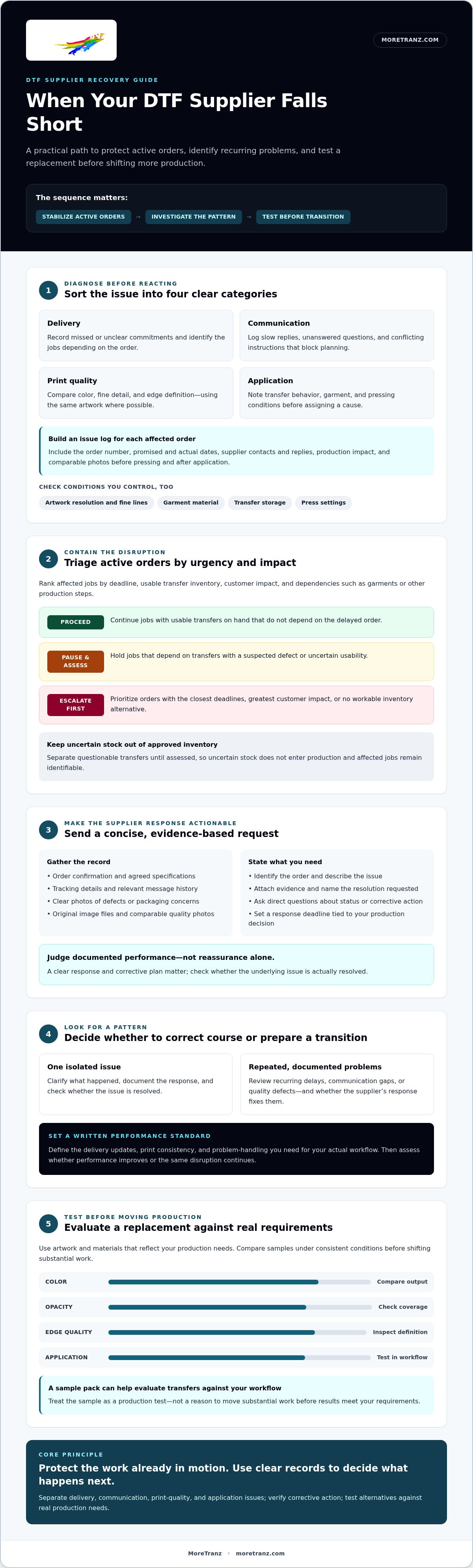
A disappointing order deserves attention, but it doesn’t automatically mean the supplier will keep failing. Start with a clear diagnosis. If you’re deciding what to do when your dtf supplier is unreliable, sort the problem into delivery, communication, print quality, or application. This clarifies what happened, which jobs are at risk, and what evidence you still need.
Create a short issue log for each affected order. Record the order number, promised and actual dates, when you contacted the supplier, what they said, and how the issue affected scheduled work or customer commitments. Add comparable photos of the transfer before pressing and the result after application. Specific records make follow-up more productive and help reveal whether the same problem is repeating.
Which supplier problems threaten production most?
Start with issues that disrupt jobs or make it difficult to plan:
- Delivery: Record missed or unclear commitments and identify the scheduled jobs that depend on the order.
- Communication: Log slow replies, unanswered questions, and conflicting instructions that prevent you from setting a reliable timeline.
- Print quality: Compare color, fine detail, and edge definition, using the same artwork where possible.
- Application: Note how the transfer behaved, along with the garment and pressing conditions. This helps investigate possible causes instead of assuming who is responsible.
Take quality photos in similar lighting and from similar angles. A consistent record makes differences easier to judge than memory or a single image.
How can you tell a one-off issue from a pattern?
Compare orders using the same criteria. Check whether delays, communication gaps, or quality defects recur, and whether the supplier’s response actually resolves them. One isolated issue may call for clarification. Repeated problems supported by clear records deserve closer scrutiny.
“Recurring, documented failures indicate a pattern more clearly than one isolated issue.”
Before blaming the supplier for an application problem, check the variables you control too. Artwork resolution and fine lines, garment material, transfer storage, and press settings can all affect the result. Compare like with like and record any differences. If the issue persists under consistent conditions, that evidence gives the supplier a clearer basis for reviewing it.
Set a written standard for what needs to change before you trust repeat orders. For example, define the delivery updates you need, the print qualities that must remain consistent, and how unresolved problems should be handled. Tie the standard to your actual workflow. This turns a general concern into a practical decision: has performance improved, or is the same disruption still affecting production?
How to Protect Active Orders When a DTF Supplier Falls Short
Contain the disruption before it spreads. The immediate goals are to protect work already in progress, keep customer commitments grounded in confirmed information, and get a clear response from the supplier. If you’re working out what to do when your dtf supplier is unreliable, don’t treat every job as equally urgent. Rank affected orders by deadline, usable transfer inventory, customer impact, and dependencies such as garments or other production steps.
- Proceed: Continue jobs with usable transfers on hand that do not depend on the delayed order.
- Pause and assess: Hold jobs that depend on transfers with a suspected defect or uncertain usability.
- Escalate first: Prioritize orders with the closest deadlines, the greatest customer impact, or no workable inventory alternative.
Contain affected work first, then choose a recovery path using verified information. Keep questionable transfers separate from approved inventory until you have assessed them. This helps prevent uncertain stock from entering production and makes it easier to identify which jobs need a decision.
What should you document before contacting the supplier?
Gather the order confirmation, agreed specifications, tracking details, and relevant message history. Photograph defects or packaging concerns clearly, and keep the original image files. In one concise message, identify the order, describe the issue, attach evidence, and state the resolution you’re requesting. Ask direct questions, such as whether the order has shipped or what corrective action is available. Set a reasonable response deadline based on when you need to make a production decision, rather than asking for an arbitrary delivery promise.
How should you manage customers and production meanwhile?
Separate jobs that can continue from those that must pause. Tell customers what is confirmed, explain the options available, and give them a specific time when you’ll update them again. Don’t promise a revised completion date until the next production step is confirmed. If the supplier hasn’t confirmed a ship date or replacement, say so plainly instead of presenting a guess as a commitment.
Keep an internal record of affected orders, usable inventory, and who needs an update. This helps prevent conflicting messages between production and customer service. If you’re considering a backup supplier, keep that evaluation separate from urgent fulfillment decisions. A DTF sample pack can help you assess a potential option using your own workflow before shifting more production.
Should You Stay With Your DTF Supplier or Start Comparing Alternatives?
Base the decision on documented performance, not frustration or reassuring promises alone. Compare your current supplier and any prospective partner using the same criteria: communication, delivery, transfer consistency, clarity of ordering requirements, and issue resolution. This gives you a practical basis for choosing between a corrective plan and a controlled transition.
Keep the comparison relevant to your work. A supplier’s process should suit your artwork, garment materials, ordering pattern, and production steps. Don’t overvalue a polished response if important details remain unclear, and don’t assume a new supplier will prevent every problem. A small test can reduce uncertainty, but it can’t guarantee the outcome of every future order.
What should a supplier comparison measure?
Ask each supplier the same questions. Are artwork requirements and specifications clear before ordering? Can you get direct answers when a problem comes up? Do repeat orders meet your needs consistently? Compare relevant evidence, such as order records, sample results, and written responses. Leave out criteria that don’t affect your garments, designs, or workflow.
| Criterion | What to compare |
|---|---|
| Communication | Clarity and usefulness of answers to questions |
| Delivery | How closely stated commitments match documented outcomes |
| Consistency | Whether comparable orders meet your quality requirements |
| Issue resolution | Whether the response addresses the specific problem and next steps |
| Ordering clarity | How clearly specifications and artwork requirements are explained |
When is a corrective plan worth trying?
A trial may make sense when the supplier acknowledges the specific failure, explains what will change, and agrees on how you’ll assess the next suitable order. “We’ll do better” isn’t measurable. A useful plan identifies the problem, the correction, and the evidence that will show whether performance improved.
Decide in advance what would trigger a transition. For example, identify the unresolved quality concern, missed commitment, or communication breakdown that would make continued reliance unacceptable. Then assess the outcome against your original criteria rather than changing expectations after the fact.
How to Vet a New DTF Supplier Before Moving Production
A sample is a checkpoint, not a guarantee. Before moving substantial production, test a potential supplier with work that reflects what you actually print. Choose designs with different requirements, such as fine details, solid areas, or color-critical elements, and use garment materials representative of your orders. This makes the results more useful than testing a generic demonstration graphic.
Transfer options can differ, so confirm that the type you test suits the job. Review the available DTF transfer types as you define your production requirements. Transfers by MoreTranz offers TrueColor MAX DTF, UV DTF, Glitter DTF, and Spangle transfers. Focus your evaluation on the artwork, garments, and application process relevant to your work.
How do you run a meaningful sample test?
Follow the supplier’s current application instructions. Keep your own process consistent across tests, including the garment type and press setup. Record which transfer and garment you tested, the instructions you followed, and any relevant conditions. Avoid changing several variables at once, or it will be harder to identify what affected the result.
- Inspect before application: Note color, opacity, fine detail, and edge quality against your written requirements.
- Record application behavior: Follow the supplier’s instructions and note how the transfer handles during application.
- Review after application: Document the finished appearance and any relevant wash-test observations using the same process you’d use to assess production work.
Keep photos and notes together. A clear record helps you compare samples with your existing quality expectations instead of relying on first impressions.
What should you confirm before placing a larger order?
Ask how to prepare files, which artwork formats are accepted, how to submit an order, and where to direct questions if a problem arises. Confirm that the supplier’s written application instructions are clear and workable with your equipment and production workflow. Resolve any unclear points before increasing the order size.
Compare the sample with your written requirements. Did the design reproduce as needed? Did the transfer apply as instructed? Were the ordering and communication steps clear? A sample that performs well under controlled conditions is useful evidence, but it can’t show that every future order will be identical. Start with a limited test and expand only when the result meets your criteria.
If you’re deciding what to do when your dtf supplier is unreliable, treat a new supplier’s sample as a practical evaluation step, not an automatic fix. Transfers by MoreTranz offers a Free Sample Pack that you can assess against your own artwork and workflow.
Make a Controlled Switch: Evaluate MoreTranz With a Free Sample Pack
Keep the transition deliberate. Stabilize urgent work with your current supplier, document recurring problems, and evaluate a new option before moving production. A sample gives you a practical way to see whether transfers fit your workflow. It provides evidence for a decision, not a guarantee that every future order will perform the same way.
MoreTranz offers a Free Sample Pack for evaluating transfers. Before testing, choose artwork and garment materials that reflect the work you produce. Write down the quality requirements that matter to your operation, such as fine-detail appearance, color consistency, clean edges, or transfer behavior during application. A clear standard makes the result easier to assess.
What should you evaluate in a MoreTranz sample?
Assess the sample against your documented production requirements, not just whether it looks appealing at first glance. Follow the provided guidance, keep application conditions consistent with your normal process, and record your observations. Note differences in appearance or application, along with relevant details about the design and garment. If you conduct a wash test, record the method and result so you can interpret what you observed.
Use the evidence to decide whether a small next order makes sense for your workflow. If the results fall short of your stated requirements, pause and investigate rather than scaling up based on assumptions. If they meet your criteria, consider a measured next step rather than transferring every job at once.
How can you transition without overcommitting?
Keep the previous supplier’s unresolved issues separate from the new supplier’s test results. A successful sample doesn’t resolve a late order, and an earlier supplier’s quality problem doesn’t establish how a new transfer will perform. Track each evaluation on its own evidence. Move work in stages, increasing reliance only after the sample meets your requirements and a subsequent order gives you more relevant experience.
Before application, review MoreTranz application instructions and check that the guidance fits your equipment and process. Write down any questions before testing, and avoid changing several application variables at once. A controlled process makes the comparison more useful and helps identify where results differ from expectations.
If you’re deciding what to do when your dtf supplier is unreliable, use the sample to choose your next step based on observed fit, not urgency alone. Keep customer commitments tied to confirmed production steps while you evaluate the option.
Take Control of Your Next Production Run
The answer to what to do when your dtf supplier is unreliable starts with control: protect urgent orders, document recurring problems, and compare any replacement against the same clear standards. Test before shifting substantial production, and base your next step on results rather than reassurance alone.
MoreTranz offers custom DTF transfers, artwork services, and a Free Sample Pack to help you assess transfers against your own workflow. Its customer base is described as 14,000 creators. A sample can help you evaluate a potential partner, but your production requirements should guide the decision.
Make the transition one measured step at a time. Clear records and a tested plan help you move forward with greater confidence while keeping production decisions in your hands.
Frequently Asked Questions
What should I do first when my DTF supplier misses a deadline?
Confirm the status of the affected order and ask the supplier for a specific update and next step. Include the order details and relevant message history so the issue is easy to identify. Then list the customer jobs that depend on those transfers and decide which production tasks can continue. Share confirmed facts with customers, but don’t promise a revised date until the shipping or production plan is clear.
How can I tell if my DTF transfers have a quality problem?
Compare the transfers with the order specifications and the supplier’s application instructions. Note whether the concern affects one transfer or multiple pieces, and record the artwork, garment, storage, and press conditions. Clear photos and repeatable test conditions help explain the issue without confusing a supplier problem with file preparation or application variables. Where possible, compare similar designs and materials before drawing a conclusion.
Should I switch DTF suppliers after one bad order?
Not automatically. Document what happened, ask the supplier for a clear response, and assess whether the issue is isolated or recurring. If a job is at risk, you can evaluate another supplier without moving all production at once. A sample tested with your artwork, garments, and application process gives you useful evidence. It can reduce uncertainty, but it can’t guarantee how every future order will perform.
How do I test a new DTF supplier before placing a large order?
Choose representative artwork and garment materials, then follow the supplier’s current application instructions. Keep conditions consistent and record visual quality, application behavior, and any relevant wash-test observations. Compare the outcome with written requirements that matter to your customers, such as color, detail, or transfer behavior. Use the results to decide whether a limited next order is appropriate before making a broader production change.
Can artwork or heat-press settings make a reliable supplier’s transfers look bad?
Yes. Artwork quality, garment material, transfer storage, press settings, and application technique can all affect the finished result. Check the supplier’s instructions and repeat a controlled test where practical before assigning blame. Keep notes and photos of the conditions and outcome. If the problem continues under the documented process, send the supplier that evidence and ask for a specific review.
What should I ask a DTF supplier before ordering?
Ask how to prepare artwork, which order specifications you need to provide, where to find application instructions, and how to raise questions or report a problem. Confirm any details that affect your production schedule and quality checks. A sample or limited test can help you assess whether the supplier’s process fits your workflow. Clear, specific answers make comparisons more useful than broad claims or assumptions.
Is a DTF sample enough to prove a supplier is reliable?
No. A sample shows how a particular design performs under a particular application process, but it can’t establish how every future order will perform. Treat it as one useful data point: record the conditions, compare the result with your requirements, and consider a limited follow-up order before shifting critical production. MoreTranz offers a Free Sample Pack for evaluating transfers, but the decision should rest on your own test results.
When should I stop trying to resolve problems with my DTF supplier?
Consider transitioning when documented problems recur, important questions remain unresolved, or the supplier can’t provide a corrective plan you can assess. Set decision criteria before placing another order, based on your deadlines, quality needs, and customer impact. Where practical, test an alternative before moving production. During a transition, keep customer updates tied to confirmed information and avoid promising dates until the next production steps are clear.