


How Durable Is UV DTF on Glass? What Affects Its Lifespan
A UV DTF Decal’s lifespan depends not just on the glass, but also on how the surface is prepared, where the decal is placed, and how the item is used. The durability of UV DTF on glass isn’t a fixed countdown. A decal may retain its appearance and adhesion with gentle handling, while frequent abrasion, harsh cleaning, or a poorly prepared surface can shorten its useful life.
If you’re getting conflicting claims about water, scratches, or everyday wear, that uncertainty is understandable. “Durable” doesn’t mean scratch-proof or guaranteed to last for a set number of years. The glass surface, decal placement, application, and cleaning routine all affect real-world performance.
This guide explains what influences durability and how to set practical expectations. You’ll learn how to prepare glass, apply and care for UV DTF Decals, and run a small test on the intended item before committing to a larger project. A controlled trial can show how the decal responds to your actual handling and cleaning routine.
Key Takeaways
- Assess durability by both adhesion and appearance during the item’s intended use, not by a one-size-fits-all lifespan promise.
- The durability of UV DTF on glass depends on the glass condition, preparation, application, placement, and handling.
- Water exposure, friction, washing, and outdoor conditions are different tests. Treat general guidance as a starting point, not a product guarantee.
- Follow the supplied application instructions, then match care to the glass item’s real-world use.
- Try a UV Decal from the MoreTranz Sample Pack on your intended glass item before starting a larger project.
What Does Durability of UV DTF on Glass Actually Mean?
“Durable” can sound like a clear promise, but it doesn’t describe one universal result. A decal on a display jar that rarely moves faces different demands from one on a drinking glass that’s handled and washed regularly. To judge performance, look at two things together: whether the decal stays attached and whether it keeps an acceptable appearance during the item’s intended use.
Concise definition: The durability of UV DTF on glass is how well a decal maintains its adhesion and visual condition during the glass item’s expected use and care.
What counts as durable on a glass surface?
Start with adhesion. Check whether the decal remains bonded across the design, paying particular attention to corners, narrow details, and exposed edges. Lifting or peeling can make a decal unsuitable for its purpose even if most of the design stays in place.
Then assess appearance. Look for changes such as visible scuffs or wear that affect how the design looks. The right threshold depends on the job: a small mark may matter on a polished product display, while a frequently handled item may be judged by whether the design remains legible and presentable.
Use the actual glass item and routine as your benchmark. Consider where the decal sits, how often the item is picked up, and whether it will be washed or mostly displayed. “Still attached” and “still looks right” are separate observations. A decal can pass one test and not the other.
Why there is no single lifespan for every glass decal
Results depend on the conditions surrounding the application. Glass with residue, dust, or a coating may behave differently from clean, smooth glass. Placement matters too: a decal on a flat area may face different handling and contact from one near an edge or on a curved section. Repeated rubbing, washing, and other routine contact can also change its condition over time.
A lifespan estimate without details about the test offers limited guidance. It may not explain what glass was used, how the decal was applied, what care routine it faced, or what counted as failure. Treat any published range as context-dependent, not as a forecast for every glass object.
Marketing terms need the same care. “Waterproof” doesn’t explain how a decal performs through a particular washing routine. “Scratch-resistant” doesn’t mean scratch-proof. “Durable” is useful only when paired with the conditions and outcome being described. For a meaningful judgment, define what success looks like for your item, then observe adhesion and appearance under its intended handling and care.
Durability is a practical standard, not a fixed number. Set expectations around the glass, the application, and the job the decal needs to do. That gives you a more useful basis for comparing claims and deciding whether the result suits your project.
Which Factors Affect UV DTF Decal Durability on Glass?
Glass isn’t one uniform application surface, and a decal’s location and surroundings matter as much as the item’s intended use. A decorative jar on a shelf has a different wear pattern from a glass that’s carried, handled, and cleaned often. To assess the durability of UV DTF on glass, consider the exact surface and routine you have in mind.
Glass surface, cleanliness, and decal placement
Start with the area where the design will sit. Dust, oil, cleaning residue, or moisture can interfere with close contact between the decal and glass. A smooth, clean, fully dry area gives you a better basis for application than one with visible texture or residue. If the glass has a coating, frosting, raised pattern, or unusual finish, don’t assume it will behave like plain, smooth glass.
Placement changes exposure, too. A design near the rim, base, or a sharp transition may encounter more contact during handling or cleaning than one on a broad, flatter area. The same applies to a design where fingers regularly grip the glass. Consider the artwork as well: fine details, narrow sections, and exposed edges may show lifting or wear more noticeably than a simple, compact shape. These are factors of placement and use, not blanket judgments about print quality.
Handling, cleaning, and the environment
Repeated friction can gradually affect a decal’s surface appearance or edges. Think through the item’s whole routine: Is it held in the same spot each time? Does it rub against other objects in storage? Will cleaning involve wiping directly over the design? The more contact the decal receives, the more important those potential wear points are.
Indoor display and outdoor exposure also create different conditions. A glass piece kept inside avoids some direct exposure to changing weather, while an outdoor item may encounter sunlight, moisture, and temperature shifts. Test under the conditions that matter to your project rather than using them to assume a universal lifespan.
Water exposure needs precise interpretation. Water resistance alone doesn’t establish that a decal is suitable for dishwasher cycles. Heat, water movement, detergent, and repeated washing create conditions that differ from occasional splashes or careful hand washing. Treat the item’s actual cleaning routine as its own durability factor.
Match the test to the intended item
Before applying decals across a batch, identify the glass type, design position, handling pattern, and cleaning method. If you’re considering a coated or textured area, test on the same kind of surface rather than assuming results will transfer from plain glass. A MoreTranz Sample Pack includes a UV Decal you can use to assess the result on your intended glass item before a larger project.
In brief: Glass condition, surface preparation, decal placement, handling, cleaning, and environmental exposure all shape durability expectations. Checking these factors helps you make a more informed choice for the item you’re decorating.
Do UV DTF Decals on Glass Resist Water, Scratches, and Daily Use?
Water, friction, washing, and outdoor exposure are different challenges, not interchangeable tests of durability. A broad claim such as “water-resistant” doesn’t tell you how a decal will respond to repeated washing or rubbing. Use the comparisons below to think through your application, then test the conditions that matter to your project.
Water contact: Occasional splashes are different from prolonged or repeated exposure. Consider how often the glass gets wet and whether moisture may reach the decal’s edges.
Friction: Handling and light contact differ from rubbing against other objects or repeated abrasion. Look at where hands, stored items, or nearby objects may touch the design.
Washing: Cleaning introduces water and friction, and may also involve heat, pressure, or detergents. The method and frequency matter.
Outdoor exposure: An item outside can encounter sunlight, moisture, and changing environmental conditions. Those conditions differ from indoor display.
For a useful comparison, match each consideration to the glass item’s real routine. A decorative piece that stays on a shelf doesn’t face the same demands as drinkware washed after frequent use. The goal isn’t to predict an exact lifespan from a category label. It’s to identify what the decal will encounter and assess it under relevant conditions.
Water resistance is not the same as dishwasher safety
Brief water contact and repeated hot wash cycles are not equivalent. A dishwasher combines recurring exposure with heat, water movement, and detergent, so a general water-resistance claim alone can’t establish dishwasher suitability. Don’t infer that a decal is dishwasher-safe unless that specific use is supported by applicable product guidance or testing.
If the item will be washed, the distinction matters. A decal that appears unaffected after a splash hasn’t demonstrated how it handles repeated cycles. Consider the cleaning routine you intend to use, and don’t treat one kind of exposure as proof of resistance to another.
What scratch and wear claims can, and cannot, tell you
Terms such as “scratch-resistant” need context. A meaningful claim explains what was tested, how the surface was handled, and what result counted as passing. Without those details, it’s hard to predict how a decal will perform on a particular glass item or care routine.
Everyday handling isn’t the same as repeated abrasion or harsh cleaning. A decal may remain presentable through gentle contact yet show wear under more aggressive treatment. Don’t read “resistant” as “proof against all scratches,” or assume the finish will remain unchanged.
For a practical decision, define what acceptable performance looks like: edges stay down, the design remains clear, or the surface shows no wear that matters for its purpose. The durability of UV DTF on glass depends on the exposure being considered, so assess water contact, washing, friction, and outdoor conditions separately.
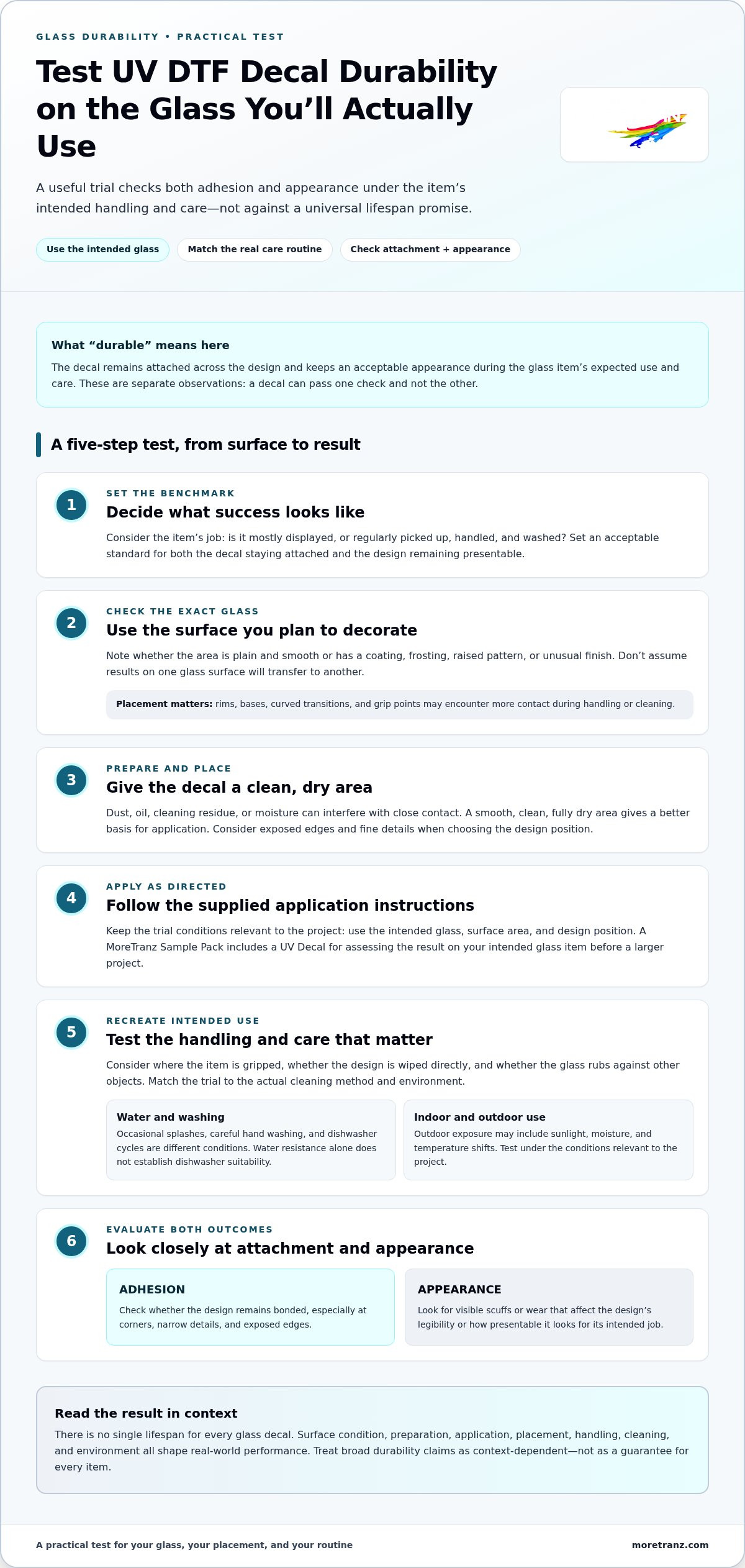
How to Apply and Care for UV DTF Decals on Glass
A careful application starts before the decal touches the glass. Plan the placement, follow the product’s supplied instructions, and test your intended cleaning routine on a representative sample before decorating a larger batch. These steps help you catch practical issues early, but they can’t guarantee a particular lifespan.
Prepare the glass and apply the decal carefully
Use this sequence to keep the process controlled:
- Check the glass. Choose a smooth area that suits the design and the item’s use. Look for coatings, texture, or curves that could make placement difficult.
- Clean and dry the area. Remove dust and residue, then make sure the application area is fully dry. Follow the product instructions for any specific preparation guidance.
- Plan the position. Hold the decal in place before applying it. Check alignment from different angles, and avoid placing it where hands or routine cleaning will repeatedly rub it.
- Apply as directed. Follow the supplied application instructions, working carefully and gradually to maintain alignment and avoid trapping air. Don’t substitute guessed pressure, timing, or other technical settings for the product directions.
- Inspect the result. Check the design and its edges for visible lifting, bubbles, or misalignment. If something looks off, consult the instructions rather than improvising a correction.
For product-specific steps, use the MoreTranz application instructions. A small test on the same type of glass is especially useful if the surface is curved, coated, or different from one you’ve applied decals to before.
Build a care routine around the intended use
Before regular use, let the application settle as directed in the product instructions. Then inspect the edges and overall appearance. Note the starting condition so you can compare it after the item has gone through the handling and cleaning routine you expect.
Keep care gentle unless specific product guidance supports another method. Avoid scraping the design, rubbing it aggressively, or assuming that a broad water-resistance claim establishes dishwasher suitability. If the glass will be washed regularly, test the intended method on a sample first. After cleaning, check for edge changes, visible wear, or shifts in appearance.
For a fair test, use the same glass type, placement, and care routine planned for the finished project. A display piece and frequently handled drinkware won’t provide equivalent results. Testing won’t predict every future condition, but it gives you a more relevant basis for deciding whether the application and care approach suit your use.
The durability of UV DTF on glass depends partly on what happens after application. Apply with care, follow the product directions, and treat your test as guidance for your project, not as a universal performance guarantee.
Test MoreTranz UV DTF Decals on Glass Before Your Next Project
A sample test turns general durability guidance into evidence for your project. The Transfers by MoreTranz Sample Pack includes UV Decals, giving you a practical way to assess one on the type of glass you plan to decorate. It won’t establish a universal lifespan or guarantee how every item will perform. It can help you decide whether the result suits your intended use before you commit to a larger run.
What to evaluate in a glass sample test
Choose a representative glass item, not just any convenient surface. Match the glass finish, shape, and decal placement as closely as possible to the final project. A test on a flat, smooth section may not tell you how the decal will behave on a curved or coated area.
Apply the sample according to its supplied instructions, then note the conditions. Keep a simple record of:
- The type of glass and the area where you placed the decal.
- How the item is handled, displayed, or stored.
- The cleaning method you intend to use.
- Any changes you observe in adhesion, edges, color, or surface appearance.
Compare the decal with its original condition after the item has experienced your planned routine. Look for edge lifting, visible wear, or changes that affect the design’s appearance. Don’t intentionally apply harsher treatment than the item will encounter just to force a result. The goal is a relevant, repeatable check of expected use.
Record what you did as well as what you saw. A result from one glass type, placement, and care routine applies to those conditions. It doesn’t prove the same outcome for another surface, design, or cleaning method.
Choose a next step based on the intended glass use
Set your pass criteria before testing. A display piece may need to retain a clean, polished appearance, while a gift or frequently handled item may need to remain presentable through its expected routine. For drinkware, focus the test on the specific handling and cleaning you plan, rather than assuming a result applies to every cup or wash method. If you’re exploring drinkware applications, Transfers by MoreTranz related guidance on UV DTF Decals for tumblers can provide additional context.
Transfers by MoreTranz is trusted by 14,000 creators. That’s social proof, not a durability test or a promise of how long a decal will last on your glass. Assess the sample on your intended item, follow the supplied instructions, and use your observations to make an informed project decision.
Put Your Glass Decal Plan to the Test
Turn your project goals into a clear standard for success. Before scaling up, decide what matters most for the finished item: a polished display, a gift that stays presentable, or a design made for regular handling. That gives you a practical way to judge the durability of UV DTF on glass without relying on a lifespan promise that may not match your use.
Use a sample to make your next decision with more confidence. Compare what you observe with the look and performance your project needs, then adjust your design or care approach if needed. A small, intentional test can help you move forward with a sharper plan and fewer assumptions.
Start your next glass project with a clear standard and a practical test. Get the MoreTranz Sample Pack to try a UV Decal on your intended glass item before moving to a larger project.
Frequently Asked Questions
Can UV DTF Decals be applied to frosted glass?
They may adhere differently to frosted glass than to smooth glass, so test before decorating the final item. Frosting creates a textured surface that may limit close contact in places, and the finish can vary between glass products. Try a sample on a discreet area with the same finish, then check whether the design transfers and stays in place under the intended handling. Follow the decal’s supplied application instructions.
Can you apply a UV DTF decal to the inside of a glass item?
Only consider an inside application if the product’s instructions support it and the decal won’t contact food, drink, or a person’s mouth. Inside placement can also change how the design is viewed through the glass, especially if the glass is curved or tinted. Don’t assume a decal intended for an outer surface is suitable for interior use. For drinkware, keep the design on the outside unless product guidance says otherwise.
Will a UV DTF decal stay durable on glass kept outdoors?
Outdoor performance depends on the specific glass, placement, and exposure, so there’s no universal lifespan to rely on. A sheltered sign and an item exposed to direct sun, rain, and changing temperatures face different conditions. The durability of UV DTF on glass outdoors is best assessed with a sample placed on the same type of glass and exposed in the same location. Observe its appearance and adhesion over your planned use period.
Can you remove a UV DTF decal from glass without damaging the surface?
Removal may be possible, but a damage-free result can’t be guaranteed for every glass surface or finish. Coatings, tinting, frosting, or other treatments may be more vulnerable than plain glass. Follow the decal’s removal guidance, and avoid scraping with sharp tools or applying solvents unless the glass maker’s care instructions allow them. If preserving a treated surface matters, test your removal approach on an inconspicuous area first.
Does decal size affect how well UV DTF adheres to glass?
Size alone doesn’t establish how well a decal will adhere. A larger design can be harder to position evenly, while a small design with fine details may require careful transfer. Glass curvature, surface preparation, and the amount of contact across the design also matter. For oversized or detailed artwork, test a representative section on the intended glass before applying the full design, and follow the product’s application directions.
Can UV DTF Decals be applied over an existing design on glass?
It’s generally more predictable to apply a decal to a clean, bare area than over another design. An existing print, raised detail, or coating can create an uneven surface and affect how the new decal sits. The underlying design may also show through or change the finished look. If layering is important to your project, test the exact combination first and inspect both the edges and appearance before repeating it.
What should you do if a UV DTF decal starts lifting at the edges?
Pause regular handling and cleaning so the lifted area doesn’t catch on cloth or other objects. Don’t pull at the edge or add glue, heat, or another product unless the supplied instructions specifically recommend that remedy. Check whether the glass or decal has residue, moisture, or wear nearby, then follow the product guidance for correction or removal. If the edge continues to lift, treat the test as a sign the application may not suit that use.