


How to Make Spangle Transfers Sparkle More: The Professional 2026 Guide
Why settle for a dull shimmer when your custom apparel could blind the competition with industrial-grade brilliance? Learning how to make spangle transfers sparkle more isn't just about aesthetics. It's about mastering the physics of light reflection and high-performance heat application. You've likely experienced the frustration of transfers that lose their luster after a single wash or designs that fail to pop against specific fabric textures. These technical failures drain your ROI and slow down your production cycles.
MoreTranz is here to help you master the technical secrets to maximizing light reflection and visual impact for your custom spangle apparel. This professional 2026 guide promises to transform your workflow by revealing the exact methodologies needed to achieve high-impact results that remain durable through every wash. We'll dive into the precise vector alignment and calibrated pressure settings trusted by 14,000 creators to dominate the market. You'll learn the strategic contrast techniques and thermal variables, such as the critical 300 degree Fahrenheit application window, required to ensure every design delivers maximum shimmer and professional-grade resilience.
Key Takeaways
- Master the physics of light reflection by using clean vector paths to ensure every holographic disc captures maximum brilliance.
- Learn how to make spangle transfers sparkle more by mastering the 'Density Secret' to balance spacing and visual impact.
- Secure industrial-grade durability and shine using firm pressure at 300°F followed by a strict cold peel process.
- Maximize your design's 'pop' by selecting high-contrast, dark fabrics that won't swallow the reflective output of your transfers.
- Achieve elite results by layering spangles over TrueColor® MAX 9-color DTF for a vivid, multi-dimensional finish trusted by 14,000 creators.
The Science of Shine: Why Some Spangle Transfers Sparkle More
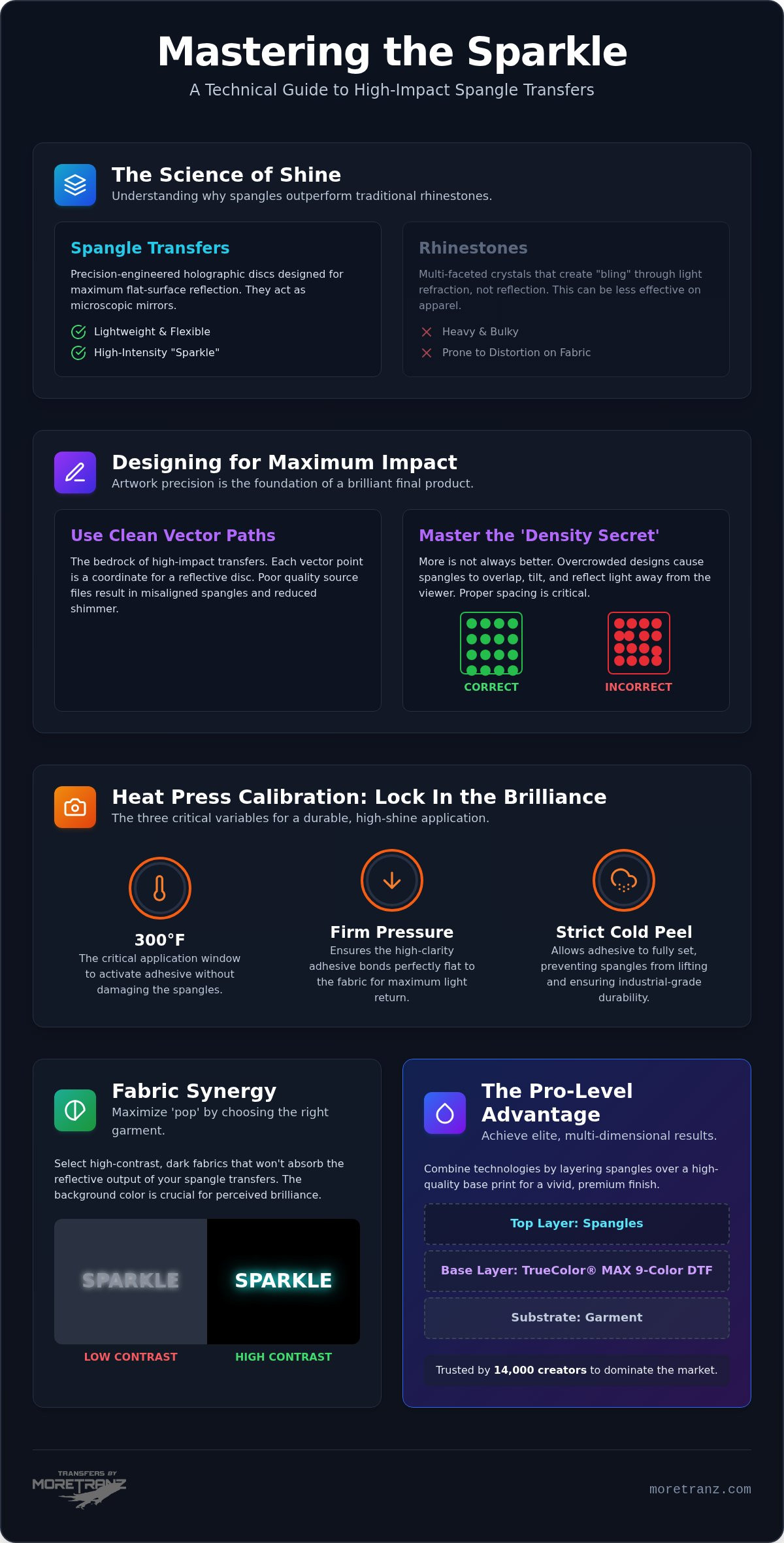
Spangle transfers are not just "flat rhinestones." They are precision-engineered holographic discs designed for maximum flat-surface reflection. While rhinestones rely on multi-faceted refraction to create "bling," spangles utilize their entire surface area to generate a distinct, high-intensity "sparkle." This fundamental difference in physics is why 14,000 creators have pivoted to Spangle Transfers as a lightweight, high-impact alternative. Understanding how to make spangle transfers sparkle more starts with recognizing that every disc acts as a microscopic mirror. If the surface isn't perfectly flat or the material quality is sub-par, your reflection dies on the garment.
The science is simple: more surface area equals more light bounce-back. Traditional hot-fix elements are often heavy and bulky, which can cause the fabric to sag and distort the angle of reflection. Spangles sit flush against the substrate. This flat profile allows for a broader angle of light return. When light hits a high-quality spangle, it doesn't just scatter; it projects. This creates a visual "throw" that is visible from across a stadium. To dominate the market, you must master the variables that influence this light return, from material selection to the technical precision of the application.
Holographic vs. Metallic Spangles
Your choice of material dictates the raw intensity of your output. Holographic spangles are the undisputed gold standard for visual impact. They feature microscopic laser-etched patterns that break white light into a full spectrum of color. This creates a shifting, rainbow-like shimmer that reacts to every movement of the wearer. Metallic finishes provide a different strategic advantage. They offer a solid, sophisticated shine that mimics polished chrome or gold. Use metallic for classic, high-end branding. Use holographic when your goal is total visual dominance. The "throw" of a holographic spangle is significantly higher, making it the primary choice for anyone focused on how to make spangle transfers sparkle more in high-energy environments.
The Role of the Adhesive Layer
Precision in the adhesive layer is the hidden variable in garment brilliance. Low-grade adhesives often "bleed" or "ooze" over the edges of the disc during the heat press cycle. This creates a dull, cloudy halo that kills the spangle's reflective edge. MoreTranz transfers utilize a proprietary, high-clarity adhesive that remains stable under industrial heat settings. It maintains a sharp, clean edge and ensures the spangle stays perfectly parallel to the fabric. If the adhesive is too thick or uneven, the spangle can tilt or sink into the fabric fibers. This disruption of the flat surface kills the light bounce. Maintaining a thin, high-clarity bond is essential for professional results that survive the wash without losing their luster.
Designing for Impact: Artwork Tweaks That Amplify Reflection
Clean vector lines are the bedrock of high-impact spangle transfers. If your source file is a low-resolution raster, your spangle placement will be erratic; this kills the uniform light reflection required for professional-grade shimmer. Mastering how to make spangle transfers sparkle more requires a shift from artistic flair to technical precision. Every point in your vector path acts as a coordinate for a reflective disc. When these coordinates are misaligned, the spangles don't sit flush. This creates microscopic gaps and shadows that swallow your design's brilliance before it ever leaves the heat press.
The "Density Secret" is the most overlooked factor in perceived brilliance. Many decorators believe that more spangles automatically equal more shine. This is a costly mistake. Overcrowded designs cause spangles to overlap or "tent" during the application process. An overlapping spangle is a tilted spangle, and a tilted spangle reflects light away from the viewer rather than toward them. You must maintain a precise gap between each disc to ensure they lay perfectly flat against the substrate. This flat orientation is what allows 14,000 creators to achieve that signature MoreTranz "throw" of light. If you want to maximize impact, focus on clean spacing that allows each holographic disc to perform as an individual mirror.
Ensure your files are production-ready by utilizing our professional Vector Conversion Service to guarantee every disc hits its mark. This service eliminates the guesswork, turning blurry logos into high-definition blueprints for maximum sparkle.
Optimizing Spangle Size for Design Detail
Spangle size dictates the shimmer frequency of a garment by determining how many individual light-reflecting points occupy a square inch of fabric. 3mm spangles offer a larger surface area, which translates to a more powerful, singular flash of light. 2mm spangles are better for intricate detail and create a tighter, more rapid "twinkle" effect. High-performance brands often mix these sizes. Use 3mm discs for the core of your design to anchor the reflection, then utilize 2mm accents to add depth and texture. This multi-layered approach is a proven strategy for how to make spangle transfers sparkle more across different viewing distances.
Path Simplification for Heat Press Precision
Complex raster images fail where clean vectors succeed because they lack the mathematical certainty required for spangle placement. Path simplification removes unnecessary nodes that cause the spangle machine to stutter or misplace discs. The connection between path accuracy and spangle flatness is absolute. A simplified path ensures that every spangle is seated in its optimal position, preventing the "crowding" that leads to dullness. MoreTranz artwork services specialize in prepping your files for 100% sparkle efficiency, ensuring your designs are optimized for rapid fulfillment and maximum visual dominance.
Heat Press Calibration: Locking in the Brilliance
Precision calibration of your heat press is the final technical hurdle in the production cycle. Even the most perfect vector art fails if the physical application is flawed. Mastering how to make spangle transfers sparkle more requires a strict adherence to the "Golden Rule" of spangle pressure: it must be firm and perfectly even. Without industrial-grade pressure, the spangles sit loosely on top of the fabric fibers. This unstable foundation allows the holographic discs to shift or tilt, which creates a scattered, chaotic reflection instead of a unified burst of light.
Temperature control is equally critical for 14,000 creators who demand professional-grade results. Excessive heat is the silent killer of brilliance. If you "over-cook" a holographic spangle, you risk liquifying the microscopic reflective coating. This process turns a high-intensity mirror into a dull, greyed-out circle that no longer reacts to light. You are looking for the exact window where the adhesive reaches its flow point without compromising the integrity of the disc. For detailed technical specifications on 2026 application standards, consult our Spangle Transfers collection to ensure your equipment is dialed in for maximum output.
The Pressure-Sparkle Correlation
High pressure ensures that every spangle is forced flush against the substrate. This creates a flat, consistent plane of reflection across the entire design. If your press has cold spots or uneven platens, you will see "dull patches" where the light doesn't catch quite right. This is often caused by "tilted spangle syndrome," where discs are applied at varying angles. Test your press regularly with pressure-sensitive strips. A perfectly level application is the only way to ensure that your finished garment delivers the visual throw required to dominate the market.
Temperature and Timing Precision
The standard benchmark for MoreTranz spangle tape is 300°F for 15 seconds. This specific window activates the clear adhesive layer while protecting the holographic surface. Beware of the "finishing press" trap. While a second press is common in DTF workflows, doing so with spangles without a protective barrier can flatten the texture and dull the shine. Always use a high-quality Teflon sheet to shield the holographic layer from direct metal contact. This simple step preserves the factory-fresh luster and ensures your design maintains its peak reflective intensity through repeated wash cycles.
A strict cold peel is non-negotiable. Peeling while the adhesive is still warm can pull the spangle slightly away from the fabric, disrupting its flat orientation. Wait for the transfer to be completely cool to the touch. This locks the spangle in its optimal reflective position, providing the high-impact visual results that help you understand how to make spangle transfers sparkle more than any standard market alternative.
Fabric Synergy: Selecting Garments That Make Spangles Pop
The substrate you choose is the silent partner in your design's visual performance. Background absorption is a real technical hurdle. If you want to understand how to make spangle transfers sparkle more, you must first master the contrast ratio. Dark, high-contrast fabrics like black, deep navy, or charcoal act as a visual "frame" for holographic discs. This dark backdrop prevents light from scattering behind the transfer, forcing the viewer's eye to focus entirely on the reflected spectrum. 14,000 creators have found that placing silver or iridescent spangles on white or light grey garments often results in a washed-out appearance. The light background competes with the spangle's reflection, significantly reducing the perceived brilliance of the output.
The "Texture Trap" is another critical factor that can kill your shine before the garment even leaves the press. Loose knits, such as heavy pique polos or open-weave hoodies, have microscopic "valleys" between the threads. These valleys cause the spangles to settle at uneven angles, disrupting the flat-surface reflection we discussed in earlier sections. For the flattest mounting surface, high-performance decorators prefer smooth polyester or tight-knit ring-spun cotton. Polyester is particularly effective because it lacks the natural fuzzy fibers found in lower-grade cotton that can interfere with the adhesive bond. Check our comprehensive guide on Transfer Types to ensure your garment choice aligns with your specific sparkle goals.
Explore our fabric compatibility guides for maximum spangle impact
The Contrast Ratio Explained
Color theory is a powerful tool for maximizing visual "pop." Silver spangles provide the highest "throw" of light, but they require a dark substrate to reach peak intensity. If you are working with lighter garments, consider using high-saturation spangle colors like royal blue, emerald, or red to maintain visibility. Matching the spangle tone to the garment's undertone creates a sophisticated, multi-dimensional effect. However, for sheer industrial-grade brilliance, the rule remains: the darker the fabric, the more intense the sparkle. This contrast is the primary secret to how to make spangle transfers sparkle more in high-traffic retail environments.
Managing Fabric Stretch
High-stretch fabrics like Spandex or Lycra present a unique challenge for spangle alignment. When the garment is worn and stretched, the distance between the spangles increases, which can create a "gapped" look that diminishes the solid wall of shimmer. Pre-pressing is non-negotiable here. A 5-second pre-press removes residual moisture and flattens the fabric fibers, creating a stabilized surface for the transfer. Tight-weave fabrics are the superior choice for high-sparkle transfers because they provide a stable, non-porous foundation that prevents the discs from sinking or tilting during the heat application process.
Professional-Grade Bling: The MoreTranz Mixed-Media Advantage
The elite frontier of garment decoration isn't found in a single medium; it's found in the "Hybrid Design." Serious brands are no longer treating spangles as a standalone element. Instead, they are layering them over high-definition prints to create multi-dimensional masterpieces. This technical evolution is the definitive answer to how to make spangle transfers sparkle more. By utilizing a vivid, high-gamut base layer, you provide a chromatic anchor that makes the holographic reflection of the spangle feel deeper and more intentional. This isn't just decoration. It's industrial-grade visual dominance designed to capture attention in high-velocity retail environments.
Beyond apparel, 14,000 creators are expanding their brand footprint by coordinating their textile designs with hard-surface accessories. Using UV DTF Decals allows you to apply the same high-intensity branding to tumblers, equipment, and electronics. When your apparel spangles catch the light alongside a matching high-gloss decal, the perceived value of your entire collection skyrockets. MoreTranz facilitates this rapid scaling by offering a professional-grade toolkit that prioritizes speed, precision, and technological superiority.
TrueColor® MAX vs. TrueColor®
The secret to a successful hybrid design lies in the color gamut of your base layer. While our standard TrueColor® technology provides exceptional clarity and professional results, TrueColor® MAX utilizes a proprietary 9-color technology that delivers a wider, more vivid spectrum. When you use TrueColor® MAX as the "base" and spangles as the "highlight," the result is a retail-quality garment that commands a premium price point. The 9-color output provides the necessary contrast to ensure your spangles don't just sit on the fabric but actually "pop" against a background of high-definition color.
- Vivid Backdrops: Use 9-color ink sets to create gradients that complement holographic shifts.
- Strategic Layering: Apply the transfer first, then seat your spangles in the "open" vector paths for a flush, professional finish.
- Market Differentiation: Offer textures and visual depths that traditional methods cannot replicate.
Scaling Your Brand with MoreTranz
Execution speed is the ultimate competitive differentiator for modern entrepreneurs. We eliminate the barriers to entry with a "no minimums" policy, allowing you to test high-sparkle, mixed-media designs without financial risk. If you want to see the difference between standard shine and industrial brilliance, leverage our MoreTranz Sample Pack to benchmark our quality against your current output. Join the 14,000 creators who have already discovered how to make spangle transfers sparkle more by partnering with a tech-forward facilitator. We don't just provide transfers; we provide the high-performance components required for your brand to dominate the 2026 marketplace.
Dominate the Market with Industrial Brilliance
Mastering the technical variables of light reflection is the only way to ensure your brand stands out in a crowded marketplace. You now have the professional roadmap for how to make spangle transfers sparkle more through precise vector pathing, strict thermal calibration, and high-contrast fabric selection. By integrating these elite methods with our proprietary TrueColor® MAX technology, you can create multi-dimensional, high-impact apparel that commands premium retail prices.
MoreTranz is your high-performance partner for rapid fulfillment and technical success. We're already trusted by 14,000 creators who prioritize quality and speed. With no minimum order requirements and fast national shipping from our Georgia facility, you can test new designs and scale your production without the typical industry bottlenecks. It's time to stop settling for standard shine and start delivering the visual intensity your customers demand.
Ready to outshine the competition? Order your custom Spangle Transfers from MoreTranz today!
Your journey toward technical dominance starts with a single, high-performance transfer. We're ready to help you light up the industry and maximize your creative potential.
Frequently Asked Questions
How do I make my spangle transfers look like real rhinestones?
Achieve a rhinestone like effect by using holographic spangles that break light into a full spectrum. While rhinestones use multi faceted refraction, spangles rely on a larger flat surface area to project light. This creates a high intensity sparkle that mimics the bling factor without the weight or bulk of traditional stones. Using 2mm spangles can also mimic the tighter twinkle of small rhinestones for detailed work.
Can I wash garments with spangle transfers without losing the sparkle?
Industrial grade spangle transfers are highly durable and survive repeated wash cycles when applied at 300 degrees Fahrenheit. The key to maintaining shine is ensuring the adhesive bond is fully activated without melting the reflective coating. 14,000 creators trust this process to deliver long lasting brilliance that won't flake or dull over time. Always turn the garment inside out before washing to protect the holographic surface from abrasion.
What is the best heat press temperature for spangle transfers?
The 2026 industry standard for MoreTranz spangle transfers is 300 degrees Fahrenheit for 15 seconds. Use firm, even pressure to lock the discs into the fabric fibers. Always follow with a strict cold peel to ensure the holographic layer remains perfectly flat and reflective. Inaccurate temperature settings are the leading cause of dullness, so calibrate your equipment regularly to maintain professional grade output.
Why are my spangles looking dull after I press them?
Dullness is usually the result of excessive heat or uneven pressure. If you over cook the transfer, the microscopic holographic coating can liquify and lose its reflective properties. Learning how to make spangle transfers sparkle more often involves calibrating your press to avoid these high temperature pitfalls. Additionally, ensure you aren't using a second finishing press without a protective Teflon sheet, as direct heat can flatten the texture and kill the shine.
Do spangle transfers work better on light or dark fabrics?
Dark fabrics like black or navy are the superior choice for maximizing visual impact. These substrates absorb light behind the transfer, which forces the spangles to stand out with higher contrast. Silver spangles on light garments often look washed out because the background competes with the reflection. If you must use light fabrics, select high saturation spangle colors to maintain the necessary contrast ratio for a professional finish.
What is the difference between spangles and Glitter DTF Transfers?
Spangles are individual holographic discs that offer a flat, mirror like reflection. Glitter DTF Transfers utilize textured particles embedded in the ink to create a multi directional twinkle. Spangles provide a more powerful, singular flash of light, making them the preferred choice for high intensity stage or retail wear. Understanding how to make spangle transfers sparkle more involves mastering the flat surface physics that Glitter DTF doesn't require.
How do I ensure my spangles lay perfectly flat for maximum reflection?
A 5 second pre press is essential to remove moisture and flatten the fabric weave. This creates a smooth foundation for the adhesive. Once the transfer is positioned, industrial grade firm pressure ensures every disc sits perfectly parallel to the garment surface. If the spangles tilt or sink into a loose knit, they will reflect light away from the viewer, resulting in a dull and inconsistent appearance.
Can I combine spangle transfers with TrueColor® MAX DTF prints?
Hybrid designs are a major trend for 14,000 creators looking to dominate the market. You can layer spangles over a TrueColor® MAX base to create a vivid, 9 color backdrop that makes the holographic accents pop. This mixed media approach results in retail quality apparel that commands a much higher price point. The expanded color gamut of TrueColor® MAX provides the perfect high definition anchor for reflective spangle highlights.