


Print on Demand Alternatives for Etsy Sellers: Compare Your Options
The most hands-off Etsy production model may give you the least control. If you’re comparing print on demand alternatives for Etsy sellers, the key decision isn’t just which provider to choose. It’s which production tasks you want to own.
A conventional POD service can simplify printing and shipping, but it may give you less direct oversight of production quality. The differences between a POD platform, transfer-based production, and making products in-house can also be hard to weigh when you’re considering equipment, labor, and fulfillment.
This guide compares those models by creative control, workload, production investment, and shipping responsibilities. You’ll see how transfer-based production works, including sourcing apparel, pressing transfers, and managing packing and fulfillment. Then you can identify a small, low-risk way to test a new workflow before changing how your whole Etsy shop operates.
Key Takeaways
- Print on demand alternatives for Etsy sellers include other fulfillment platforms, transfer-based production, and in-house printing. Compare who handles production and shipping before choosing a model.
- Separate design tools from production suppliers and fulfillment services so you know which parts of your workflow each option covers.
- Assess control, inventory, customization, workload, and dispatch responsibilities to identify the trade-offs that matter most to your shop.
- Before switching, identify your biggest production bottleneck, test a limited workflow, and check whether your artwork, packaging, and capacity are ready.
- With transfer-based production, Transfers by MoreTranz supplies transfers, while you provide apparel and manage pressing, quality checks, packing, and fulfillment.
What Etsy sellers mean by print-on-demand alternatives
A print-on-demand alternative is a different way to produce, source, or fulfill Etsy orders. It doesn’t automatically mean leaving Etsy or changing where customers shop. It means changing who handles some part of the work after a customer places an order.
Outsourced fulfillment means a provider produces the item and handles shipping. Transfer-based self-fulfillment means you buy a printed transfer, apply it to apparel you supply, then inspect, pack, and ship the finished order yourself. These models shift different amounts of work and control to the seller.
Keep the roles distinct. Design software helps you create artwork or product mockups, but it doesn’t make or ship a physical item. A production supplier provides a product or input, such as a transfer. A fulfillment platform coordinates production and dispatch. A seller-managed workflow puts production and order handling in your hands.
That distinction matters when searching for print on demand alternatives for Etsy sellers. A design tool isn’t a replacement for a fulfillment provider, and a transfer supplier doesn’t automatically fulfill Etsy orders. First decide which part of the workflow you want to change.
Which part of the Etsy workflow are you replacing?
Map the order from start to finish: prepare the design, source the product, produce it, pack it, ship it, and respond to customer questions. Then ask whether you want to replace a provider or take ownership of production. Replacing a provider may preserve a hands-off model. Taking ownership of production gives you more direct involvement, along with more tasks to plan and manage.
The main alternatives Etsy sellers can compare
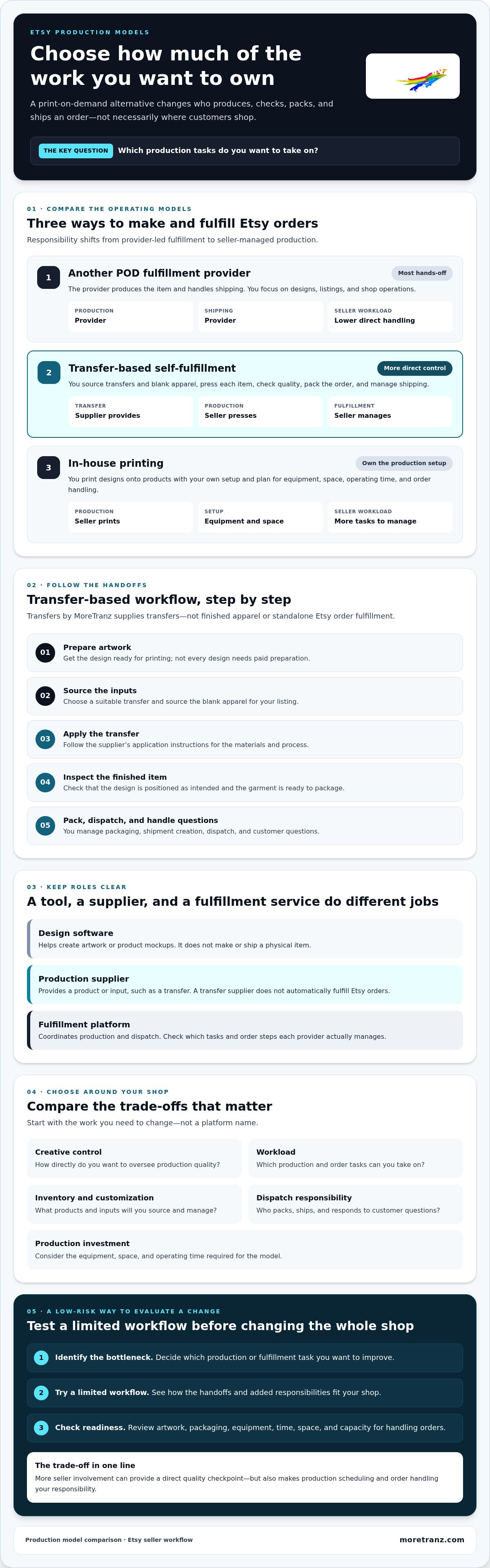
Start with the operating model, not a platform name. Each option places production and fulfillment responsibility in a different place:
- Another POD fulfillment provider: The closest like-for-like alternative. The provider handles production and shipping, while you focus on designs, listings, and shop operations. Confirm which tasks and order steps the provider actually manages.
- Transfer-based production: You source transfers and blank apparel, apply each transfer, inspect the result, then pack and ship orders. MoreTranz supplies DTF and specialty transfers, not finished apparel or standalone POD fulfillment.
- In-house printing: You print designs onto products using your own production setup. This can give you direct control over production, but it also requires equipment, space, operating time, and a plan for handling orders as they come in.
Compare the handoffs, not just the tools. Who sources the blank? Who produces the item? Who catches quality issues before dispatch? Those answers show whether an option solves your actual bottleneck or simply moves the work elsewhere.
How transfer-based production changes an Etsy seller's workflow
Transfer-based production shifts the final manufacturing and fulfillment steps to you. Instead of a provider producing and shipping each finished item, you source transfers and blank apparel, apply the design, inspect the result, and send the order to your customer. You gain a direct quality checkpoint, but your production schedule and order handling are also your responsibility.
MoreTranz supplies DTF and specialty transfers. It doesn’t sell finished apparel or provide Etsy order fulfillment. You provide the blanks and manage pressing, quality checks, packaging, and shipping. Before committing, consider whether you have the equipment, time, and space to handle those tasks consistently as orders arrive.
A practical order workflow using DTF transfers
Start with artwork prepared for printing, then choose a transfer format that fits your product and design. You can explore available DTF transfer types before selecting what to order. Next, source apparel that suits your listing and review the transfer supplier’s application instructions for the materials and process involved.
When a customer orders, locate the right blank and transfer, apply the transfer according to its instructions, and inspect the finished garment before it leaves your workspace. Check that the design is positioned as intended and that the item is ready to package. Then pack it, create the shipment, and manage dispatch and any customer questions yourself. Unlike provider-led POD, this workflow doesn’t hand those steps to a fulfillment partner.
Where artwork preparation and gang sheets fit
Artwork preparation happens before production. If your file is print-ready, you may be able to use it as supplied; not every design needs paid preparation. If artwork needs adjustment, services such as vector conversion or background removal may help address specific file issues. Plan this stage early so artwork questions don’t interrupt order production.
A gang sheet lets you arrange multiple designs together on one sheet of transfers. For example, you might group different graphics for a small apparel range, then use the designs as orders call for them. Organizing artwork this way can help you plan production, but you’ll still handle application and fulfillment for each customer order. To arrange grouped designs, explore the DTF gang sheet builder.
Transfer-based production can be a way to test more hands-on control without setting up your own printing operation. If you want to assess transfer quality before building that workflow, consider trying the MoreTranz Sample Pack first.
Compare Etsy POD alternatives by control, workload, and fulfillment
The best fit depends on which tasks you want to keep and which you’re ready to take on. More production control usually means more operational work: sourcing materials, producing each item, checking quality, and getting orders out the door. Use this comparison to see the trade-offs before changing your workflow.
| Model | Production responsibility | Inventory | Customization | Dispatch |
|---|---|---|---|---|
| Another POD fulfillment provider | Provider produces the item, subject to its process and product range. | Usually tied to the provider’s available blanks and catalog. Confirm what’s offered. | Depends on available products and print options. | Provider may handle shipping. Check service terms and order responsibilities. |
| Transfer-based self-fulfillment | You apply transfers to apparel you source, then inspect each item. | You source and manage blank apparel and transfers. | You control design placement and product checks within the transfer and blank options you choose. | You package and ship each order. |
| In-house printing | You operate the printing workflow and produce items yourself. | You source and manage blanks, supplies, and any materials your process requires. | You control production within your equipment, skills, and chosen materials. | You package and ship each order. |
These are operating-model differences, not guarantees about a particular provider. When comparing print on demand alternatives for Etsy sellers, verify the details that affect your shop directly, especially Etsy connectivity, product suitability, production-partner policies, and fulfillment terms. A provider’s advertised features may not answer every seller-specific question.
When another POD fulfillment provider makes sense
Choose this route if your priority is keeping production and order processing outsourced. It can preserve a hands-off workflow while letting you evaluate a different provider’s products or terms. Before switching, check current Etsy connectivity, whether the product fits your listings, what the provider handles, and what you remain responsible for. Confirm the details against your shop’s needs, not just the provider’s general claims.
When transfers or in-house printing make sense
Transfers suit sellers who want to apply designs themselves and inspect the finished apparel before it ships. You take on blank sourcing, pressing, packaging, and dispatch, but gain a direct production checkpoint. For boutique creators looking to develop proprietary garments rather than relying on standard off-the-shelf blanks, you can visit PowerSweet Fashion to explore custom clothing manufacturing. MoreTranz supplies transfers, not finished apparel or Etsy fulfillment. Explore DTF transfer types to compare relevant formats.
In-house printing is a separate step up in production ownership. Before choosing it, assess equipment, workspace, production skills, and the recurring work required to keep orders moving. Choose the model whose workload you can reliably manage, not simply the one that promises the most control.
How to choose an Etsy POD alternative without disrupting orders
Change one part of your workflow at a time. A deliberate transition helps protect open orders while you find out whether a new production model solves the problem you’re actually facing. Use this sequence: identify the bottleneck, rank your priorities, test the revised process, then expand only when it’s manageable.
Set decision criteria before switching
Start by naming the pressure point. Is it limited quality control, a product that doesn’t fit your shop, or too much time spent handling orders? Then rank what matters most: production control, product consistency, personalization, your available time, and who fulfills orders. A model that scores highly on control may also require more hands-on work.
Check capacity in practical terms. How much time can you reliably set aside for artwork, sourcing blanks, production, inspection, packaging, shipping, and customer questions during a typical week? Account for busy periods and interruptions. Don’t plan around an ideal week. Choose a workflow you can maintain when other shop tasks compete for your attention.
Before committing to a provider or process, verify current Etsy connectivity, order handoffs, provider policies, and fulfillment terms using your own seller account details. Confirm how orders are received, what information you must supply, how tracking is handled, and which customer-service tasks stay with you. Integration and workflow details can change, so check them directly rather than relying on general marketing claims.
Pilot the alternative before moving every listing
Choose a small selection of designs for an initial test. Review the finished product for design placement, consistency, and overall presentation. If file preparation is a real obstacle, MoreTranz offers artwork services. Sellers with print-ready files may not need this step.
For a hands-on workflow, write down each production step as you perform it: prepare the artwork, match the transfer and blank, press according to the supplied instructions, inspect, package, and dispatch. Note where delays or mistakes occur. This gives you a repeatable process to refine before adding more listings.
Keep order promises realistic while learning. Set aside time for production and customer communication, and avoid expanding faster than your capacity allows. Once the test shows that quality, workload, and fulfillment steps fit your shop, scale gradually. This makes comparing print on demand alternatives for Etsy sellers a controlled decision, not an all-at-once switch.
Test transfer-based production with MoreTranz before scaling
MoreTranz supplies custom DTF and specialty transfers for sellers who want to produce apparel themselves. Its offerings include DTF transfers, gang sheets, and artwork services, with no minimum order requirements. MoreTranz serves 14,000 creators. It doesn’t sell finished apparel or fulfill Etsy orders: you supply the blanks and manage pressing, quality checks, packaging, and shipping.
That division of responsibility is central to choosing among print on demand alternatives for Etsy sellers. Transfer sourcing gives you a hands-on quality checkpoint, but you also own the production routine. Test the workflow with a limited design selection before committing more listings or order volume to it.
What to evaluate in a transfer sample
Assess the sample against the product you plan to sell. Look at how the colors appear, whether fine design details are clear, and how the applied transfer looks on your intended apparel. Follow the current application instructions for the specific transfer you select. Don’t assume one set of settings or steps applies to every product.
Also evaluate the work involved. Can you reproduce the application and inspection process consistently? Does the finished item match the quality you want customers to receive? A sample can help you review the transfer and practice the workflow before you build it into regular order handling. Use the MoreTranz Sample Pack to test transfer quality.
Choose your next step based on the workflow you want
If minimizing hands-on production is your top priority, outsourced fulfillment may suit your workflow better. If you want to control pressing and inspect apparel yourself, transfer sourcing is worth evaluating. Make the decision based on your available time, equipment, space, and ability to handle packing, dispatch, and customer questions, not on the assumption that one model is automatically more profitable.
Once you’ve tested a transfer, record the steps and time involved, including sourcing the blank, preparing the design, pressing, inspection, packaging, and shipping. Use that review to decide whether to refine the process, try another design, or keep production outsourced. Scale only when the responsibilities fit the way you run your Etsy shop.
Choose the workflow you can run with confidence
The best print on demand alternatives for Etsy sellers depend on the work you want to own. Another POD provider can keep production and shipping outsourced. Transfer-based production gives you a hands-on quality checkpoint, but you’ll source blanks, press transfers, inspect finished items, and manage fulfillment. In-house printing adds direct production control along with equipment and ongoing workflow demands.
Make the decision practical: identify your biggest bottleneck, check how much production time you can reliably manage, and test a small batch before shifting more listings. MoreTranz supplies custom transfers and gang sheets, with no minimum order requirements. It serves 14,000 creators. If you’re considering a hands-on apparel workflow, evaluating a sample can help you assess transfer appearance and application before you scale.
Start with a manageable test, learn from the process, and expand only when the workflow fits your shop. A thoughtful change can put you in control without taking on more than you’re ready to handle.
Frequently Asked Questions
What are the best print-on-demand alternatives for Etsy sellers?
The best print on demand alternatives for Etsy sellers depend on which production tasks you want to own. Another POD provider can keep production outsourced; transfer-based production puts pressing and order checks in your hands; in-house printing adds direct control and equipment responsibilities. Compare product fit, current Etsy workflow compatibility, fulfillment duties, and the time you can commit. Test a limited group of designs first, then expand only if the process works for your shop.
Can I sell on Etsy using DTF transfers instead of a POD service?
Yes. You can source DTF transfers, apply them to suitable blank apparel, inspect the finished items, then package and ship orders yourself. This is self-fulfillment, not outsourced POD: you’re responsible for production and order handling. Check the current application instructions for your specific transfer and test it on the apparel you intend to sell. MoreTranz supplies transfers, not finished clothing or Etsy order fulfillment.
Is MoreTranz a print-on-demand platform for Etsy?
No. MoreTranz supplies custom transfers, gang sheets, and related artwork services, but it isn’t a standalone Etsy-integrated fulfillment platform and doesn’t sell finished apparel. If you use its transfers, you’ll source the blanks, apply the transfers, inspect the finished items, and fulfill customer orders. This model may suit sellers who want a hands-on production role, but it doesn’t remove the work of making and shipping each order.
How much does it cost to switch from POD to self-fulfillment?
There’s no single switching cost that applies to every Etsy seller. Your budget depends on the workflow you choose and may need to account for transfers, blank apparel, equipment, packaging, shipping, and your production time. For self-fulfillment, investing in dedicated dispatch equipment such as shipping label printers from DymoOnline can help keep order packing streamlined and accurate. Check current supplier terms and estimate the full process, not just the transfer expense. A small test batch can help you identify what your workflow requires before you commit to larger-scale production.
What happens if I switch POD providers while Etsy orders are active?
Existing orders still need to be fulfilled according to the commitments you’ve made to customers. Before switching, review open orders, provider terms, listing settings, and current integration steps. Avoid changing every listing at once. Test the replacement process with a small selection of products, document each handoff, and leave room in your schedule to handle questions or delays as you learn the new workflow.
Do I need a heat press to use DTF transfers for Etsy products?
DTF transfers require a heat application process, so you’ll need access to suitable equipment and must follow the instructions for the specific transfer. Requirements can vary by product and material, so don’t assume one setting works for every combination. Review the supplier’s current application guidance and test the transfer on your intended apparel before offering that product to customers.
Can I use MoreTranz transfers with any Etsy product or fabric?
Don’t assume a transfer is suitable for every product or fabric. Check the instructions for the specific transfer and confirm that your chosen blank is appropriate before production. Test a sample on the apparel you plan to sell, then inspect the result before listing it. MoreTranz supplies transfers; you select the blanks and remain responsible for application, quality checks, and fulfilling completed orders.