

Professional Custom Shirts: 2026 Heat Transfer Guide
Your heat press isn't the primary reason your shirts look amateur. It's your transfer technology. Choosing the best heat transfers for professional shirts determines whether your brand scales or fails after the first wash. Most creators blame their equipment for cracking logos and dull colors. The real bottleneck is often a low-tier transfer that simply cannot handle the rigorous demands of 2026 retail standards.
You want your apparel to feel like it came off a premium retail rack, not a hobbyist's basement. You're tired of visible white boxes around logos and prints that peel before the customer even wears them. This guide reveals the industrial-grade transfer technologies and precision artwork techniques that Transfers by MoreTranz provides to 14,000 creators to ensure every print is vibrant, durable, and professional. We'll break down the shift to TrueColor® and TrueColor® MAX systems, master the math behind high-resolution artwork, and optimize your production workflow for maximum ROI. Stop settling for home-made quality and start producing retail-ready apparel that justifies a higher price point.
Key Takeaways
- Identify the three pillars of professional apparel-garment quality, artwork precision, and industrial-grade transfer durability-to move beyond hobbyist results.
- Master the technical selection process by choosing the best heat transfers for professional shirts, focusing on the 9-color gamut of TrueColor® MAX for superior vibrancy.
- Avoid the reputation-damaging "Blurry Logo" trap by prioritizing high-resolution file architecture and professional vector conversion services.
- Shift your production mindset from simple ironing to industrial chemical bonding with consistent pressure for prints that never crack or peel.
- Scale your brand efficiently using DTF Gang Sheets to minimize waste and maximize profit margins like the 14,000 creators in the MoreTranz network.
The Anatomy of a Professional Custom Shirt
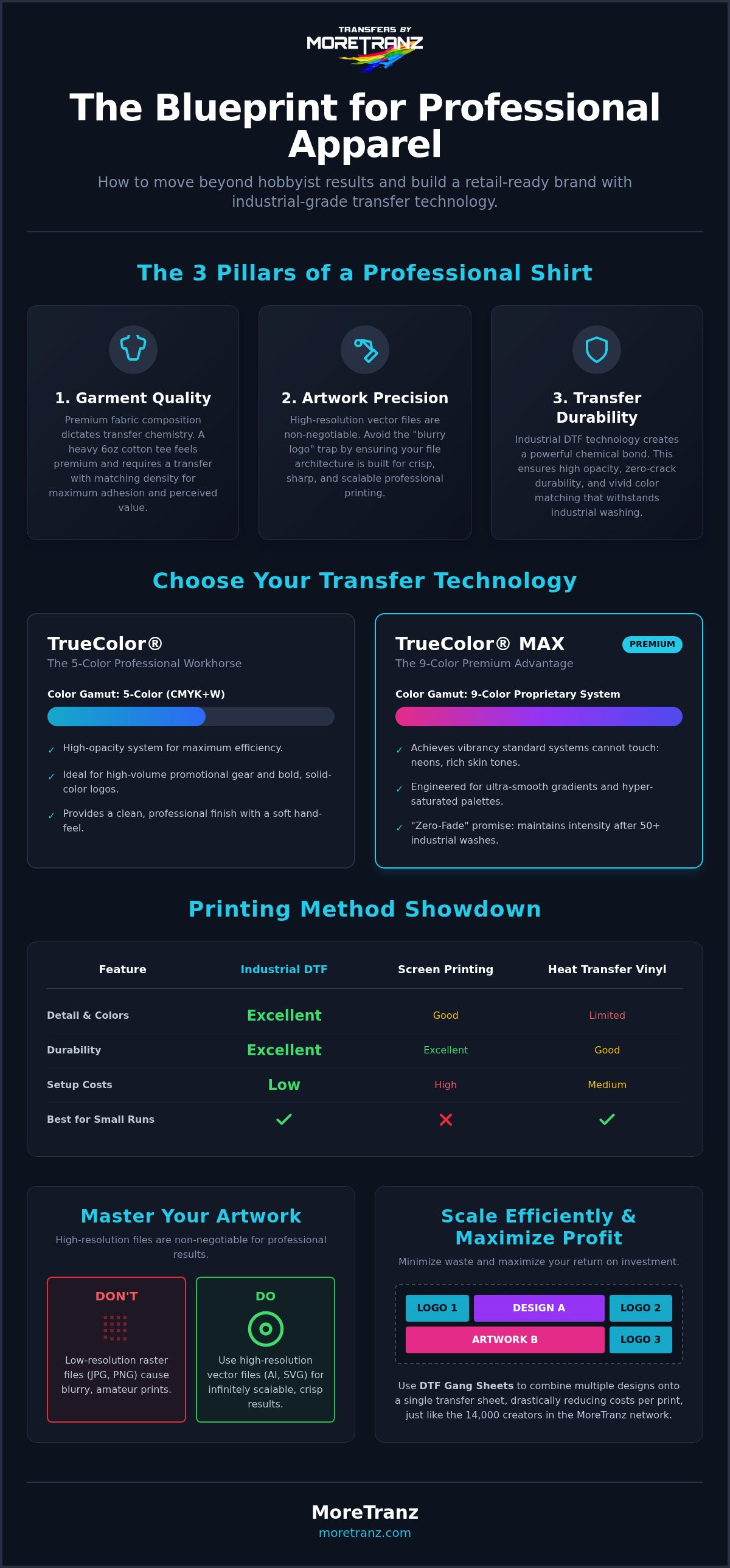
A professional shirt isn't just fabric and ink; it's an engineered product. When choosing the best heat transfers for professional shirts, you must evaluate the three pillars of success: garment quality, artwork precision, and transfer durability. If one fails, the brand fails. Retail-ready apparel requires a synergy between these elements to withstand the rigors of daily wear and industrial washing. You can't hide a poor transfer behind a premium garment, and a high-quality print won't save a low-grade shirt.
Ditch the craft-grade iron-ons found at local hobby shops. Those are designed for one-time events, not serious brands. Industrial Direct to Film (DTF) technology, utilized by 14,000 creators at MoreTranz, creates a powerful chemical bond between the ink and the fiber. This results in the 2026 retail standard: high opacity, zero-crack durability, and vivid color matching that remains consistent across thousands of units. Professionalism is also felt. A heavy, plastic-like shield on a chest is a sign of poor quality. High-end apparel requires a soft hand-feel. The print must remain flexible and breathable, moving with the wearer rather than resisting them. This level of quality is a hallmark of professional studios like Trilli Prints, which specialize in high-end custom apparel that meets these rigorous retail standards.
Garment Selection for High-End Results
Your fabric composition dictates your transfer chemistry. 100% cotton offers a natural bond; however, polyester blends require specific temperature and pressure controls to prevent dye migration. Fabric weight also influences perceived value. A heavy 6oz cotton tee feels premium, but only if the transfer has the density to match that weight. Matching technology like TrueColor® to specialized fabrics ensures maximum adhesion without compromising the garment's integrity. Always test your fabric's reaction to heat before committing to a full production run to avoid scorching or ghosting.
Comparing Professional Printing Methods
Screen printing was once the king of the shop, but DTF has revolutionized high-detail work. Choosing the best heat transfers for professional shirts allows you to execute complex, multi-color logos without the massive setup costs of screens. Unlike vinyl, which requires tedious weeding and offers limited colors, DTF provides superior color consistency. MoreTranz offers ready to press transfers that eliminate the mess of ink and the limitations of traditional methods. This efficiency makes small-to-medium production runs highly profitable and scalable for growing brands that need immediate results.
Choosing the Right Transfer Technology: TrueColor® vs. TrueColor® MAX
Success in the custom apparel industry hinges on the technical specs of your print engine. You don't just need a transfer; you need a proprietary chemical bond that survives the retail floor. MoreTranz established its transfer lines as the industrial benchmark, a standard now trusted by 14,000 creators nationwide. When you're choosing the best heat transfers for professional shirts, the decision usually comes down to the required color depth and the complexity of your artwork.
Standard market alternatives often fail because they rely on basic ink sets that can't replicate high-fidelity designs. Our technology is engineered for industrial resilience, ensuring neons stay bright and deep reds don't shift toward brown. We offer two distinct tiers to match your production needs and price points, allowing you to scale without sacrificing quality.
TrueColor®: The Reliable 5-Color Standard
This is the professional workhorse for everyday apparel. TrueColor® utilizes a high-opacity CMYK+W (5-color) system designed for maximum efficiency on standard cotton and polyester blends. It's the ideal choice for high-volume promotional gear and bold, solid-color logos. While traditional heat transfer paper often disintegrates after a few laundry cycles, TrueColor® is built to last. It provides a clean, professional finish with a soft hand-feel that exceeds the expectations of 14,000 creators who prioritize reliable, repeatable results.
TrueColor® MAX: The 9-Color Premium Advantage
For brands that refuse to compromise, TrueColor® MAX is the only viable solution. This premium line utilizes a proprietary 9-color gamut to achieve a level of vibrancy that standard 5-color systems cannot touch. It’s specifically engineered to hit difficult neons, rich skin tones, and ultra-smooth gradients that define high-end retail merchandise. If your artwork features complex shading or hyper-saturated palettes, this is your toolkit. We back this technology with a "Zero-Fade" promise, ensuring your designs maintain their visual intensity even after 50 industrial washes. You can explore our full range of industrial-grade transfer types to find the perfect match for your next high-performance project.
Master Your Artwork: Why High-Resolution Files Are Non-Negotiable
Output quality is a direct reflection of input architecture. If your source file is flawed, even the most advanced industrial printer cannot save the design. Professional apparel decoration follows a strict "garbage in, garbage out" rule. When choosing the best heat transfers for professional shirts, your artwork's technical foundation is the ultimate bottleneck. High-resolution files aren't just a suggestion; they're the requirement for achieving the precision edges and vibrant neons that 14,000 creators expect from MoreTranz.
The "Blurry Logo" trap is the fastest way to ruin your professional reputation. Raster files, like standard PNGs or JPEGs, are composed of fixed pixels. As you scale these images for large back-prints, those pixels stretch, creating jagged, "stair-step" edges. Amateur prints are easily identified by these blurry borders and muted details. Professional apparel demands clean, razor-sharp edges that look as intentional as the garment itself. Proper file preparation also ensures that the white-ink backing-the foundation of all DTF transfers-is applied with absolute accuracy, preventing any ghosting or misalignment during the press.
Vector vs. Raster: The Technical Divide
Vector files are the gold standard for professional branding. Built on mathematical paths rather than pixels, vectors offer infinite scalability without any loss in clarity. While a high-resolution PNG (300 DPI) is acceptable for small-scale chest hits, it fails when expanded to full-size graphics. When choosing the best heat transfers for professional shirts, you must prioritize file architecture over simple aesthetics. If you're working with low-resolution assets, our Vector Conversion Service is the industrial bridge you need. It transforms pixelated artwork into high-performance vector paths, ensuring your brand remains crisp at any size.
Background Removal and Transparency
Nothing signals "amateur" faster than the dreaded "white box" around a logo. This happens when a designer fails to properly remove the background, leaving a visible block of ink that ruins the garment's aesthetic. Achieving a professional "soft-hand" feel requires precise transparency layers. MoreTranz provides specialized Background Removal Services to handle complex photographic designs and intricate line work. This ensures that only the intended design is printed, allowing the fabric to breathe and the transfer to bond seamlessly with the fibers. Correct formatting prevents adhesive migration and ensures your TrueColor® MAX transfers look like they were woven directly into the shirt.
Professional Heat Press Techniques for Flawless Results
Stop thinking about your heat press as a simple iron. It's an industrial bonding tool. Professional apparel decoration requires a shift in mindset toward industrial chemical bonding. Choosing the best heat transfers for professional shirts is only half the battle; the application physics must be perfect to ensure wash-fast durability. A handheld iron cannot provide the consistent, heavy pressure required for retail production. 14,000 creators rely on calibrated equipment to ensure every print meets industrial standards. Use an infrared thermometer to verify that your platen heat is consistent across the entire surface. Cold spots lead to premature peeling and ruined reputations.
The Professional Pressing Protocol
- Step 1: Pre-press. Heat the garment for 5 seconds. This removes hidden moisture and flattens stray fibers for a smoother surface.
- Step 2: Alignment. Use laser guides or t-shirt rulers. Centered designs are the hallmark of professional branding.
- Step 3: Primary Press. Follow the specific time and temperature settings for TrueColor® MAX. Use heavy pressure to force the adhesive into the fabric weave.
- Step 4: Finishing Press. After peeling, perform a 5-second "Second Press" with a finishing sheet. This embeds the design deeper into the fibers and creates that sought-after retail soft-hand finish.
Troubleshooting Common Application Failures
Scorching is a common disaster on sensitive synthetic fabrics. If you see a heat ring, lower the temperature and increase the dwell time. When choosing the best heat transfers for professional shirts, you must match the heat settings to the garment's tolerance. Lifting usually isn't a heat issue; it's a pressure issue. If the edges don't stick, increase your press pressure before cranking up the heat. Maintain your equipment by cleaning the platen regularly. Built-up adhesive residue causes uneven heat distribution and can ruin your next 1,000 shirts. Consistent maintenance is the only way to ensure every order leaves your shop with retail-ready quality.
Scaling Your Brand with MoreTranz Efficiency
Scaling a brand requires more than just creative vision; it demands a high-performance partner capable of industrial-grade fulfillment. Choosing the best heat transfers for professional shirts is the first step toward building a sustainable, high-margin business model. Join the 14,000 creators who have already standardized their production on the MoreTranz platform. We provide the technical tools to transition from a small-scale shop to a high-output brand without the traditional overhead or mess of screen printing. Our "No Minimum" advantage allows you to test new designs with a single sheet before committing to bulk production. This ensures your capital is always invested in market-validated products.
Branding in 2026 doesn't stop at the hem of a shirt. Serious entrepreneurs leverage UV DTF Decals to expand their visual identity onto tumblers, electronics, and hard-surface equipment. These decals provide the same visual intensity and physical resilience as our textile transfers, allowing for a cohesive brand experience across all product categories. By diversifying your output, you increase your customer lifetime value and strengthen your position in the marketplace.
Maximizing Production with Gang Sheets
Efficiency is the engine of profit. DTF Gang Sheets are the secret to high margins in professional apparel because they allow you to organize multiple designs on a single roll. This strategy maximizes every square inch of material and slashes your cost-per-print. For high-impact boutique looks that command premium prices, integrate Spangle Transfers into your production mix. These specialty options provide unique textures and reflective qualities that differentiate your brand from standard market alternatives.
Rapid Fulfillment and Professional Support
Brand reputation is built on reliability and speed. If your fulfillment cycles are slow, your customers will look elsewhere. MoreTranz prioritizes rapid fulfillment and reliable lead times to ensure you never miss a deadline. Before you execute a major product launch, utilize the MoreTranz Sample Pack to verify TrueColor® quality and test adhesion on your specific garments. We're a tech-forward partner deeply invested in your success, offering the sophisticated hardware and artwork support needed to scale your brand with total confidence.
Dominate Your Market with Professional Grade Output
Retail-ready apparel isn't an accident. It's the result of combining elite garment selection with proprietary transfer chemistry. By mastering the shift from simple ironing to industrial chemical bonding, you ensure your brand survives the wash and the competition. Choosing the best heat transfers for professional shirts is the single most important variable in your production workflow. More than 14,000 creators have already moved past hobbyist limitations by adopting the TrueColor® MAX 9-color gamut.
High-resolution file architecture and precision heat press calibration aren't optional. They are the requirements for high-margin success in 2026. Whether you're scaling with DTF Gang Sheets or expanding your branding with UV DTF Decals, the quality of your output defines your reputation. MoreTranz provides the industrial-grade toolkit you need to maintain visual intensity and physical resilience across every order. There are no minimum requirements to get started. You have the tech, the support, and the professional community behind you.
Stop settling for amateur results and start building a brand that lasts. The path to industrial dominance starts with your next press.
Frequently Asked Questions
How do I make sure my custom shirt designs do not peel after washing?
Prevent peeling by ensuring a complete industrial chemical bond during the application process. You must pre-press your garment for 5 seconds to eliminate moisture and flatten fibers. MoreTranz recommends using heavy pressure and verified temperature settings to force the adhesive into the fabric weave. 14,000 creators use a second finishing press to lock the design into the fibers. This protocol ensures your prints withstand 50 or more industrial wash cycles without lifting or cracking.
What is the best file format for professional t-shirt printing?
Vector files are the gold standard for professional apparel because they offer infinite scalability without pixelation. Use AI, EPS, or high-resolution PDF formats to ensure razor-sharp edges on every print. If you must use a raster file, ensure it is at least 300 DPI at the final print size. Choosing the best heat transfers for professional shirts requires clean input architecture. MoreTranz offers a Vector Conversion Service to transform low-quality assets into retail-ready artwork.
Do I need a professional heat press to use TrueColor® MAX transfers?
Yes, a professional heat press is mandatory for achieving retail-grade results with TrueColor® MAX. Handheld irons and hobbyist presses cannot generate the consistent, heavy pressure or accurate heat required for a permanent industrial bond. You need a machine that maintains even temperature across the entire platen to prevent cold spots. This equipment ensures that your high-fidelity 9-color transfers bond correctly, providing the durability and soft-hand feel that professional brands demand.
Can I use DTF transfers on 100% polyester athletic wear?
The primary difference lies in the color gamut and ink technology. TrueColor® is our reliable 5-color CMYK+W standard for high-volume promotional gear and simple logos. TrueColor® MAX is a premium 9-color system designed for hyper-vibrant neons, complex gradients, and accurate skin tones. While both offer industrial durability, TrueColor® MAX is the retail-standard solution for creators who require maximum visual impact and superior color fidelity for high-end merchandise.
How do I remove the background from my logo for a professional look?
Professional background removal requires creating precise transparency layers in your design software. You must eliminate the "white box" effect to ensure the transfer only applies the intended graphic to the garment. If your design has complex edges or photographic elements, utilize the MoreTranz Background Removal Service. Our experts handle the technical heavy lifting, ensuring your files are correctly formatted for our TrueColor® systems, allowing the fabric to remain breathable and flexible.
Why do my printed colors look different from my computer screen?
Discrepancies occur because computer screens use RGB light while industrial printers use CMYK or expanded ink sets. Screens are often uncalibrated and backlit, making colors appear more luminous than they are in physical form. Choosing the best heat transfers for professional shirts involves understanding this technical shift. TrueColor® MAX minimizes this gap using a 9-color gamut that hits shades standard printers miss. Always use a MoreTranz Sample Pack to verify physical color output.
Are UV DTF Decals durable enough for outdoor use on tumblers?
UV DTF Decals are engineered for extreme durability on hard surfaces like tumblers, glass, and metal. These are not standard stickers; they are industrial-grade transfers that resist water, sunlight, and everyday wear. They provide a high-end "printed-on" look without the need for a heat press. 14,000 creators use these decals to brand outdoor equipment and drinkware, knowing the prints will maintain their adhesion and vibrancy even in demanding environments.