


Removing UV DTF Decals Without Residue: The Professional 2026 Guide
Why should a five-minute application error cost you a thirty-dollar acrylic blank? Many creators believe that once a high-bond adhesive cures under UV light, the substrate is permanently compromised. It is a frustrating bottleneck that leads to scratched surfaces and piles of wasted inventory. Mastering the industrial art of removing UV DTF stickers without residue is the only way to maintain a high-speed, profitable production line.
You've likely felt the frustration of stubborn adhesive that refuses to budge or scrapers that leave permanent scars on premium materials. At Transfers by MoreTranz, we believe your tools should empower your growth, not hinder it. This guide provides the masterclass you need. You will learn the exact industrial techniques used by 14,000 creators to strip UV DTF Decals cleanly. We'll leave your surfaces pristine and ready for your next TrueColor® or TrueColor® MAX project. We are breaking down the three-stage workflow of heat, mechanical lift, and chemical polish to ensure your business stays efficient and your blanks stay flawless.
Key Takeaways
- Understand the industrial science behind UV-cured bonds to avoid damaging expensive inventory during the removal process.
- Assemble a specialized professional toolkit designed to protect your blanks while maintaining a high-speed production workflow.
- Apply targeted heat techniques that safely break down polymer adhesives for a seamless, scratch-free lift every time.
- Master the chemical polishing methods for removing UV DTF stickers without residue by matching the right solvent to your specific substrate.
- Learn why 14,000 creators choose TrueColor® MAX to achieve consistent results and cleaner, more predictable substrate recovery.
Understanding the Bond: Why UV DTF Decals Require Precision Removal
UV DTF decals are engineered for performance, not convenience. When you apply a transfer to a hard surface, you are initiating an industrial-grade bond designed to survive years of handling and environmental stress. The term "permanent" is often misunderstood by those new to the industry. For the 14,000 creators we support at MoreTranz, permanent means the decal won't fail under heavy use; it doesn't mean the substrate is lost forever if a mistake occurs. Mastering the process of removing UV DTF stickers without residue is the difference between a profitable rebrand and a discarded blank.
The Industrial Strength of UV-Cured Adhesives
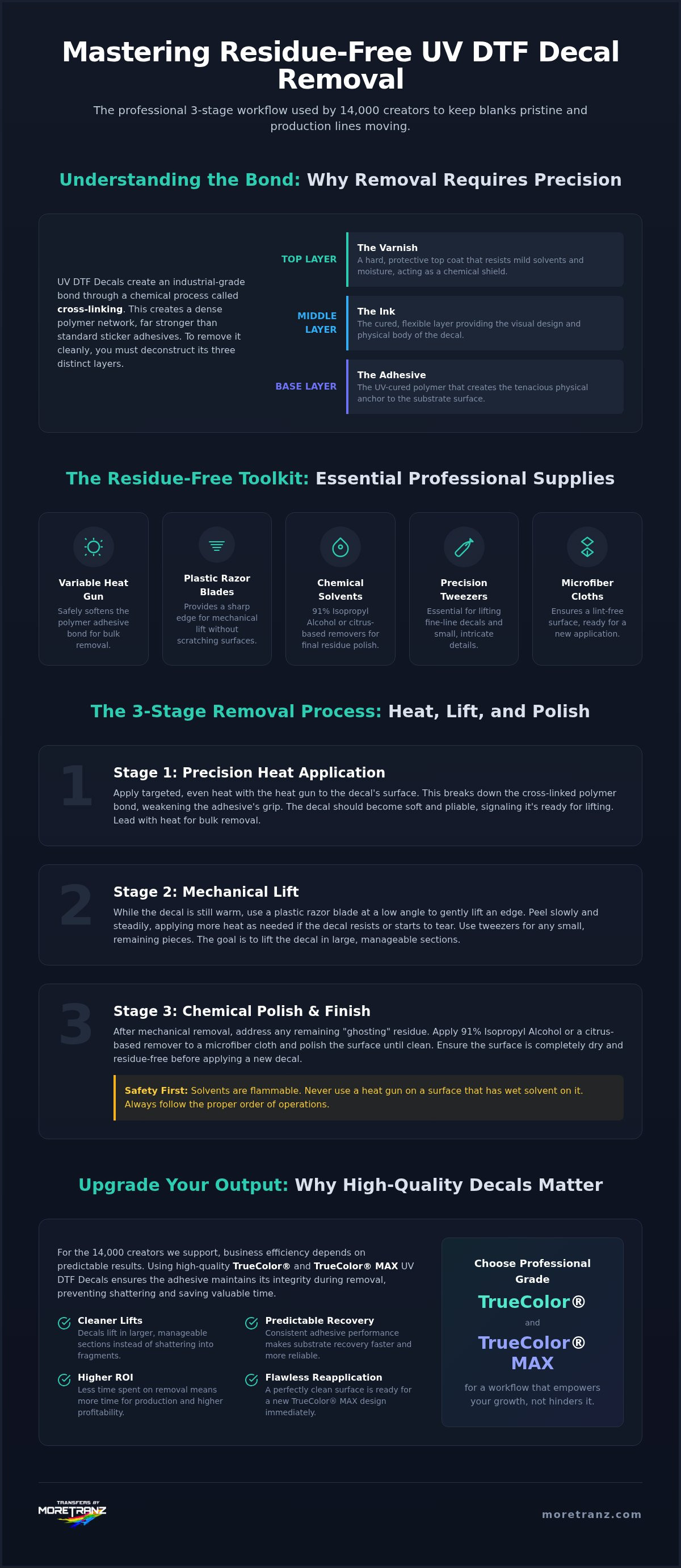
Standard vinyl stickers rely on simple pressure-sensitive adhesives that sit on the surface of a material. UV DTF technology is fundamentally different. During the printing process, the adhesive is cured via ultraviolet light. This triggers a chemical reaction called cross-linking, which creates a dense, three-dimensional polymer network. This network grips the substrate with incredible tenacity, which is why traditional water-soaking methods fail. To break this bond effectively, you must understand the three layers you are fighting:
- The Varnish: A hard, protective top coat that resists most mild solvents.
- The Ink: A flexible, cured layer that provides the visual impact and physical body.
- The Adhesive: The UV-cured polymer that creates the physical anchor to the surface.
The varnish layer acts as a chemical shield. It protects the underlying adhesive from common household cleaners and environmental moisture. Successful removal requires you to attack the polymer structure itself, rather than just the surface contact point.
When to Rebrand: Efficiency for 14,000 Creators
Business efficiency depends on knowing when to strip a surface and when to start fresh. There is a specific "clean-peel" window shortly after application where the bond has not reached its maximum structural density. For high-value items like premium tumblers or electronics, the ROI of removal is exceptionally high. Using high-quality TrueColor® transfers ensures that the adhesive maintains its integrity during the process. Instead of shattering into microscopic fragments, a superior decal tends to lift in larger, manageable sections. This predictability is vital for maintaining a fast removal workflow. Once the surface is clear, you can immediately pivot to a new TrueColor® MAX design, keeping your production line moving without missing a beat.
The Residue-Free Toolkit: Professional Supplies for Clean Removal
Efficiency in the workshop starts with the right hardware. You can't rely on household hacks if you want professional results. To master removing UV DTF stickers without residue, you need a dedicated station equipped with industrial-grade supplies. This isn't just about peeling; it's about substrate recovery. 14,000 creators rely on this specific toolkit to keep their production lines moving and their blanks pristine. Assemble these items before you begin to avoid mid-process delays:
- Variable Temperature Heat Gun: Precision models with adjustable settings are superior to standard craft dryers. They allow you to hit the specific thermal threshold required to soften UV-cured polymers.
- Plastic Razor Blades: These are essential for mechanical lift. They provide a sharp edge that won't mar stainless steel or scratch delicate acrylic.
- Chemical Solvents: Keep 91% Isopropyl Alcohol and a citrus-based adhesive remover, such as Goo Gone, on hand for final polishing.
- Precision Tweezers: Use these for fine-line decals and intricate details that are too small for a scraper.
- Lint-Free Microfiber Cloths: These ensure the final surface is ready for a new application without leaving behind dust or fibers.
Heat Tools vs. Chemical Solvents
Timing is everything. Lead with heat for bulk removal. High-energy heat breaks the cross-linked polymer bond, allowing the decal to lift in large sections. Save your chemical solvents for the "ghosting" residue left behind. Safety is paramount here. Isopropyl Alcohol and Acetone are highly flammable. Never use a heat gun on a surface that still has wet solvent on it. Following this order of operations ensures a safe, fast workflow. It's the standard protocol for serious brands who value business ROI.
Surface-Safe Scrapers and Microfibers
Choosing the right mechanical tool prevents permanent damage to your expensive blanks. Plastic razor blades are the industry standard because they offer the necessary leverage without the risk of metal-on-metal gouging. If you are working with intricate TrueColor® MAX transfers, precision is your priority. Use non-marring silicone wedges for broader areas and fine-tipped tweezers for the edges. Finish every removal with a microfiber polish. This removes microscopic adhesive particles that can interfere with your next project. A perfectly clean surface is the only acceptable starting point for your next MoreTranz application.
Method 1: The Precision Heat & Peel Technique
Heat is the ultimate disruptor for UV-cured polymers. It is the most reliable method for removing UV DTF stickers without residue because it converts a rigid, cross-linked bond back into a pliable state. 14,000 creators use this technique to salvage high-value blanks and pivot to new designs. Success requires a calculated balance of thermal energy and mechanical control. If you rush the heat, you risk melting the substrate. If you rush the pull, you will shear the adhesive and leave a sticky mess behind. This method is your first line of defense in substrate recovery.
Softening the Adhesive Without Damaging the Substrate
Precision is your priority. Never hold your heat gun in one spot for more than a few seconds. Constant circular motion is mandatory to prevent "hot spots," especially on acrylic or thin-walled plastics that warp at low thresholds. For standard powder-coated metal tumblers, maintain a surface temperature between 120°F and 150°F to safely liquefy the adhesive without compromising the coating. Focus your thermal energy specifically on the perimeter of the UV DTF Decals. Use a plastic razor blade from your toolkit to test the "give" of the material. When the edge begins to pucker or slide under light pressure, you have reached the optimal window for removal. If the decal feels brittle, it needs more heat.
Mastering the Low-Angle Peel
The direction of your pull determines the amount of residue left on the surface. Most beginners make the mistake of pulling straight up at a 90-degree angle. This vertical tension often causes the adhesive layer to separate from the ink, leaving a ghosted image on the blank. Professionals follow the 45-degree rule. Pull the decal back over itself slowly and steadily, keeping your hand close to the surface. This specific angle focuses the tension directly on the bond line. It encourages the adhesive to stay with the film carrier rather than the substrate. High-performance transfers like TrueColor® MAX possess the structural integrity to resist snapping during this high-tension phase. If the decal does break, stop immediately. Re-apply heat to the new leading edge before attempting to lift it again. This slow, deliberate tension ensures a clean exit for the decal and a pristine surface for your next MoreTranz project.
Method 2: Solvent-Based Removal for Stubborn Residue
Chemical intervention is the final stage of industrial substrate recovery. While heat handles the bulk of the decal, microscopic adhesive "ghosting" often remains. This is where precision solvent selection becomes critical for removing UV DTF stickers without residue. If you ignore this step, your next application will fail due to poor surface tension. 14,000 creators understand that a blank isn't truly ready until it passes the chemical decontamination phase. You aren't just cleaning; you're prepping for the next high-performance bond.
Safe Solvents for Glass, Metal, and Acrylic
91% Isopropyl Alcohol is the industry gold standard for glass and stainless steel. It breaks down polymer chains rapidly and evaporates without leaving a film. However, you must exercise caution with uncoated plastics and acrylics. Harsh solvents like Acetone can cause "crazing" or permanent clouding on these materials. For these delicate surfaces, lead with a citrus-based adhesive remover. These cleaners are particularly effective at breaking down the dense adhesive used in TrueColor® MAX decals. Use the "Soak and Slide" technique: apply the solvent to a lint-free cloth, press it against the residue for 60 seconds, and slide the softened adhesive off in one motion. This prevents you from spreading the sticky mess across a larger surface area.
Final Polishing for a Print-Ready Surface
A clean-looking surface isn't always a print-ready surface. Citrus-based cleaners often leave behind an oily film that acts as a release agent. This oil will destroy the bond of your next transfer. You must perform a final wipe-down with a clean microfiber cloth and a fresh splash of alcohol to strip these oils away. Perform the "Squeak Test" to verify your work. Drag a clean, dry finger across the substrate. If it glides silently, there is still an oily residue present. If it grips and squeaks, you have achieved a chemically bare substrate. This level of precision ensures your next project has the maximum possible bond. Once you've mastered this recovery process, you can confidently test new designs with a MoreTranz Sample Pack to see how our high-bond adhesives perform on your restored blanks.
Browse High-Performance TrueColor® Transfers Now
Upgrade Your Output: Why High-Quality UV DTF Decals Matter
The quality of your input directly dictates the efficiency of your output. When you use inferior materials, the removal process becomes a chaotic battle against inconsistent adhesives that fail unpredictably. High-performance UV DTF Decals are engineered to provide a rock-solid bond that remains structurally sound during the stripping process. This industrial consistency is why professionals prioritize premium transfers. By choosing the right materials from the start, you simplify the task of removing UV DTF stickers without residue if you ever need to rebrand or correct an application error. MoreTranz provides the technical foundation you need to maintain a flawless production line.
Precision Printing with TrueColor® MAX Technology
TrueColor® MAX represents the pinnacle of hard-surface branding. Our proprietary 9-color technology delivers a visual intensity that standard 5-color printers cannot match. These industrial-grade ink sets do more than just look better; they create a more resilient decal body that resists fragmenting when heat is applied. This means when you follow our removal protocols, the decal is more likely to lift in a single, clean sheet. We offer no minimum orders on these premium transfers. This flexibility allows you to test new hard-surface designs on expensive blanks without the risk of overstocking inventory. It is a professional-grade toolkit designed for the modern entrepreneur who demands precision.
Scaling Your Brand with MoreTranz Gang Sheets
Business growth requires a constant focus on ROI and rapid fulfillment cycles. MoreTranz Gang Sheets allow you to maximize your production by grouping multiple designs on a single roll. This strategy reduces your cost per unit and streamlines your application workflow. You can even combine different technologies, such as utilizing Spangle Transfers alongside your UV DTF projects to create a high-impact, multi-textured aesthetic. Join the 14,000 creators who have moved beyond hobbyist tools to embrace professional-grade production. We provide the technical dominance you need to scale your brand with total confidence. Mastering the art of removing UV DTF stickers without residue is just the beginning of your journey toward industrial-grade precision and market superiority.
Master Your Substrate Recovery and Scale Your Brand
Mastering the industrial cycle of application and removal is what separates hobbyists from serious entrepreneurs. You now have the technical roadmap for removing UV DTF stickers without residue, ensuring your expensive blanks are never wasted. By balancing targeted thermal energy with precise chemical polishing, you maintain a production line that is both flexible and high-performing. It is about more than just cleaning a surface; it's about reclaiming your inventory and preparing for the next high-impact design.
Transitioning to superior technology like TrueColor® MAX makes every step of the process more predictable. Our vivid 9-color output provides the durability your brand deserves, while our no-minimum order policy lets you test new concepts with zero risk. You're joining a community of 14,000 creators who prioritize precision and technological dominance in a crowded marketplace. MoreTranz is here to ensure your brand remains resilient and visually striking.
Ready for a cleaner, bolder brand? Shop TrueColor® MAX UV DTF Decals now
Your next project starts on a pristine surface. Take these industrial techniques and push your creative boundaries today.
Frequently Asked Questions
Can I reuse a UV DTF decal after I remove it?
No, UV DTF Decals are designed for single-use application only. The removal process, whether using heat or solvents, fundamentally destroys the cross-linked polymer structure of the ink and the adhesive layer. Attempting to reuse a decal will result in zero adhesion and a compromised aesthetic. Always start with a fresh TrueColor® MAX transfer to ensure your project maintains its industrial-grade durability and visual impact.
Will a heat gun damage my powder-coated tumbler during removal?
Your powder-coated finish is safe as long as you avoid concentrated hot spots. Most industrial powder coatings can withstand temperatures up to 300°F, but you only need 120°F to 150°F to break the adhesive bond. Keep your heat gun moving in a constant circular motion to prevent discoloration. This controlled approach is the standard method used by 14,000 creators to protect expensive blanks during the removal process.
What is the best way to remove sticky residue from acrylic without clouding it?
Use a citrus-based adhesive remover or a mild Isopropyl Alcohol solution to clean acrylic surfaces safely. You must avoid high-concentration Acetone, as it triggers a chemical reaction that causes permanent crazing or clouding on most plastics. Apply your chosen solvent to a lint-free microfiber cloth first rather than pouring it directly onto the substrate. This ensures you maintain total control over the decontamination without risking the clarity of your acrylic blank.
How long should I wait after applying a decal before it becomes 'permanent'?
The bond reaches its maximum structural density approximately 24 to 48 hours after application. While the UV-cured layers are solid immediately, the pressure-sensitive adhesive continues to build a mechanical grip over the first two days. If you identify an application error, it is much easier to manage the task of removing UV DTF stickers without residue if you act within the first hour before the bond fully sets.
Is it safe to use Goo Gone on all hard surfaces?
Goo Gone is safe for the majority of glass, metal, and high-density plastic surfaces, but always perform a spot test on a hidden area first. Citrus-based cleaners are highly effective at breaking down the aggressive adhesives found in TrueColor® transfers. However, these cleaners leave behind an oily film. You must follow up with a fresh alcohol wipe-down to ensure the surface is chemically clean and ready for your next MoreTranz project.
Why did my UV DTF decal leave a 'ghost' image after removal?
Ghosting happens when the ink layer separates from the adhesive, leaving a microscopic footprint on your blank. This is usually the result of removing the decal while it is too cold or pulling it at a 90-degree angle. By applying consistent heat and following the 45-degree pull rule, you ensure the adhesive remains attached to the decal body rather than the surface. This technique is vital for maintaining a fast, efficient workflow.
Can I use a hair dryer if I don't have an industrial heat gun?
A hair dryer can work for small projects, but it lacks the thermal consistency required for removing UV DTF stickers without residue at scale. Industrial heat guns provide targeted, high-energy heat that liquefies the polymer bond much faster than a standard beauty tool. For the 14,000 creators running serious branding businesses, investing in a variable-temperature heat gun is a necessary step to reduce labor time and prevent substrate damage.
How do I prep a surface for a new decal after removing an old one?
Surface preparation is a two-step process of mechanical cleaning and chemical decontamination. After the old decal is gone, use 91% Isopropyl Alcohol to strip away any remaining oils or citrus cleaner films. Your surface is ready only when it passes the "Squeak Test," indicating a chemically bare substrate. This level of precision ensures your new TrueColor® MAX design achieves a flawless, permanent bond that will survive years of heavy use.