

UV DTF for Branding Hard Goods: The 2026 Professional Guide
Traditional vinyl is a liability for professional hard-good branding. You've likely felt the frustration of weeding intricate designs only to have them peel off a tumbler after a few washes. You know your clients demand a permanent, "printed-on" finish that survives daily use. Utilizing UV DTF for branding hard goods is the only way to deliver that industrial-grade quality without the massive overhead of specialized machinery.
Transfers by MoreTranz empowers 14,000 creators to bypass technical bottlenecks and deliver elite results. In this guide, you'll discover how to master the application of UV DTF Decals to achieve vibrant, high-definition graphics on any surface. We'll show you how our TrueColor® MAX technology provides unmatched color depth and physical resilience. We'll also break down the streamlined workflow that allows for no minimum orders and rapid fulfillment. This is your roadmap to technological dominance in the hard-goods sector for 2026.
Key Takeaways
- Master the mechanics of UV DTF for branding hard goods to achieve permanent, industrial-grade finishes on any surface without expensive machinery.
- Leverage TrueColor® MAX 9-color technology to produce high-definition graphics that capture vibrant brand colors standard CMYK systems miss.
- Identify the specific metals and plastics compatible with UV DTF Decals to ensure maximum adhesion on everything from water bottles to electronics.
- Learn professional preparation and alignment techniques that guarantee a seamless "printed-on" look for both flat and tapered hard goods.
- Scale your production efficiently using bulk gang sheets with no minimum order requirements, joining the 14,000 creators who trust MoreTranz for rapid fulfillment.
What is UV DTF for Branding Hard Goods?
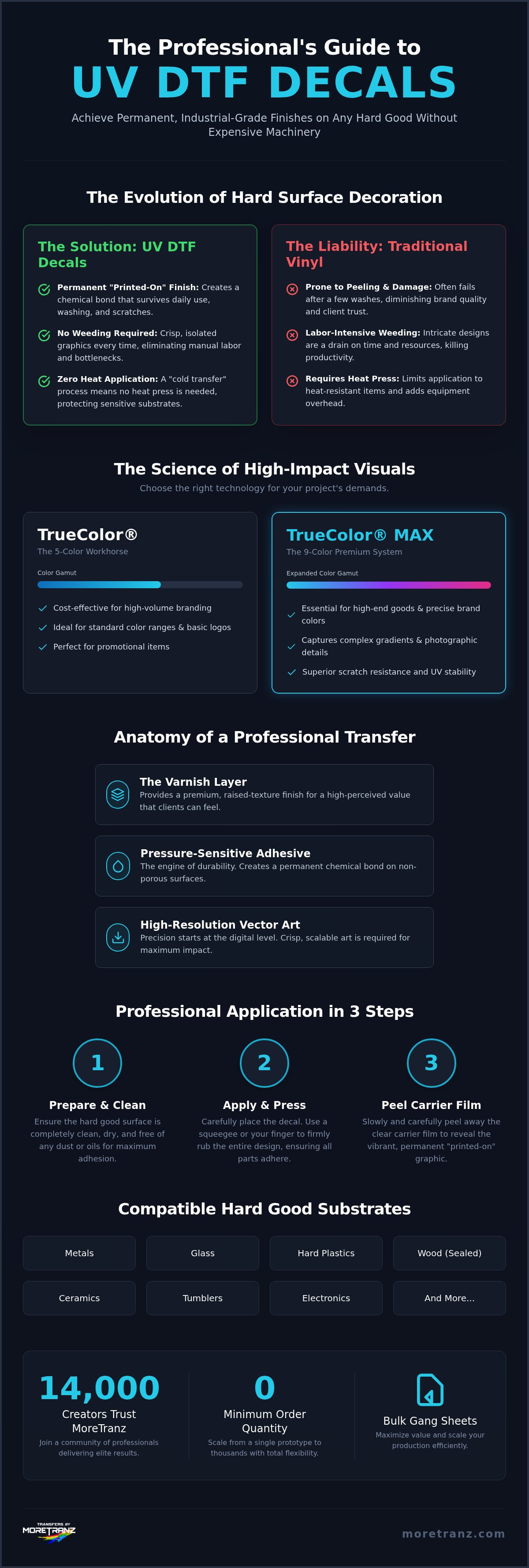
UV DTF (Direct-to-Film) is a high-performance printing process that uses UV-curable ink to create permanent, industrial-grade decals for hard surfaces. The technology is a game-changer for professional branding. It works by printing ink directly onto a specialized film, which is then instantly cured by UV light. A pressure-sensitive adhesive carrier is applied over the cured ink, creating a ready-to-use transfer. Utilizing UV DTF for branding hard goods allows you to bypass the need for expensive, direct-to-substrate printing machinery while maintaining professional standards.
The primary advantage for hard goods is the "cold transfer" application. Unlike standard apparel transfers, UV DTF requires zero heat. You don't need a heat press to achieve a permanent bond. You simply peel the carrier, apply the decal to your substrate, and rub to secure the adhesion. This efficiency is why 14,000 creators have integrated MoreTranz into their daily production. The result is a high-build, tactile texture and physical resilience that standard stickers cannot match.
The Evolution of Hard Surface Decoration
Traditional vinyl is rapidly becoming a bottleneck for high-output brands. The manual labor involved in weeding intricate logos is a drain on resources. UV DTF for branding hard goods eliminates this step entirely. There is no background to weed and no excess material to clear. You get crisp, isolated graphics every time.
We are also seeing a significant shift from traditional pad printing to digital transfers for small and medium production runs. Pad printing requires custom plates and long setup times, making it nearly impossible for low-volume orders. UV DTF Decals offer the same industrial durability with the flexibility of digital printing. This allows branding professionals in 2026 to scale from a single prototype to a run of thousands without a single setup change.
Key Components of a Professional UV Transfer
A professional-grade transfer from MoreTranz is an engineered stack of materials designed for longevity. Every component serves a specific functional purpose in the branding lifecycle.
- The Varnish Layer: This clear, protective coating provides a premium, raised-texture finish. It adds a physical dimension to your branding that clients can actually feel, signaling higher perceived value.
- Pressure-Sensitive Adhesive: This is the engine of durability. It creates a permanent chemical bond on non-porous surfaces like metal, glass, and hard plastics.
- High-Resolution Vector Art: Precision starts at the digital level. To maximize the impact of UV DTF Decals, your art must be crisp and scalable.
When you combine these technical components with our TrueColor® MAX technology, you achieve a level of visual intensity and color accuracy that was previously reserved for massive industrial factories. It's about bringing that same technological dominance to your own production floor.
TrueColor® MAX: The Science of High-Impact Visuals
Visual dominance is the ultimate differentiator in a crowded marketplace. When you utilize UV DTF for branding hard goods, the quality of your output depends entirely on the ink technology behind the film. TrueColor® MAX isn't just another printing method; it's an industrial-grade solution designed to capture the full spectrum of brand identity. Standard CMYK processes often fall short when replicating neon highlights or deep, saturated corporate tones. Our 9-color technology expands the printable gamut, ensuring that your graphics remain vibrant and accurate on every substrate.
The density of the white ink layer is equally critical for professional results. For 14,000 creators working with black powder-coated tumblers or transparent glass, opacity is the difference between a professional product and a lackluster DIY project. TrueColor® MAX provides a solid, light-blocking foundation that prevents the substrate color from bleeding through your design. Beyond aesthetics, these transfers are engineered for physical resilience. The UV-curable inks offer superior scratch resistance and UV stability, making them a reliable choice for outdoor equipment and high-touch items.
TrueColor® vs. TrueColor® MAX
Choosing between the two tiers depends on your specific project requirements. Standard TrueColor® is our 5-color workhorse. It's the most cost-effective option for high-volume branding where standard color ranges are sufficient. Use it for basic logo placement and promotional items where speed and budget are the primary drivers. It delivers clean, reliable results for everyday branding needs.
TrueColor® MAX is the non-negotiable choice for high-end hard goods. If your design features complex gradients, photographic details, or specific brand colors that require absolute precision, the 9-color system is essential. It delivers smoother transitions and a level of depth that makes the graphic pop off the surface. If you're unsure which tier fits your needs, exploring a MoreTranz Sample Pack is the fastest way to compare the output quality firsthand.
Texture and Finish: The Varnish Layer
The finish is what truly separates UV DTF Decals from standard stickers. Our integrated varnish layer creates a tactile, 3D effect that mimics high-end embossing. This isn't just a visual trick; it's a physical layer that adds dimension to tumblers, electronics, and toolboxes. The varnish acts as a protective top-coat, shielding the ink from moisture, friction, and daily wear.
This combination of high-density ink and protective varnish results in a permanent "printed-on" look. The decal doesn't sit on top of the product like a cheap sticker. Instead, it feels like an original, factory-finished part of the hard good. This level of professional integration is why serious brands trust MoreTranz for their high-performance output. Utilizing UV DTF for branding hard goods with this level of finish ensures your products stand out with a premium, industrial feel.
Substrate Compatibility: What Hard Goods Can You Brand?
There is a common myth that UV DTF Decals work on every single object in existence. While the technology is incredibly versatile, professional branding requires an understanding of surface energy and material science. Utilizing UV DTF for branding hard goods is most effective on non-porous surfaces where the pressure-sensitive adhesive can create a permanent chemical bond. 14,000 creators rely on MoreTranz because our transfers are engineered for high-performance adhesion, but the substrate choice remains a critical factor in your production success.
Metals and hard plastics are the primary targets for this technology. Anodized aluminum, stainless steel, and powder-coated surfaces provide an ideal foundation for long-term durability. Whether you are branding heavy-duty toolboxes, industrial equipment, or premium water bottles, the transfer integrates with the surface to resist peeling. Plastics like ABS, PVC, and acrylic also offer excellent compatibility, making them perfect for electronics and high-end promotional items. The bond is immediate and strengthens over the first 24 hours.
Glass and ceramics represent another massive market for UV DTF Decals. For decorative glassware, mugs, and tapered tumblers, the "cold transfer" process is superior to traditional methods that require high-heat ovens. When working with transparent glass, the high-density white ink foundation found in our TrueColor® MAX transfers ensures your design remains opaque and vibrant. You can even apply these transfers to finished natural materials. Polished stone and sealed, finished wood hold the decals well, though raw, unsealed wood will cause the adhesive to fail.
The Hard Surface Compatibility Matrix
Powder-coated surfaces are where UV DTF truly shines. Traditional vinyl often struggles with the textured "orange peel" finish of modern tumblers, leading to edge lifting. UV DTF Decals conform to these micro-textures, creating a bond that outlasts standard vinyl by a significant margin. For industrial branding, anodized aluminum and stainless steel provide a sleek, professional look that survives heavy handling. If you are producing signage or point-of-sale displays, acrylic and PVC offer a high-gloss finish that complements the 3D varnish layer of the transfer.
Surfaces to Avoid
Success with UV DTF for branding hard goods also means knowing when to use a different technology. You must avoid unpolished, highly porous materials like raw brick, unsealed concrete, or open-grain wood. These surfaces don't provide enough contact area for the adhesive to grab. Silicone-coated items are another hard "no" because the non-stick properties of silicone will reject the transfer immediately. Similarly, fabric and soft-touch "rubbery" plastics are better suited for standard DTF heat transfers rather than UV decals. To ensure your specific substrate is a match, we always recommend the "test before you rest" approach. Ordering a MoreTranz Sample Pack allows you to verify adhesion on your exact products before committing to a bulk production run.
How to Apply UV DTF Decals to Hard Goods
Application is the final bridge between your digital vision and a physical product. When you're utilizing UV DTF for branding hard goods, the process is entirely manual and requires zero heat. This simplicity is a massive advantage for rapid fulfillment, but it demands technical precision. If your application technique is flawed, even the highest-quality transfer will fail to meet industrial durability standards. You're not just sticking a label; you're creating a permanent brand asset. 14,000 creators trust MoreTranz because our transfers are engineered for ease of use, but mastering the "rub-on" phase is your responsibility.
Professional Surface Preparation
Prep is the most overlooked step in the professional workflow. You must use 70% isopropyl alcohol to clean your substrate immediately before application. This is the industry standard for stripping away oils, fingerprints, and invisible factory residues that compromise adhesion. Surface energy is the physical property that determines how effectively an adhesive bond can form between the decal and the solid substrate. High-energy surfaces like stainless steel and glass are ideal foundations. Ensure your surface is bone-dry and free of lint before the transfer touches the material. UV DTF for branding hard goods only works if the bond is uncontaminated.
Mastering Curved Surfaces
Centering a logo on a tapered tumbler or a rounded water bottle is a common challenge for branding professionals. We recommend the "Center-Out" technique to eliminate errors. Align your UV DTF Decals using low-tack tape to create a temporary hinge for perfect positioning. Once you're satisfied with the placement, press the center of the graphic first and work your way toward the edges. This movement pushes air bubbles out rather than trapping them under the film. It ensures a smooth, professional finish on even the most complex tapered substrates without wrinkles or distortion.
The final bond is determined by the physical pressure you apply. After the transfer is in place, use a squeegee or firm thumb pressure across the entire design. This rub-on phase activates the pressure-sensitive adhesive for long-term physical resilience. When you're ready to peel the carrier film, do it slowly at a 45-degree angle. This controlled motion ensures that every fine detail from your TrueColor® MAX design remains permanently fused to the hard good. This is the exact workflow used by elite creators to achieve a seamless, printed-on finish.
Get a MoreTranz Sample Pack to test your application technique.
Scaling Your Brand with Bulk UV DTF Gang Sheets
Scaling a branding business requires moving beyond one-off production. Utilizing UV DTF for branding hard goods through bulk gang sheets is the most effective way to maximize your ROI. By grouping multiple designs onto a single sheet, you slash your per-unit cost and eliminate the waste associated with individual prints. MoreTranz supports this growth by offering no minimum order requirements. This flexibility allows micro-brands—from tech startups to niche wellness brands like Transfemme—to test new products while providing massive enterprises the volume they need for rapid fulfillment. It's about industrial power without the industrial overhead.
The workflow efficiency of UV DTF Decals is unmatched in the hard-goods sector. Consider a run of 100 tumblers. Traditional screen printing requires screens, emulsions, and significant setup time. With our ready-to-apply transfers, you simply cut from your gang sheet and apply. You can brand 100 items in a fraction of the time. This efficiency is why we are the trusted partner for 14,000 creators nationwide. You spend less time in production and more time growing your business, and if you are scaling by importing bulk substrates from overseas, you can find out more about professional freight forwarding and customs clearance.
Optimizing Your Gang Sheet Layout
Efficiency starts with your file setup. Maximize every square inch of your sheet to ensure the highest possible return on investment. Don't waste space; fill gaps with small logo variations, social media handles, or secondary brand marks. A single order can contain various sizes and designs, allowing you to stock up on multiple branding assets simultaneously. Explore our transfer types to start your gang sheet and see how much you can pack into a single layout.
Professional Art Support for Hard Goods
The physical resilience of your decal is only as good as the art behind it. Clean, sharp lines are mandatory for professional results on hard surfaces. Utilizing a Vector Conversion Service is the professional secret to ensuring your decals remain high-definition at any scale. Before you finalize your production files, ensure your resolution is at least 300 DPI and all backgrounds are transparent. This precision ensures the TrueColor® MAX ink layers align perfectly for maximum impact.
To see the visual intensity and physical bond of our 9-color technology on your specific products, your final step should be to Order a Free Sample Pack. This allows you to verify the professional finish and adhesion on your substrates before committing to a full production run. Join the 14,000 creators who have already upgraded their workflow with MoreTranz.
Dominate the Hard-Goods Market with MoreTranz
The shift toward professional-grade digital transfers is non-negotiable for creators who demand efficiency and impact. You've seen how UV DTF Decals provide a permanent, embossed finish that surpasses standard vinyl. By mastering surface preparation and leveraging TrueColor® MAX 9-color technology, you can deliver industrial-strength branding on any hard surface without expensive machinery. Utilizing UV DTF for branding hard goods is the fastest way to scale your production while maintaining elite visual standards.
MoreTranz is your high-performance partner in this evolution. We empower 14,000 creators nationwide with the tools to bypass traditional manufacturing bottlenecks. Whether you're producing a prototype or a bulk run, our custom gang sheets offer flexibility with no minimum order constraints. It's time to stop weeding and start executing your vision with total confidence in your output's resilience.
Upgrade your branding with TrueColor® MAX UV DTF Decals
Take control of your workflow and join the community of professionals who prioritize precision and technological dominance. Your brand deserves the physical intensity that only industrial-grade transfers can provide. Let's build something permanent together.
Frequently Asked Questions
Are UV DTF Decals dishwasher safe for tumblers?
UV DTF Decals from MoreTranz are highly water-resistant and can withstand standard residential dishwasher cycles. While they're engineered for extreme durability, we recommend hand washing to extend the life of the decal beyond the latest 2026 standards. Industrial dishwashers utilize aggressive chemicals and high-heat drying cycles that may eventually degrade the bond. Testing on your specific substrate is the best way to ensure permanent results.
Do UV DTF Decals require a heat press for application?
No heat press is required for these transfers. Utilizing UV DTF for branding hard goods is a cold-application process that relies entirely on pressure-sensitive adhesive. You simply peel the carrier film, position the graphic, and rub it onto the surface. This makes it a perfect solution for heat-sensitive materials like plastics and electronics that would melt or warp under a traditional heat press.
Can I apply UV DTF Decals to powder-coated stainless steel?
Yes, UV DTF Decals are the superior choice for powder-coated stainless steel. Unlike traditional vinyl that often peels on textured surfaces, our transfers conform to the micro-ridges of the coating. This creates a mechanical and chemical bond that is nearly impossible to remove once cured. It's the professional secret for branding high-end tumblers and toolboxes with a permanent, factory-finished look.
How long do UV DTF Decals last on hard surfaces?
These decals are designed to be a permanent branding solution. They feature high scratch resistance and chemical stability, ensuring they remain vibrant for years of daily use. On non-porous surfaces like glass and metal, the bond actually strengthens over the first 24 hours. While nothing is truly indestructible, these transfers represent the peak of durable, direct-to-substrate decoration currently available to the 14,000 creators we serve.
What is the difference between UV DTF and standard stickers?
Standard stickers sit on top of a substrate with a visible plastic border. UV DTF Decals provide a "printed-on" look with no background film and a tactile, 3D varnish layer. The ink is cured with UV light during production, making it significantly more resilient than standard sticker inks. You get the visual impact of direct UV printing without the need for expensive industrial machinery.
Can UV DTF Decals be used for outdoor signage and equipment?
Yes, the UV-curable inks used in our transfers are highly stable under sunlight. This makes them an excellent choice for outdoor signage, equipment branding, and vehicle accessories. They resist fading and cracking even when exposed to the elements. For 14,000 creators producing outdoor products, this reliability is a critical competitive advantage that ensures brand logos stay sharp in any environment.
Do I need a special printer to use MoreTranz UV DTF Decals?
You don't need any specialized equipment to use our products. MoreTranz handles the complex printing and UV curing process in our GA facility. We ship you the ready-to-apply transfers, so your only task is the application. This allows you to offer industrial-grade UV DTF for branding hard goods to your clients without investing thousands of dollars in your own hardware.
How do I prepare a high-resolution file for TrueColor® MAX printing?
To achieve the best results with TrueColor® MAX, provide files at 300 DPI with a transparent background. Vector formats like AI, EPS, or PDF are preferred because they maintain perfect edge clarity at any size. Ensure your colors are set to CMYK for accuracy. If your art isn't print-ready, our Vector Conversion Service can refine your designs to meet our high-definition output standards.