

UV DTF vs Sublimation: 2026 Tumbler Comparison Guide
That $600 sublimation setup might be costing you more than it earns. While traditional methods rely on expensive polyester-coated blanks and high-heat cycles, the shift toward UV DTF Decals is rewriting the rules of the game. Comparing uv dtf vs sublimation for tumblers in 2026 reveals a stark reality; speed and versatility are the new currency of the custom drinkware industry.
You already know the frustration of ghosting, fading, and the constant overhead of specialized inventory. It's a grind that limits your creativity and your profit. At MoreTranz, we've helped 14,000 creators break free from these constraints by providing industrial-grade solutions that prioritize output over effort. This guide promises to reveal which method delivers the superior color intensity, 3D texture, and ROI your business demands to dominate the market.
We'll break down the technical specifications of TrueColor® technology, compare material costs, and show you how to decorate any surface without a heat press. From rapid fulfillment to physical resilience, here is everything you need to choose the right high-performance toolkit for your brand.
Key Takeaways
- Evaluate the technical evolution of uv dtf vs sublimation for tumblers to decide between a permanent chemical dye and a high-performance, 3D embossed finish.
- Reduce your initial investment by identifying how UV DTF Decals eliminate the need for specialized sublimation blanks and expensive convection ovens.
- Accelerate your fulfillment speed with a 30-second manual application process that outperforms traditional 6-minute heat-press cycles.
- Leverage TrueColor® and TrueColor® MAX technologies to achieve superior color vibrance on any hard surface without minimum order requirements.
- Join 14,000 creators who prioritize industrial-grade durability and scratch resistance by choosing cured varnish over standard ink.
Understanding the Technology: UV DTF Decals vs. Sublimation
What are UV DTF Decals?
UV DTF Decals are high-strength, cured ink transfers. The production process involves layering a specialized primer, vivid pigment, and a protective varnish onto a carrier film. We utilize TrueColor® and TrueColor® MAX technology to ensure these layers deliver unmatched visual impact. The result is a graphic with a tactile, slightly raised 3D texture. This embossed effect adds immediate perceived value to any tumbler. Application is straightforward. You peel the decal, press it onto the surface, and remove the transfer tape. It requires zero heat and zero specialized machinery.
How Sublimation Works
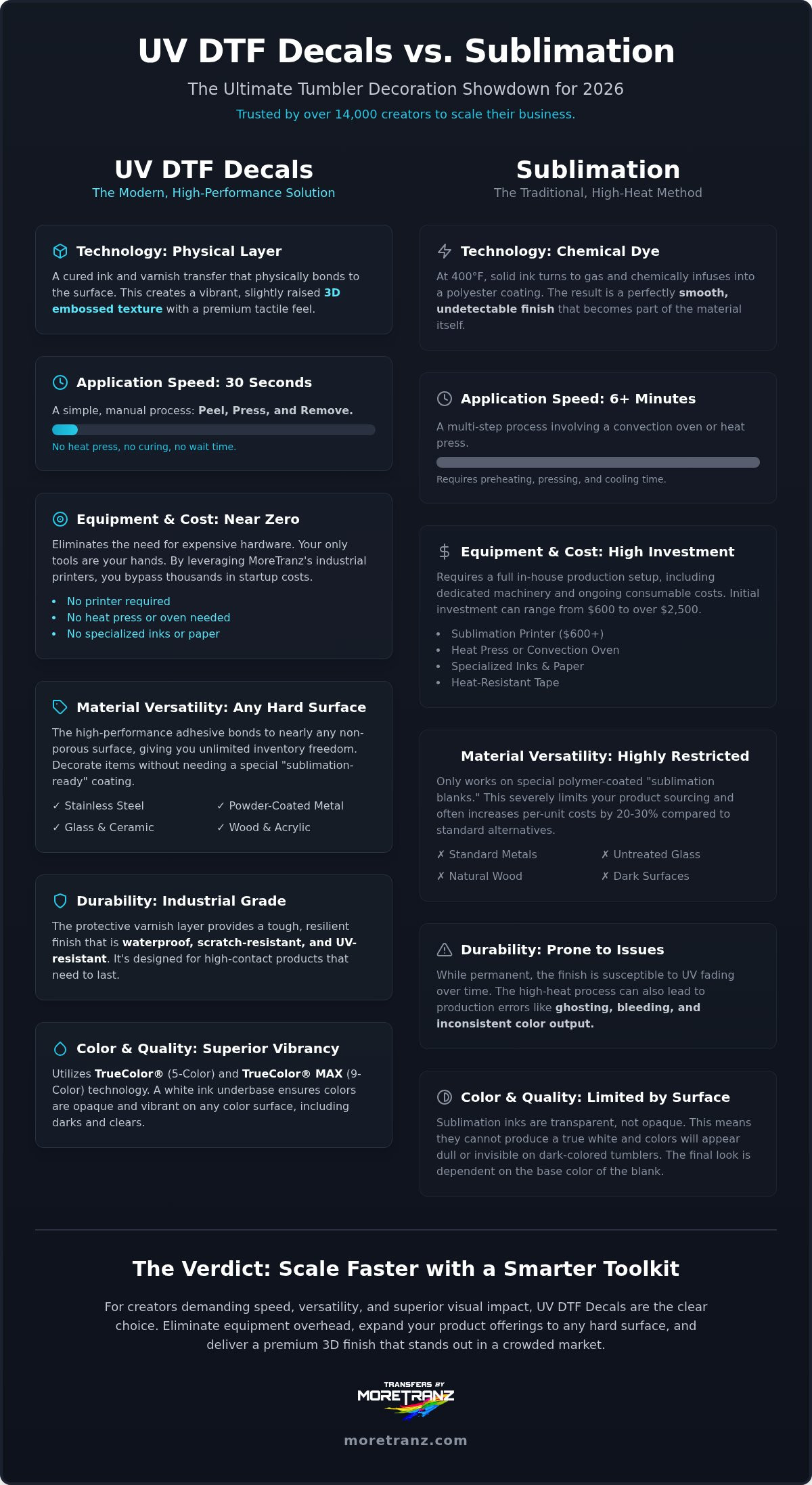
Sublimation is a heat-activated chemical process. At 400 degrees Fahrenheit, sublimation ink transforms from a solid to a gas. This gas permeates the surface of the substrate and becomes part of the material itself. This creates a perfectly smooth finish that is impossible to feel. However, this technology has strict requirements. You must use polyester-coated "sublimation blanks" to facilitate the bond. Without this specialized coating, the ink will not adhere. This limits your production to specific, often more expensive, inventory options. Sublimation also struggles with dark surfaces because the inks are not opaque.
The primary difference lies in surface versatility. Sublimation requires a chemical match. UV DTF Decals rely on a high-performance adhesive carrier that bonds to almost any hard surface. This allows you to decorate stainless steel, powder-coated metal, or untreated glass with ease. By removing the need for specialized coatings, you can source cheaper blanks and increase your profit margins immediately. This flexibility is why so many professionals are expanding their toolkit beyond traditional heat-based methods.
Equipment and Material Requirements: The Cost of Entry
Scaling a tumbler business requires a lean operational model. When you weigh uv dtf vs sublimation for tumblers, the most significant differentiator is the initial capital expenditure. Sublimation forces you into an in-house manufacturing role; you own the equipment, the maintenance, and the mistakes. UV DTF Decals allow for an agile, outsourced model where your only tools are your hands and a squeegee. MoreTranz empowers 14,000 creators to bypass the heavy machinery and focus entirely on fulfillment and design.
The Sublimation Setup: High Investment, High Maintenance
A professional sublimation workflow is a hardware-heavy commitment. You'll need a dedicated sublimation printer, which can range from $600 for a desktop Sawgrass to $2,495 for a small-format Epson SureColor F570. This is just the beginning. You must also budget for specialized ink sets, heat-resistant tape, and butcher paper to protect your equipment. The "blank" problem adds another layer of cost. Sublimation only works on polymer-coated stainless steel. These specialized blanks often carry a 20% to 30% price premium over standard, uncoated alternatives. Add in the learning curve of calibrating time, temperature, and pressure, and your setup suddenly feels like a financial burden.
The UV DTF Advantage: Just the Decal and the Tumbler
UV DTF Decals eliminate the industrial barrier to entry. By leveraging the industrial-grade printers at MoreTranz, you get professional results without the $10,000 mid-range printer price tag. Your production floor stays clean; there are no ink clogs to clear or heat presses to warm up. This method transforms any smooth, hard surface into a viable product. You can decorate wood, glass, or powder-coated metal without searching for a specific coating. This flexibility allows you to source blanks from any supplier, significantly lowering your per-unit cost. If you're ready to see the difference on your own inventory, the MoreTranz Sample Pack provides a low-risk way to test durability across various materials.
Profit margins are further protected through the use of custom gang sheets. Instead of printing one design at a time, you can pack dozens of logos and graphics onto a single sheet. This maximizes every square inch of the transfer, ensuring you get the highest possible ROI per order. It's a faster, smarter way to build a brand without being tethered to a heat press. For those looking to expand their catalog, exploring our full range of transfer types is the first step toward total production freedom.
Performance and Durability: Which Finish Wins?
The physical profile of your finished product determines its market value. When comparing uv dtf vs sublimation for tumblers, you're choosing between a design that lives inside the coating and one that commands attention on top of it. MoreTranz provides 14,000 creators with the tools to deliver a premium, high-tactile experience that customers can actually feel. Sublimation offers a smooth, "no-feel" finish, but it lacks the visual depth that modern consumers crave for high-end branding.
Visual Impact: Glossy 3D Texture vs. Embedded Ink
Professional UV DTF Decals offer a distinct 3D embossed effect. This is achieved through a proprietary layering of ink and high-gloss varnish. Unlike sublimation, which relies on the tumbler's own finish, UV DTF creates its own texture. Our TrueColor® MAX technology utilizes a 9-color process to deliver saturation that sublimation simply cannot match, especially on dark or textured substrates. While sublimation ink is transparent and struggles on non-white surfaces, UV DTF remains perfectly opaque and vibrant regardless of the background color. You can learn more about these advantages in our guide to Custom UV DTF Decals for Tumblers.
Resilience: Dishwasher Safety and Scratch Resistance
Durability is where industrial engineering meets creative design. Professional UV DTF Decals utilize industrial-grade adhesives that withstand repeated washing and physical abrasion. The cured varnish acts as a sacrificial layer; it takes the brunt of scratches and impacts while protecting the underlying pigment. Sublimation is often touted as the permanent choice because the ink is fused into the polymer. However, if the tumbler's coating chips or scratches, the design goes with it. Because UV DTF doesn't rely on that fragile outer coating, it often survives better on the heavy-duty tumblers used by active professionals.
UV stability is another critical factor for outdoor use. Sublimation prints are susceptible to UV degradation over time, leading to noticeable fading in direct sunlight. In contrast, the UV-cured inks and varnish used by MoreTranz are specifically engineered to resist solar breakdown. This ensures your branding remains sharp and saturated for the life of the product. While we always recommend hand-washing for maximum longevity, our transfers are built to survive the rigors of daily life without losing their professional edge. Choosing the right tech means choosing the one that stays vibrant long after the first wash.
Business Scalability for Creators: Efficiency and ROI
Efficiency defines your bottom line. When analyzing uv dtf vs sublimation for tumblers, the clock is your most expensive asset. Sublimation requires a significant time investment for every single piece. UV DTF Decals prioritize rapid movement and high-volume output. MoreTranz serves 14,000 creators who have transitioned to this model to maximize their hourly earnings and minimize equipment downtime. Scaling a brand requires a system that moves as fast as your orders come in.
Production Speed: Pressing vs. Peeling
Consider the logistics of a 50-unit tumbler order. In a traditional sublimation workflow, each unit requires precise wrapping, heat-resistant taping, and roughly 6 minutes in a convection oven or press. Even with batching, the process is labor-intensive and prone to failure. One slip in tape tension causes ghosting or uneven ink transfer, resulting in a discarded blank and lost profit. UV DTF Decals change the math entirely. Application takes 30 seconds. You peel the carrier, stick the graphic, and move to the next. There is no heating cycle, no cooling period, and zero risk of heat-related "rejects." This speed allows a single operator to fulfill massive orders in a fraction of the time. By using TrueColor® MAX, you ensure that this rapid pace doesn't sacrifice the high-end vibrance your clients expect.
Inventory Flexibility: Decorate Anything
Inventory management often kills small business cash flow. Sublimation forces you to stock specific, high-cost polymer-coated blanks. If your supplier runs out of stock, your production stops. UV DTF Decals grant you total sourcing freedom. You can buy wholesale tumblers from any vendor, including powder-coated finishes, raw stainless steel, or glass. You can even decorate difficult areas like handles or tapered bases where traditional heat presses fail. The "No Minimums" policy at MoreTranz allows for rapid prototyping and custom one-off orders without the need for a massive upfront investment. 14,000 creators use our gang sheets to pack multiple designs onto a single transfer, keeping their per-unit costs at an absolute minimum. You don't need to press stock in advance. You keep the decals on hand and decorate the tumbler only when the order is placed. This on-demand model reduces waste and keeps your capital liquid.
Optimize your production with high-performance transfers
The Final Verdict: Choosing the Best Tech for Your Brand
Choosing between uv dtf vs sublimation for tumblers is a strategic decision that directly impacts your equipment maintenance, inventory costs, and turnaround times. Sublimation is a precision tool for specific substrate bonds. UV DTF Decals are an industrial-grade solution for total creative freedom. MoreTranz supports 14,000 creators by providing the high-performance transfers needed to scale without the burden of specialized machinery or expensive coated blanks.
When to Stick with Sublimation
Operational agility is the primary driver for creators moving toward UV technology. The proprietary TrueColor® advantage delivers unmatched color precision, while TrueColor® MAX provides a 9-color depth that sublimation cannot replicate on dark or textured surfaces. This versatility allows you to expand your catalog instantly into phone cases, laptop skins, and rigid signage using the same high-performance transfers. The 3D embossed texture adds a tactile, premium feel that justifies a higher price point in competitive markets. By removing the need for a heat press, you eliminate the risk of ghosting, uneven heating, and scorched inventory. You get a perfect application every time in under 30 seconds.
Professional results require professional files. Many creators struggle with blurry graphics or jagged edges, which is why we recommend utilizing Vector Conversion Services to ensure your art is crisp and high-definition. This is the secret to maintaining brand integrity across every product you sell. Your growth depends on your ability to deliver superior durability and visual intensity on demand. Join 14,000 creators who have already upgraded their workflow to a faster, more profitable model. Take the next step in your business evolution and start ordering professional UV DTF Decals today to experience the TrueColor® difference firsthand.
Scale Your Tumbler Empire with Industrial Precision
The decision between uv dtf vs sublimation for tumblers comes down to your specific need for production speed and material versatility. Sublimation remains a reliable choice for full-wrap dyes on specialized blanks, but it doesn't offer the rapid application or the 3D embossed texture that defines modern premium branding. MoreTranz provides the high-performance toolkit necessary to eliminate equipment overhead while maintaining industrial manufacturing standards.
By leveraging vivid 9-color TrueColor® MAX technology, you ensure that every graphic delivers maximum visual impact and industrial-strength durability. You aren't just buying transfers; you're joining a community of 14,000 creators who have traded maintenance cycles for immediate profit. It's time to stop fighting with ghosting issues and start fulfilling high-volume orders with total confidence in your output. Your brand deserves the precision and technological dominance of a professional-grade finish that lasts.
Upgrade Your Brand with Professional UV DTF Decals
Take control of your workflow and watch your business scale with the efficiency of a global manufacturer.
Frequently Asked Questions
Are UV DTF Decals dishwasher safe for daily use?
Yes, UV DTF Decals are engineered for high-performance durability. While we recommend hand-washing to maximize the lifespan of any custom drinkware, our industrial-grade adhesives and cured varnish layers withstand standard dishwasher cycles. The physical bond is extremely resilient against heat and water pressure. This makes them a superior choice for 14,000 creators who need reliable output that survives daily use without peeling or fading over time.
Do I need a heat press to apply UV DTF Decals to tumblers?
No, you don't need a heat press, convection oven, or any specialized machinery. This is a major advantage when comparing uv dtf vs sublimation for tumblers. The application is entirely manual. You simply peel the backing, position the decal, and use a squeegee to ensure a firm bond. This zero-heat process eliminates the risk of scorched inventory and significantly reduces your production time for every custom order.
Can I use UV DTF Decals on non-sublimation tumblers?
Yes, you can decorate virtually any hard surface. Unlike sublimation, which requires a specific polyester coating, UV DTF Decals bond to raw stainless steel, powder-coated metal, glass, and even wood. This allows you to source wholesale tumblers from any vendor, bypassing the high cost of specialized sublimation blanks. It provides the ultimate flexibility for your inventory management and allows for a much wider range of profitable product offerings.
What is the difference between TrueColor® and TrueColor® MAX for hard goods?
TrueColor® is our standard 5-color industrial printing tier that delivers vivid, professional results for most applications. TrueColor® MAX is our premium 9-color system designed for creators who demand the highest level of color precision and gamut. The MAX tier provides smoother gradients and more accurate reproduction of complex brand logos. Both tiers utilize our proprietary UV-curing technology to ensure your hard goods feature a high-gloss, scratch-resistant finish.
How long do UV DTF Decals last on a stainless steel tumbler?
UV DTF Decals are built for long-term resilience. When applied correctly to a clean stainless steel surface, these decals can last for years of regular use. The cured varnish layer protects the pigment from UV degradation and physical abrasion. 14,000 creators trust this technology because it maintains its 3D texture and color intensity far longer than traditional stickers. Proper surface preparation is the key to ensuring an industrial-strength bond.
Can I apply UV DTF Decals to curved or tapered surfaces?
Yes, the flexible carrier film allows for seamless application on curved and tapered surfaces. This is a critical factor in the uv dtf vs sublimation for tumblers debate, as it allows you to decorate handles and irregular shapes where heat presses often fail. You must apply the decal slowly to avoid air bubbles, but the adhesive is forgiving enough to ensure a professional, flush finish on almost any tumbler geometry or size.
Why do 14,000 creators prefer UV DTF over traditional vinyl stickers?
14,000 creators choose UV DTF because it eliminates the labor-intensive weeding process required by traditional vinyl. Our decals arrive ready to apply with a premium 3D embossed texture that vinyl cannot replicate. The industrial UV-curing process provides superior scratch resistance and color fastness compared to standard solvent-based sticker printing. It is a faster, more durable, and more professional-looking solution for high-end custom branding and commercial production cycles.
How do I prepare my artwork for the MoreTranz UV DTF process?
High-resolution files are essential for professional results. We recommend using vector formats like AI, EPS, or PDF to ensure every line remains crisp at any scale. If you are working with raster images, ensure they are at least 300 DPI with a transparent background. For the most complex designs, our Vector Conversion Service is available to optimize your art. This ensures your final output matches the industrial quality of our TrueColor® MAX printing system.