

DTF on Moisture-Wicking Fabrics: The Professional Guide to Performance Apparel
Your premium athletic brand is only as strong as its weakest link. Usually, that link is a scorched polyester shirt or a graying white logo. Mastering DTF on moisture-wicking fabrics shouldn't feel like a gamble with your inventory. You've likely felt the frustration of dye migration turning crisp white logos into muddy messes or high heat melting delicate synthetic fibers. It's a common bottleneck for decorators trying to scale in a performance apparel market projected to reach $47.7 billion in 2026.
At Transfers by MoreTranz, we know that 14,000 creators rely on precision to keep their production lines moving. This guide provides the technical workflow for pressing high-durability, vibrant transfers without compromising fabric integrity. You'll learn how to achieve zero-minimum professional results that withstand heavy washes and intense athletic use. We'll break down the exact pressure settings, low-temperature techniques, and the proprietary TrueColor® MAX technology required to dominate the high-end sportswear market with total confidence.
Key Takeaways
- Learn how low-temperature application preserves synthetic integrity and why DTF on moisture-wicking fabrics is the superior choice for performance wear.
- Compare TrueColor® and TrueColor® MAX transfers to select the optimal color gamut and stretch for your specific athletic apparel needs.
- Implement a repeatable pro workflow focusing on pre-pressing and precise pressure to ensure prints withstand intense athletic use and heavy washes.
- Eliminate dye migration on dark polyester by utilizing advanced high-opacity white ink barriers engineered specifically for synthetic blends.
- Scale your production rapidly with zero-minimum orders and professional artwork services trusted by 14,000 creators.
Why DTF is the Ultimate Solution for Performance Wear
The Challenge of Moisture-Wicking Synthetics
Moisture-wicking technology relies on capillary action within the fibers. These technical weaves are engineered to pull sweat away from the body to the fabric surface. Heavy ink deposits from screen printing act like a solid plug. They clog the fabric and eliminate breathability. This creates a plastic shield effect that athletes find uncomfortable. Standard heat transfer methods also carry a high risk of fabric scorching. Synthetics have low melting points. DTF solves this by using a specialized adhesive. It activates at lower temperatures, preserving the fabric's technical integrity and soft hand-feel.
DTF vs. Sublimation for Athletic Apparel
Sublimation is a common industry choice, but it's fundamentally limited. It only works effectively on white or very light garments. If you're branding dark-colored performance tees or black compression gear, sublimation fails. DTF works on every color in your catalog. It provides a vibrant, opaque layer that maintains visual intensity even on the darkest polyester. For creators looking for a versatile entry point, TrueColor® DTF Transfers offer the perfect balance of rapid fulfillment and professional quality. They ensure your logos stay sharp while the fabric stays functional. This flexibility allows you to offer a wider range of apparel options without investing in multiple printing technologies.
TrueColor® vs. TrueColor® MAX: Selecting Your Transfer
Selection is the first step toward a superior product. TrueColor® (5-Color) serves as the high-speed engine for standard production. It's the go-to for common blends and high-volume runs where efficiency is king. But performance apparel is a different beast. TrueColor® MAX (9-Color) provides the specialized chemistry required for DTF on moisture-wicking fabrics. It pushes the boundaries of color gamut and ink resilience. MoreTranz supports 14,000 creators who refuse to compromise on output quality. For 100% polyester garments, TrueColor® MAX is the undisputed professional recommendation for color accuracy and long-term durability.
When to Choose TrueColor® MAX
Athletic brands often utilize vibrant, high-visibility palettes that standard CMYK processes struggle to replicate. If your design features neon greens, electric blues, or deep, saturated oranges, you need the 9-color process. TrueColor® MAX DTF Transfers utilize additional ink channels to hit these difficult targets with surgical precision. Beyond the visual impact, the "soft-hand" feel is a critical differentiator for performance wear. Technical shirts are thin and lightweight. Heavy, plastic-feeling transfers weigh down the garment and cause skin irritation during movement. TrueColor® MAX feels significantly lighter on the skin. It preserves the airy, technical quality of the moisture-wicking shirt while maintaining a professional, retail-ready finish.
The Importance of High-Stretch Ink
Compression shorts, leggings, and jerseys undergo extreme mechanical stress. Standard inks often fail under this tension. They develop visible cracks or begin to peel away from the synthetic surface. TrueColor® MAX ink is engineered specifically to expand and contract alongside spandex and elastane blends. It bonds at a molecular level to ensure the graphic remains intact during a full range of motion. This prevents the "white-out" effect where the base layer shows through a cracked top coat. TrueColor® MAX ink flexibility is the key to athletic longevity.
Success in the athletic market requires testing your gear under real-world conditions. You can experience the difference in stretch and hand-feel yourself by ordering a MoreTranz Sample Pack to find the perfect match for your specific fabric line. Choosing the right transfer technology ensures your brand remains synonymous with quality, even after the most intense workouts.
Pressing DTF Transfers on Performance Gear: Pro Workflow
Execution is the final barrier between a professional product and a failed order. Technical synthetics react instantly to thermal stress. You need a workflow that prioritizes fabric safety without sacrificing the adhesive bond. MoreTranz supports 14,000 creators who understand that precision is the only way to avoid the "melted" look on high-end jerseys. A professional-grade press is non-negotiable. It eliminates the cold spots that lead to premature peeling during the first wash. Always refer to the official Instructions to maintain industrial consistency across every batch you ship.
Moisture is the enemy of adhesion. Synthetic weaves are designed to hold and move liquid. If you don't remove this latent moisture before pressing, it turns to steam. This steam creates micro-bubbles under the ink that eventually cause the print to lift. Success with DTF on moisture-wicking fabrics requires a disciplined approach to heat and timing. You aren't just melting glue; you're facilitating a chemical bond between the TrueColor® MAX adhesive and the polyester fibers.
Step-by-Step Pressing Guide
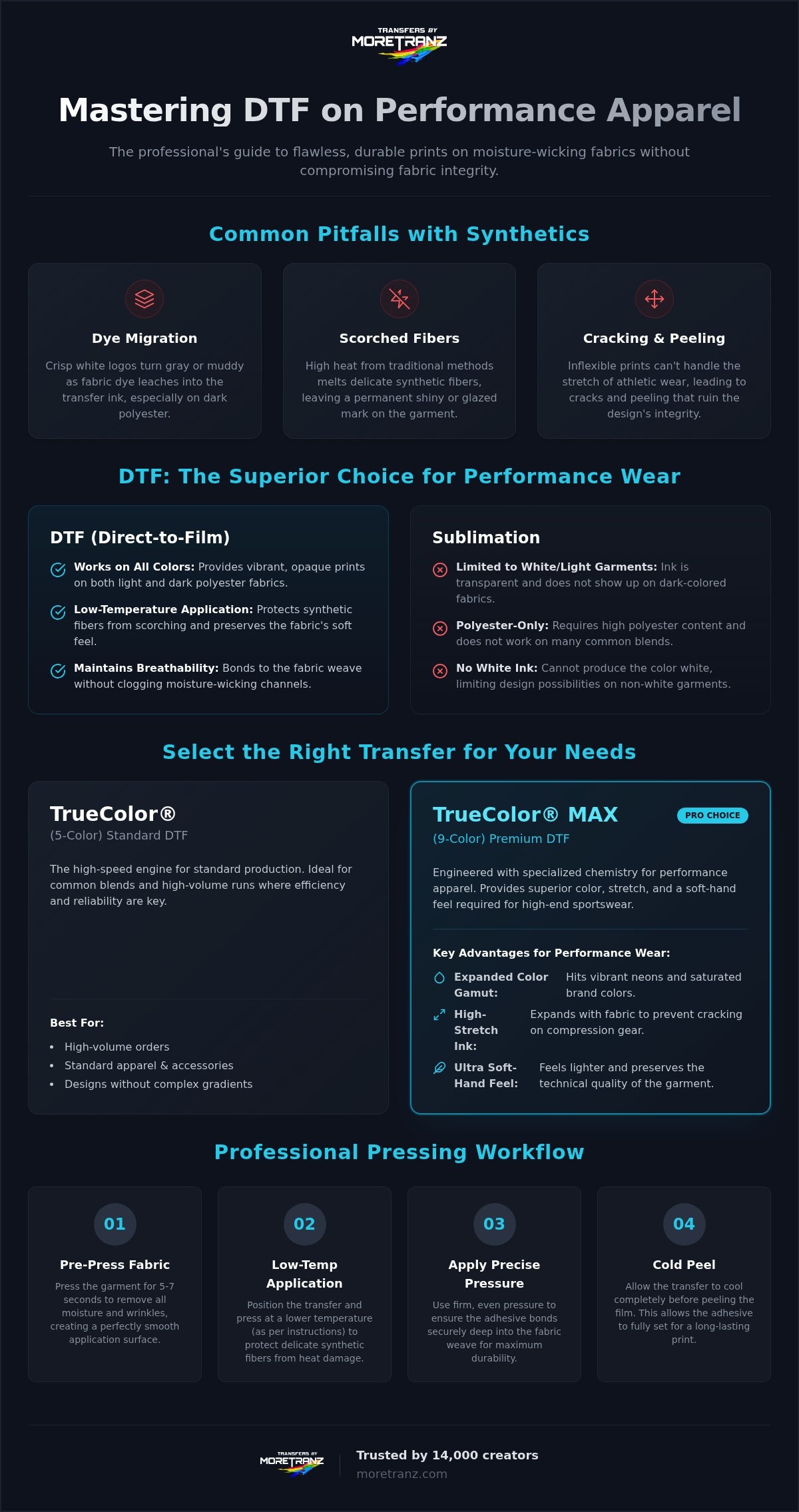
Follow this specific protocol to ensure your performance wear remains retail-ready. First, calibrate your press to a lower temperature range, typically between 275°F and 290°F. This prevents the fabric from "glazing" or developing a permanent heat ring. Second, execute a 5-second pre-press. This step is critical to eliminate trapped moisture and flatten the wicking channels for a smoother application surface. Third, align your TrueColor® MAX transfer and press for 10 to 12 seconds with medium pressure. Finally, allow the garment to cool completely before peeling. A cold peel is essential for DTF on moisture-wicking fabrics because it allows the adhesive to fully set into the textured weave.
Essential Tools for Athletic Pressing
Standard setups often fail on complex performance gear. Teflon sheets are superior to parchment paper for synthetics. They distribute heat more evenly and offer a better barrier against direct plate contact. If you're branding difficult items like compression sleeves or sports bras, consider using interchangeable lower platens. These tools isolate the print area and prevent the press from crushing zippers or thick seams that cause uneven pressure. Using Teflon Platen Covers is a smart insurance policy for your shop. They protect the garment from stray ink and keep your press plates clean during high-volume production cycles. This level of protection ensures that your focus remains on output rather than equipment maintenance.
Overcoming Performance Wear Challenges: Dye Migration and Stretch
Dye migration is a silent killer of professional margins. It occurs when polyester dyes sublimate at high temperatures. They turn into gas and infiltrate your white ink. This turns a bright white logo into a muddy gray or pink mess. Mastering DTF on moisture-wicking fabrics requires understanding this chemical reaction. MoreTranz provides the migration-resistant technology that 14,000 creators use to eliminate these costly re-dos. When you're managing high-volume athletic orders, one bad batch can erase a week's profit. You need a solution that stops the bleed before it starts.
TrueColor® MAX transfers are engineered with a proprietary high-opacity white base. This layer acts as a physical and chemical barrier. It blocks the gaseous dyes from rising through the ink stack and contaminating the design. Low-temperature application is your most effective defense. By keeping your press between 275°F and 290°F, you keep the polyester dyes stable. They remain locked in the fabric rather than migrating into your design. This thermal management ensures that your output remains vibrant and professional even on the most sensitive synthetics.
Preventing Dye Migration on Dark Polyester
Black, navy, and red polyester garments present the highest risk. These fabrics are heavily dyed and react aggressively to heat. Professional DTF transfers utilize a specialized barrier layer that standard transfers lack. This ensures your colors stay true even on the most difficult synthetics. The science of the barrier layer is about density and chemical resistance. It's built to withstand the pressure of the press while maintaining a soft hand-feel. For an elite finish, perform a second finishing press after peeling the film. Use a heavy texture sheet for 5 seconds. This final hit locks the ink into the fibers and creates a rugged, retail-quality texture that athletes expect.
Maximizing Logo Durability for Active Use
The bond is only as strong as the adhesive. For DTF on moisture-wicking fabrics, the choice of powder is critical. Using DTF Adhesive Powder Fine is recommended for intricate athletic logos. The smaller particle size allows for better penetration into the tight synthetic weave. It fills the gaps between the technical fibers, creating a superior mechanical bond that survives intense stretching and repeated wash cycles. This level of precision is what separates amateur prints from industrial-grade performance gear.
Artwork precision is the final piece of the puzzle. Jagged pixels lead to poor adhesive coverage and premature peeling. If your files aren't production-ready, utilize professional Artwork Services for vector conversion. Clean vectors ensure every edge of your logo receives the exact amount of adhesive needed for industrial-strength durability. This prevents the lifting that often occurs at the sharp corners of performance graphics during high-intensity movement.
Scaling Your Athletic Brand with MoreTranz
Dominating the performance wear market requires a manufacturing partner that moves as fast as your brand. MoreTranz provides a professional-grade toolkit designed for the modern entrepreneur. Scaling your operations becomes a logical progression when you eliminate the friction of high minimums and inventory risk. By utilizing DTF on moisture-wicking fabrics, you can prototype new gym wear designs and bring them to market in days. This agility allows you to respond to fitness trends in real-time, ensuring your brand stays relevant and profitable.
ROI is maximized through strategic planning. Custom gang sheets allow you to fit multiple logos on a single high-performance film. This reduces waste and lowers your cost per print. When scaling production, pairing cost-effective transfers with reliable sourcing for wholesale blank t-shirts bulk helps protect profit margins and keep inventory moving. Whether you're fulfilling a single custom jersey or a high-volume team order, the production quality remains industrial-strength. You get the same visual intensity and physical resilience that 14,000 creators have come to trust for their most demanding projects. MoreTranz empowers you to maintain a competitive edge through technological dominance and reliable fulfillment.
Efficiency with the Gang Sheet Builder
Precision in the pre-production phase saves hours on the heat press. The TrueColor® MAX Gang Sheet Builder allows you to drag and drop your designs into a "ready to press" format. This streamlines your manufacturing workflow by delivering transfers that are optimized for speed. You don't have to worry about manual nesting or complicated software. Just upload your vectors, arrange them for maximum density, and receive professional-grade transfers that arrive ready for immediate application. Scaling from one-off customs to bulk team orders happens with zero friction, keeping your production line lean and efficient.
Beyond Apparel: UV DTF Decals for Hard Surfaces
A comprehensive athletic brand doesn't stop at clothing. You can expand your reach to water bottles, weight belts, and gym equipment using UV DTF Decals. These aren't standard stickers. UV DTF Decals provide industrial-strength branding for hard surfaces. They offer the same durability and high-impact visuals as your apparel transfers but are engineered for non-fabric substrates. This allows you to offer a complete branded experience to your clients. From the shirt on their back to the bottle in their hand, every touchpoint reflects your commitment to quality.
The path to market dominance starts with a single press. Experience the TrueColor® MAX difference on your own performance fabrics and see how it revolutionizes your output. Claim your Free Sample Pack today and start pressing like a pro.
Dominate the Performance Apparel Market
Mastering DTF on moisture-wicking fabrics is the definitive competitive edge for modern decorators. You now have the technical workflow to eliminate the risks of scorched synthetic fibers and muddy dye migration. This precision matters. By utilizing TrueColor® MAX 9-color technology, you ensure that every logo remains vibrant and flexible even under extreme athletic stress. Your output will withstand heavy washing while maintaining the technical integrity of the garment.
MoreTranz positions you as a high-performance partner for serious brands. We provide the precision of industrial manufacturing with the flexibility of no minimum orders. This allows you to prototype and scale with zero inventory risk. Join the 14,000 creators who have already upgraded their production standards to achieve superior, industrial-strength output on every order. Success in performance wear is about reliability and visual impact.
The future of activewear branding is high-stretch, high-vibrancy, and zero-compromise. Whether running your own production setup or collaborating with established custom print providers like Printwell Canada, it's time to start executing your vision with total confidence and professional speed.
Frequently Asked Questions
Can I use DTF transfers on 100% polyester moisture-wicking shirts?
Yes, you can successfully apply TrueColor® MAX transfers to 100% polyester moisture-wicking shirts. Unlike screen printing, which requires high-heat curing that can melt synthetic fibers, DTF technology utilizes a lower-temperature bonding process. This preserves the fabric's technical integrity while ensuring a vibrant, opaque finish. 14,000 creators trust this method for professional athletic branding. It's the standard for high-performance jerseys and gym wear that requires both durability and precision.
How do I prevent the heat press from leaving a square mark on my performance fabric?
Prevent heat press marks by using Teflon platen covers and reducing your press pressure. Square marks, or glazing, occur when the heat plate crushes the synthetic fibers at high temperatures. Using a protective barrier and ensuring your press is calibrated for medium pressure helps distribute heat evenly. Always pre-press for five seconds to stabilize the fabric. These steps protect the delicate weave of your performance gear from permanent thermal damage.
What is dye migration, and how does MoreTranz prevent it?
Dye migration is the process where polyester dyes turn into gas and bleed into your transfer's white ink. This usually ruins logos on dark fabrics like black or red jerseys. MoreTranz prevents this through our TrueColor® MAX technology. These transfers feature a proprietary, high-opacity white base that acts as a chemical barrier. This layer blocks gaseous dyes from rising, ensuring your white logos stay crisp and bright through every production run.
Do DTF transfers stretch enough for yoga pants and leggings?
TrueColor® MAX transfers are engineered specifically for high-stretch applications like yoga pants and compression leggings. The ink chemistry allows for extreme expansion and contraction without cracking or peeling. This flexibility is critical for athletic longevity, ensuring the graphic moves with the athlete. When applied correctly, DTF on moisture-wicking fabrics maintains its structural integrity even during intense mechanical stress. It's the professional choice for garments with high spandex content.
What temperature should I use for DTF on moisture-wicking fabrics?
You should set your heat press between 275°F and 290°F for DTF on moisture-wicking fabrics. Staying within this lower thermal range is essential to avoid scorching or melting sensitive polyester and spandex blends. High-heat settings intended for cotton will damage synthetic fibers and increase the risk of dye migration. Always verify your specific press's accuracy. Following these precise temperature guidelines ensures a permanent bond without compromising the retail-ready look of your performance apparel.
Is the "hand-feel" of DTF transfers too heavy for breathable gym wear?
The hand-feel of TrueColor® MAX is remarkably soft and lightweight. Traditional vinyl often feels like a heavy plastic shield that blocks breathability, but our advanced ink technology bonds thinly to the fibers. This keeps the garment comfortable during high-intensity training. It doesn't block the moisture-wicking channels, so the shirt remains functional. You get the visual impact of a professional print with the airy feel required for elite-level sportswear.
How many washes will a DTF transfer last on athletic apparel?
A professionally applied TrueColor® MAX transfer will typically last through 50 or more heavy wash cycles. These transfers are built for industrial-strength durability and physical resilience. Because the adhesive bonds at a molecular level with the synthetic weave, the print won't crack or lift during regular athletic use. 14,000 creators rely on this longevity to build brand trust. Your designs will stay vibrant and intact for the entire lifespan of the performance garment.
Do I need a special adhesive powder for moisture-wicking fabrics?
Using DTF Adhesive Powder Fine is the best strategy for moisture-wicking surfaces. The smaller particle size allows for deeper penetration into the tight, technical weave of synthetic fabrics. This creates a superior mechanical bond compared to standard, coarser powders. It ensures that intricate logos and fine details remain locked into the fabric during intense movement. This specialized adhesive is part of the professional toolkit needed to dominate the competitive athletic apparel market.