


Avoiding Scorch Marks When Heat Pressing: The Professional Decorator’s Guide
Scorching a high-dollar synthetic garment isn't a rite of passage; it's a failure of technical control that drains your profit margins. You've likely felt the frustration of pulling a press handle only to find a permanent yellow ring or a shiny heat mark ruining an expensive blank. Many decorators struggle with avoiding scorch marks when heat pressing because they fear that lowering the temperature will sacrifice transfer durability. This leads to inconsistent results and wasted inventory that your business cannot afford.
Mastering the balance of heat, pressure, and protection is the key to scaling your production with total confidence. At Transfers by MoreTranz, we understand the urgency of delivering perfect quality at industrial speeds. That's why 14,000 creators rely on our technical insights to eliminate scorched garments forever. This guide provides the exact specifications needed to protect your fabrics while maintaining maximum impact. You'll learn to calibrate your equipment for sensitive blends and leverage the low-temp versatility of TrueColor® MAX transfers. We're moving beyond guesswork to achieve clean, professional-grade output on every single press.
Key Takeaways
- Identify the critical difference between fiber melting and oxidation to apply the correct corrective action for any fabric blend.
- Map your heat platen's actual thermal distribution with infrared tools to ensure your digital display isn't providing false data.
- Master the "Lower and Slower" technique for avoiding scorch marks when heat pressing sensitive synthetics and high-performance activewear.
- Choose the optimal heat barrier between Teflon and parchment paper to regulate moisture release and define your final print texture.
- Utilize TrueColor® MAX 9-color technology to maintain superior visual impact at lower application temperatures that protect your garments.
The Science of Scorching: Why Heat Presses Burn Fabrics
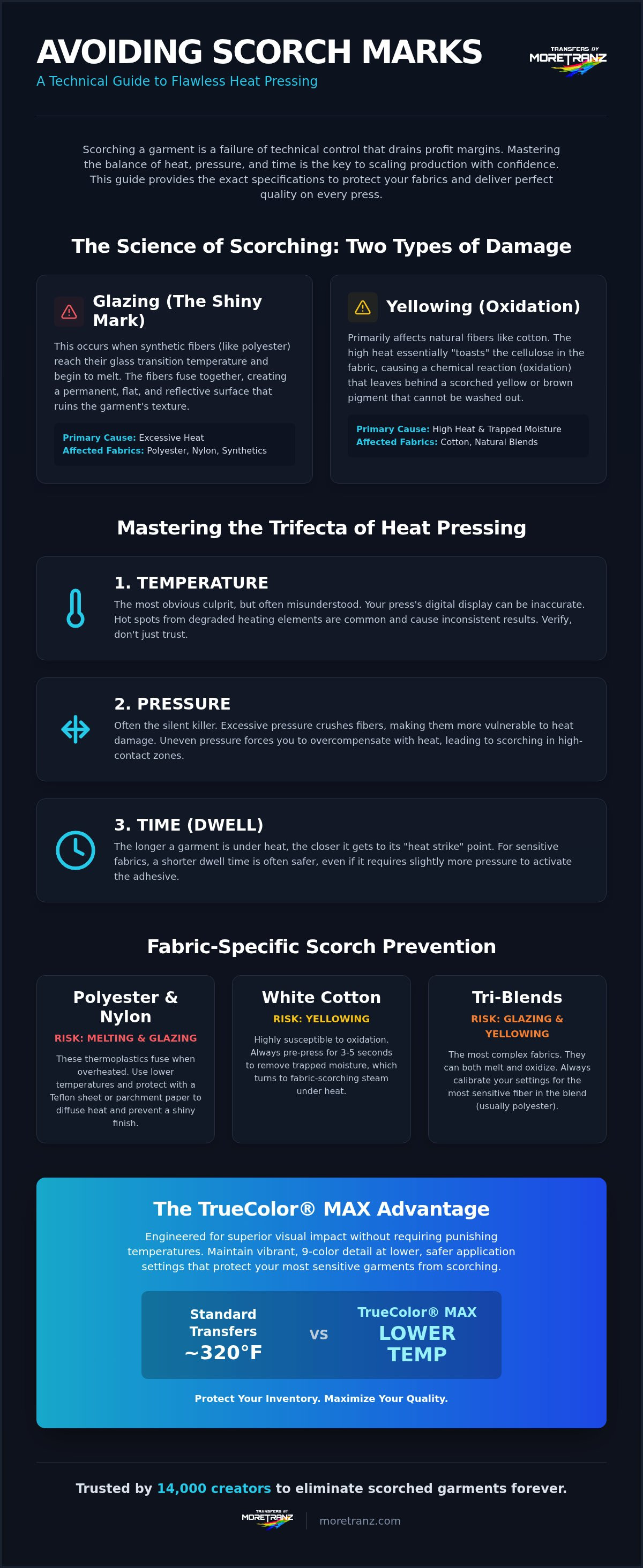
Scorching is a physical or chemical alteration of textile fibers caused by excessive thermal energy. It isn't just a surface stain; it's a structural breakdown. When you apply too much heat, you're either melting the plastic components of the fabric or charring the organic ones. Professional decorators know that avoiding scorch marks when heat pressing starts with understanding this molecular failure. Every fabric has a specific heat threshold. Once you cross that point of no return, the damage is irreversible and the garment is scrap.
The "Shiny Mark" and "Yellowing" are two distinct types of damage. Glazing, or the shiny mark, occurs when synthetic fibers reach their glass transition temperature and begin to melt together. This creates a flat, reflective surface that stands out against the surrounding texture. Yellowing is different. It is a result of oxidation, primarily affecting natural fibers like cotton. The heat essentially toasts the cellulose, leaving behind a scorched pigment that won't wash out.
Moisture plays a silent, destructive role in this process. If a garment contains trapped humidity, the heat press instantly converts that water into superheated steam. This steam can lead to localized burns and discoloration even if your platen temperature seems safe. Pre-pressing is a non-negotiable step for the 14,000 creators who partner with MoreTranz. It purges the moisture and flattens the fibers, preparing the surface for a flawless TrueColor® MAX application.
Thermal Sensitive Fabrics and Their Limits
Polyester and nylon are notoriously difficult because they are thermoplastics. They don't burn; they melt. If your temperature is too high, the fibers fuse, resulting in permanent glazing. White cotton presents a different challenge. High heat causes rapid yellowing that is immediately visible. Tri-blends are the most complex. Because they contain a mix of organic and synthetic fibers, they can exhibit both glazing and yellowing simultaneously. You must calibrate your settings for the most sensitive fiber in the blend to ensure a clean result.
Identifying the Culprit: Heat, Time, or Pressure?
Heat is the obvious suspect, but pressure is often the true killer. Excessive pressure crushes the fibers, making them more vulnerable to thermal damage. It also forces the heat deeper into the fabric structure faster than intended. Double pressing without allowing the garment to cool also creates a cumulative heat effect that can lead to a late-stage scorch. Heat strike is the precise moment when thermal energy overcomes fiber resilience and permanent structural damage occurs. Avoiding scorch marks when heat pressing requires a balance where no single variable is pushed to its extreme.
Calibrating the Trifecta: Temperature, Time, and Pressure
Generic charts often claim that a flat 320 degrees works for every substrate. Professional decorators know this is a myth that leads to ruined inventory. Avoiding scorch marks when heat pressing requires you to ignore the digital readout and verify the actual thermal output of your platen. Hot spots are common in equipment where heating elements are spaced unevenly or have degraded over time. Use an infrared thermometer to map at least nine points across your platen surface. If you find a variance of more than 10 degrees, your press is a liability that will cause inconsistent results.
Pressure is the second variable in this critical trifecta. Perform a paper test by placing four strips of paper at each corner of the lower platen and one in the center. Close the press. If any strip pulls out easily, your distribution is uneven. This lack of uniformity often forces operators to increase heat or time to compensate for "cold" or "loose" areas, which inevitably leads to scorching in the zones where contact is firm. TrueColor® MAX transfers are engineered for high-vibrancy results without requiring punishing temperatures, but they still demand a perfectly leveled surface.
Dwell time is your final lever. The longer a garment sits under the platen, the closer it gets to its heat strike point. If you're working with sensitive performance wear, a shorter dwell time at a slightly higher pressure is often safer than a long cycle at low pressure. You're aiming for the minimum effective dose of thermal energy to activate the adhesive without triggering the chemical oxidation of the fabric fibers.
Testing Your Equipment for Accuracy
Verification is the only path to industrial consistency. Heat strips provide a physical record of the peak temperature reached during a press cycle. Place them directly on the lower platen to see if your digital display is lying to you. If your press runs hot, dial back the digital setting by the exact offset discovered during testing. For high-volume production where precision is non-negotiable, a Dual Platen Heat Press offers the thermal stability needed to maintain these calibrations across thousands of units without cooling down between hits.
Optimizing Pressure for TrueColor® MAX
Heavy pressure isn't a universal solution for DTF durability. In fact, excessive force can drive the adhesive too deep into the weave or crush the fabric fibers, accelerating the glazing process. Obstructions like seams, zippers, and buttons are notorious scorch magnets because they create localized high-pressure points. Using Heat Press Lower Platens allows you to isolate the print area, elevating it away from these dangerous obstacles. This ensures the TrueColor® MAX transfer receives even contact without the surrounding fabric reaching its heat strike point. To see how these transfers perform under properly calibrated conditions, you can order a free sample pack to test on your specific equipment.
Essential Tools for Heat Protection and Scorch Prevention
Avoiding scorch marks when heat pressing is often a matter of selecting the right thermal barrier for your specific substrate. While high-heat settings are necessary for some transfers, the thermal energy doesn't have to reach the garment fibers directly. Defensive layering is the primary strategy used by 14,000 creators to maintain industrial-grade quality without sacrificing production speed. By utilizing the correct accessories, you create a buffer that protects the integrity of the fabric while allowing the adhesive to bond perfectly.
Teflon sheets are the industry standard for durability. They are reusable and easy to clean, but they come with a significant drawback: heat retention. Because Teflon holds thermal energy, it can actually contribute to scorching if you're running back-to-back hits on sensitive polyester. Parchment paper is the professional's alternative. It's breathable, allowing moisture to escape, and it leaves a clean matte finish on your TrueColor® MAX transfers. This breathability is critical for avoiding steam burns caused by trapped humidity in the weave.
Maintaining a pristine press is just as important as the barrier itself. Burnt-on residue from a previous mistake can transfer to your next garment, creating "ghost" scorch marks that look like fresh burns. Installing Teflon Platen Covers on both the top and bottom platens protects your equipment and ensures a smooth, non-stick surface. This prevents the buildup of carbonized inks and adhesives that lead to localized overheating and ruined blanks.
Barriers: Teflon vs. Parchment vs. Kraft Paper
Choosing the wrong cover sheet can change the entire look of your print. Use this comparison to match your barrier to your desired outcome and fabric sensitivity:
| Barrier Type | Heat Conductivity | Final Print Finish |
|---|---|---|
| Teflon Sheet | High (Retains heat) | Glossy / Semi-Gloss |
| Parchment Paper | Medium (Vented) | Matte |
| Kraft Paper | Low (Insulated) | Natural / Flat Matte |
If you experience a scorch, clean the platen immediately using a soft cloth and a specialized platen cleaner while the press is still warm. Never use abrasive metal scrapers. These create scratches that lead to uneven heat distribution and future scorching issues across your TrueColor® transfers.
Specialized Pressing Accessories
Heat press pillows and foam pads are essential for avoiding "press lines" on polyester gym wear. These tools allow the seams and collars to sink into the foam, ensuring the platen only makes firm contact with the print area. For headwear and curved surfaces, a Cap Heat Press is the only way to apply transfers without crushing the structure of the hat or burning the brim. Before committing to a high-volume run, every shop should utilize a Free Sample Pack to test how different barriers interact with their specific fabric blends and equipment.
Fabric-Specific Strategies to Prevent Scorch Marks
Polyester and synthetic blends require a tactical shift in your production workflow. Standard settings are often too aggressive for these plastic-based fibers. Avoiding scorch marks when heat pressing these substrates depends entirely on the "Lower and Slower" methodology. By dropping the temperature and extending the dwell time, you allow the adhesive to bond without reaching the fabric's melting point. This approach is the gold standard for the 14,000 creators who prioritize garment integrity over raw speed.
Dye migration is a secondary threat when overheating synthetics. High heat releases the garment's original dye, which then bleeds into your transfer and ruins the color accuracy. Using a cold peel process is your final safeguard. Letting the film cool completely before removal allows the fibers to stabilize. This prevents the "glazing" effect that occurs when hot, vulnerable fibers are disturbed. Don't rush the cooling phase. Industrial efficiency relies on precision, not just speed.
Taming 100% Polyester and Synthetics
For 100% polyester, set your press to 280-290°F. Increase the time to 15-20 seconds for safety. This ensures a deep bond without the glazing risk. Always use a pressing pillow for jerseys. It keeps the platen away from side seams and collars, which are primary scorch zones. The "Water Mist" trick, often discussed in forums, involves spraying water on a mark to lift it. It's a bandage for a technical failure and rarely works on permanent fiber damage. Your goal is technical prevention, not post-production damage control.
Protecting Delicate Blends and Tri-blends
Tri-blends are volatile. The rayon and polyester components react differently to heat than the cotton base. You must balance the ratio perfectly to avoid localized burning. TrueColor® Glitter DTF Transfers require specific attention because the textured surface can trap heat differently than standard films. "Precision is the difference between a custom garment and a ruined one." Monitor your pressure settings closely. Excessive force combined with high heat on a tri-blend is a recipe for instant scorching. Pre-press for only 2-3 seconds to remove moisture without stressing the fibers.
Achieving the TrueColor® MAX Finish Without the Burn
Thermal efficiency is the ultimate competitive edge in professional garment decoration. Most standard transfers require high temperatures to achieve acceptable vibrancy, which significantly increases the risk of fabric failure. TrueColor® MAX technology redefines this workflow. By utilizing a proprietary 9-color printing process, these transfers deliver extreme visual intensity without the need for punishing heat. This specialized ink density ensures that colors pop at lower application temperatures, making the task of avoiding scorch marks when heat pressing sensitive synthetics much easier for your production team.
Vibrancy shouldn't come at the cost of garment safety. High-performance brands and 14,000 creators trust MoreTranz because our transfers are engineered for industrial resilience at safer thermal levels. When you reduce the required heat, you protect the molecular structure of the fabric. For items that simply can't withstand any thermal energy, we provide a high-impact alternative. Using UV DTF Decals allows you to brand hard surfaces and heat-sensitive substrates with zero risk of scorching. This versatility ensures your shop can handle any request with total confidence.
The MoreTranz Advantage for Professional Decorators
Industrial reliability is built into every sheet we ship. Our TrueColor® MAX DTF Transfers are designed to bond quickly and permanently, reducing the cumulative heat exposure on your blanks. Efficiency starts before the press even warms up. Utilizing our professional Artwork Services ensures your designs have clean, optimized edges. These precision edges facilitate a faster bond, allowing you to minimize dwell time and further protect the fabric. Since we require no minimum orders, you can test these settings on new, expensive fabric blends without the risk of high-volume waste.
Your Next Step Toward Flawless Production
Transitioning to a scorch-free workflow requires the right combination of technical knowledge and premium materials. You have mastered the science of heat distribution and the importance of thermal barriers. Now, it's time to put that expertise into practice with the industry's most advanced transfer technology. Stop compromising between color impact and garment safety. Experience the durability and 9-color vibrancy of our premium line on your own equipment. Move your business toward a standard of perfection where every print is clean and every garment is preserved.
Mastering the Scorch-Free Press
Precision is the only path to industrial dominance. By mastering the science of heat distribution and implementing the lower and slower methodology, you eliminate the technical failures that drain your profits. Avoiding scorch marks when heat pressing becomes a repeatable process once you transition to high-performance materials and verified equipment settings. You've learned that TrueColor® MAX transfers provide the ultimate safety net for your business. This technology offers elite 9-color vibrancy at temperatures that protect your most expensive blanks from thermal damage.
Join the ranks of 14,000 creators who've already standardized their workflow with MoreTranz. We provide the professional-grade toolkit you need to scale without the risk of high-volume waste. With no minimum order requirements, your shop gains the flexibility to innovate on any substrate with total confidence in the final output. It's time to execute with precision and deliver results that speak for themselves.
Your next flawless press starts today. Build a reputation for quality that sets your brand apart from the competition.
Frequently Asked Questions
Can you remove a scorch mark from a shirt after pressing?
Scorching is usually permanent because it involves a chemical or physical alteration of the fabric fibers. While light yellowing on white cotton can sometimes be reduced with a hydrogen peroxide solution; there is no reliable way to fix melted synthetic fibers. The 14,000 creators we support focus on technical prevention rather than post-production repairs. Once the heat strike point is reached, the structural integrity of the garment is compromised beyond professional standards.
What temperature should I use for DTF transfers on 100% polyester?
For 100% polyester, you should set your heat press to a lower range of 280-290°F for 15-20 seconds. This "Lower and Slower" method is essential for avoiding scorch marks when heat pressing synthetic materials. TrueColor® MAX transfers are engineered to bond perfectly at these reduced temperatures. This ensures you maintain superior 9-color vibrancy without reaching the glass transition temperature where polyester begins to glaze or melt.
Why does my heat press leave a square box around my design?
A square box is typically the result of excessive pressure or moisture trapped within the garment fibers. When the platen edges crush the fabric, it creates a permanent indentation or a shiny glaze mark. You can eliminate this by using heat press pillows to elevate the print area. This prevents the platen from making firm contact with the seams and surrounding fabric, ensuring a clean, professional finish without the telltale box.
Is it better to use a Teflon sheet or parchment paper for DTF?
Parchment paper is generally the better choice for DTF transfers. It is breathable, which allows moisture to escape and prevents steam-related scorching. Teflon sheets are durable but retain significant thermal energy, which can cause heat to build up and burn sensitive fabrics during back-to-back production cycles. Most professionals prefer the matte finish and safety of parchment paper to ensure consistent results across various fabric blends and garment types.
How do I know if my heat press pressure is too high?
You'll know your pressure is too high if the garment shows deep indentations or a reflective, shiny surface around the design. Perform the "paper test" at each corner of your platen to ensure even distribution rather than raw force. Excessive pressure accelerates the heat strike point, making thermal protection much more difficult. Professional results require a firm, even contact that doesn't crush the fabric's natural texture or weave.
What is the best way to prevent dye migration on polyester shirts?
The most effective way to prevent dye migration is to lower your application temperature. Dye migration occurs when high heat turns the garment's dye into a gas that bleeds into the transfer. TrueColor® MAX technology is specifically designed to bond at lower temperatures, keeping the garment dyes stable. This prevents color contamination and ensures your 9-color prints remain vibrant and true to your original artwork without damaging the polyester fibers.
Does the color of the garment affect the risk of scorching?
Color significantly impacts how scorching appears on your blanks. White and light-colored cotton garments are highly susceptible to visible yellowing caused by oxidation. Darker synthetic garments are more likely to show glazing, which appears as a shiny or reflective patch where fibers have melted. Regardless of the garment's hue, the underlying risk remains the same. You must calibrate your equipment to stay below the specific heat threshold of your fabric.
How many seconds should I pre-press my garment?
You should pre-press your garment for 2-3 seconds before applying any transfer. This rapid burst is sufficient to remove trapped moisture and flatten the fibers for a smooth bonding surface. Avoiding scorch marks when heat pressing requires this step to prevent the formation of superheated steam. A short pre-press stabilizes the fabric and ensures the adhesive on your TrueColor® transfers can bite into the weave for maximum durability and impact.